Simon Bressendorff, Ida Marie Zobbe Sjøgaard, Andreas Prestel, Vasileios Voutsinos, Martin D. Jansson, Patrice Ménard, Anders H. Lund, Rasmus Hartmann-Petersen, Birthe B. Kragelund, Christian Poulsen, Peter Brodersen
{"title":"Importance of an N-terminal structural switch in the distinction between small RNA-bound and free ARGONAUTE","authors":"Simon Bressendorff, Ida Marie Zobbe Sjøgaard, Andreas Prestel, Vasileios Voutsinos, Martin D. Jansson, Patrice Ménard, Anders H. Lund, Rasmus Hartmann-Petersen, Birthe B. Kragelund, Christian Poulsen, Peter Brodersen","doi":"10.1038/s41594-024-01446-9","DOIUrl":null,"url":null,"abstract":"ARGONAUTE (AGO) proteins bind to small non-coding RNAs to form RNA-induced silencing complexes. In the RNA-bound state, AGO is stable while RNA-free AGO turns over rapidly. Molecular features unique to RNA-free AGO that allow its specific recognition and degradation remain unknown. Here, we identify a confined, linear region in Arabidopsis AGO1 and human Ago2, the N-coil, as a structural switch with preferential accessibility in the RNA-free state. RNA-free Arabidopsis AGO1 interacts with the autophagy cargo receptor ATI1 by direct contact with specific N-coil amino acid residues whose mutation reduces the degradation rate of RNA-free AGO1 in vivo. The N-coil of human Ago2 has similar degron activity dependent on residues in positions equivalent to those required for the Arabidopsis AGO1–ATI1 interaction. These results elucidate the molecular basis for specific recognition and degradation of the RNA-free state of eukaryotic AGO proteins. ARGONAUTE (AGO) is the core protein component of small RNA-guided silencing complexes. Free, but not RNA-bound, AGO turns over rapidly. The authors identify a structural AGO switch whose accessibility only in the free state confers rapid degradation.","PeriodicalId":49141,"journal":{"name":"Nature Structural & Molecular Biology","volume":"32 4","pages":"625-638"},"PeriodicalIF":10.1000,"publicationDate":"2025-01-07","publicationTypes":"Journal Article","fieldsOfStudy":null,"isOpenAccess":false,"openAccessPdf":"","citationCount":"0","resultStr":null,"platform":"Semanticscholar","paperid":null,"PeriodicalName":"Nature Structural & Molecular Biology","FirstCategoryId":"99","ListUrlMain":"https://www.nature.com/articles/s41594-024-01446-9","RegionNum":1,"RegionCategory":"生物学","ArticlePicture":[],"TitleCN":null,"AbstractTextCN":null,"PMCID":null,"EPubDate":"","PubModel":"","JCR":"Q1","JCRName":"BIOCHEMISTRY & MOLECULAR BIOLOGY","Score":null,"Total":0}
引用次数: 0
Abstract
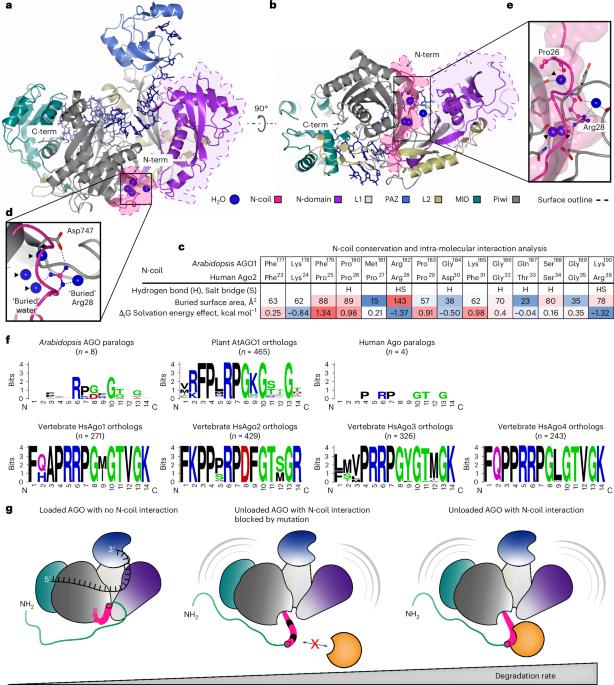
ARGONAUTE (AGO) proteins bind to small non-coding RNAs to form RNA-induced silencing complexes. In the RNA-bound state, AGO is stable while RNA-free AGO turns over rapidly. Molecular features unique to RNA-free AGO that allow its specific recognition and degradation remain unknown. Here, we identify a confined, linear region in Arabidopsis AGO1 and human Ago2, the N-coil, as a structural switch with preferential accessibility in the RNA-free state. RNA-free Arabidopsis AGO1 interacts with the autophagy cargo receptor ATI1 by direct contact with specific N-coil amino acid residues whose mutation reduces the degradation rate of RNA-free AGO1 in vivo. The N-coil of human Ago2 has similar degron activity dependent on residues in positions equivalent to those required for the Arabidopsis AGO1–ATI1 interaction. These results elucidate the molecular basis for specific recognition and degradation of the RNA-free state of eukaryotic AGO proteins. ARGONAUTE (AGO) is the core protein component of small RNA-guided silencing complexes. Free, but not RNA-bound, AGO turns over rapidly. The authors identify a structural AGO switch whose accessibility only in the free state confers rapid degradation.
期刊介绍:
Nature Structural & Molecular Biology is a comprehensive platform that combines structural and molecular research. Our journal focuses on exploring the functional and mechanistic aspects of biological processes, emphasizing how molecular components collaborate to achieve a particular function. While structural data can shed light on these insights, our publication does not require them as a prerequisite.



 京公网安备 11010802042870号
京ICP备2023020795号-1
京公网安备 11010802042870号
京ICP备2023020795号-1

 分享
分享
 求助内容:
求助内容: 应助结果提醒方式:
 扫码关注我们
