Margalida Roig-Oliver, Jaume Flexas, María José Clemente-Moreno, Marc Carriquí
{"title":"Cell wall composition in relation to photosynthesis across land plants' phylogeny: crops as outliers","authors":"Margalida Roig-Oliver, Jaume Flexas, María José Clemente-Moreno, Marc Carriquí","doi":"10.1111/nph.20385","DOIUrl":null,"url":null,"abstract":"<p>The role of cell wall composition in photosynthesis has only recently been proposed. Apparently contradictory results have been reported, but previous studies were often limited to single or closely related species. The aim of the present letter is to combine published and novel data on cell wall composition and photosynthesis limitations, including data for all the major land plant's phylogenetic groups (Supporting Information Methods S1; Dataset S1), to provide novel evidence on the importance of cell wall composition in determining mesophyll conductance to CO<sub>2</sub> diffusion (<i>g</i><sub>m</sub>) across land plants' phylogeny. We address the hypothesis that the pectin fraction of total major cell wall compounds is positively related to <i>g</i><sub>m</sub> and, consequently, to photosynthesis, when pooling species from across the entire phylogeny.</p><p>The <i>leaf economics spectrum</i> (LES) represents a complex framework of interconnected leaf traits related to carbon fixation and nutrient use across plant lineages (Wright <i>et al</i>., <span>2004</span>), with net CO₂ assimilation (<i>A</i><sub>N</sub>) and leaf mass per area (LMA) as key traits (Onoda <i>et al</i>., <span>2017</span>). Generally, LMA varies among plant species and negatively correlates with physiological traits such as net assimilation (<i>A</i><sub>N</sub>) at a phylogenetic scale (Onoda <i>et al</i>., <span>2017</span>). Similarly, lower LMA is linked with enhanced mesophyll conductance to CO₂ diffusion (<i>g</i><sub>m</sub>) (Onoda <i>et al</i>., <span>2017</span>). This parameter, encompassing the CO<sub>2</sub> pathway from substomatal cavities to Rubisco carboxylation sites in chloroplasts stroma, is recognized as a key trait regulating photosynthesis (Flexas <i>et al</i>., <span>2012</span>, <span>2018</span>). However, the mechanistic regulation of <i>g</i><sub>m</sub> is not fully understood (Evans <i>et al</i>., <span>2009</span>; Flexas <i>et al</i>., <span>2012</span>, <span>2018</span>; Mizokami <i>et al</i>., <span>2022</span>).</p><p>Although leaf temperature is unrelated to cell wall, porosity and tortuosity are theoretically influenced by cell wall composition, and even <i>T</i><sub>cw</sub> itself could be indirectly linked to it.</p><p>Recently, cell wall compositional traits were shown to be involved in <i>g</i><sub>m</sub> (Ellsworth <i>et al</i>., <span>2018</span>; Clemente-Moreno <i>et al</i>., <span>2019</span>; Carriquí <i>et al</i>., <span>2020</span>; Roig-Oliver <i>et al</i>., <span>2020a</span>,<span>c</span>, <span>2021a</span>,<span>b</span>,<span>c</span>; Salesse-Smith <i>et al</i>., <span>2024</span>). In Flexas <i>et al</i>. (<span>2021</span>), we proposed several mechanisms through which cell wall composition might influence <i>g</i><sub>m</sub>, which can be summarized as follows. Although the physical porosity of cell walls is not likely to be a significant barrier for CO<sub>2</sub> diffusion, given that CO<sub>2</sub> molecules are much smaller than the typical pore sizes (Carpita <i>et al</i>., <span>1979</span>), pectins exhibit hydrocolloid properties that allow them to absorb and retain large amounts of water. Since CO<sub>2</sub> diffuses through aqueous solutions, the presence of hydrophilic regions within the pores could significantly affect its diffusion rate.</p><p>Although specific land plants lineages possess specific cell wall compositional characteristics (Sarkar <i>et al</i>., <span>2009</span>; Sørensen & Willats, <span>2010</span>; Popper <i>et al</i>., <span>2011</span>), the cell wall is a three-dimensional framework mainly composed by cellulose microfibrils crosslinked to noncellulosic polysaccharides (hemicelluloses), all embedded within a pectin matrix (Somerville <i>et al</i>., <span>2004</span>; Cosgrove, <span>2005</span>; Anderson & Kieber, <span>2020</span>). This pectin network is believed to be a key structure determining several cell wall properties that could potentially affect CO<sub>2</sub> diffusion, such as porosity, thickness and elasticity (Cosgrove, <span>2005</span>; Ochoa-Villareal <i>et al</i>., <span>2012</span>; Schiraldi <i>et al</i>., <span>2012</span>; Weraduwage <i>et al</i>., <span>2016</span>; Novakovic <i>et al</i>., <span>2018</span>; Carriquí <i>et al</i>., <span>2020</span>; Roig-Oliver <i>et al</i>., <span>2020a</span>,<span>c</span>, <span>2021b</span>, <span>2022</span>; Flexas <i>et al</i>., <span>2021</span>). For instance, a remarkable correlation was found between <i>A</i><sub>N</sub> and/or <i>g</i><sub>m</sub> and the bulk modulus of elasticity (ε) when pooling together species from different growth forms and phylogenetic groups along vascular plants (Nadal <i>et al</i>., <span>2018</span>). In fact, recent studies provided empirical relationships between variations in pectin concentration and adjustments in <i>T</i><sub>cw</sub> and ε itself. However, these studies were performed either testing one or few species (Teng <i>et al</i>., <span>2006</span>; Clemente-Moreno <i>et al</i>., <span>2019</span>; Roig-Oliver <i>et al</i>., <span>2020a</span>,<span>c</span>, <span>2021a</span>,<span>c</span>) or varieties (Ellsworth <i>et al</i>., <span>2018</span>; Roig-Oliver <i>et al</i>., <span>2021d</span>, <span>2022</span>) of angiosperms responding to environmental stresses or having specific genetic modifications, or being comparisons of nonstressed species within the same phylogenetic group (Carriquí <i>et al</i>., <span>2020</span>; Roig-Oliver <i>et al</i>., <span>2021b</span>). These studies suggested that either pectin concentration or the proportion between different cell wall components (i.e. the pectin to hemicelluloses and cellulose ratio) are crucial regulators of <i>g</i><sub>m</sub> and other leaf physiological traits, but in a variable manner (Carriquí <i>et al</i>., <span>2020</span>; Roig-Oliver <i>et al</i>., <span>2020a</span>, <span>2022</span>).</p><p>To our knowledge, no previous study has addressed the implication of cell wall composition influencing both <i>g</i><sub>m</sub> and <i>T</i><sub>cw</sub> along land plants' lineages. Thus, our aims were (1) to perform a meta-analysis using both literature and newly measured species in which cell wall composition, photosynthetic and leaf anatomical properties across species spanning from mosses to angiosperms are considered; and (2) to explore how cell wall compositional traits influence leaf anatomy and photosynthesis, being <i>T</i><sub>cw</sub>, cell wall porosity and <i>g</i><sub>m</sub> key traits. Our main hypothesis is that cell wall composition and, particularly, the fraction of pectins over the other two major components (cellulose + hemicellulose)—as a proxy of cell wall porosity (and, perhaps, tortuosity)—contributes to determining <i>g</i><sub>m</sub> variations along land plants' lineages.</p><p>Despite the modest number of species considered in our dataset, it still covers 70% or more of the published ranges (excluding the first and last decile) for each trait and phylogenetic group in 75% of the cases (Fig. S1). This comprehensive coverage ensures that our findings are representative and robust.</p><p>The exploration of the variation in structural and physiological traits, as well as those related to cell wall composition, across several land plant groups reveals significant insights (Figs 1, S2). Contrary to common assumptions, our findings suggest that there is no dependence of <i>T</i><sub>cw</sub> on LMA across phylogenetic scales (Figs 1a,b, S2). Instead, the patterns for <i>A</i><sub>N</sub> and <i>g</i><sub>m</sub> show remarkable similarities across different plant lineages, as already highlighted by Gago <i>et al</i>. (<span>2019</span>) and Huang <i>et al</i>. (<span>2022</span>) (Fig. 1c,d). This observation underscores the notion that limitations imposed by <i>g</i><sub>m</sub> are dominant throughout land plants' phylogeny (Gago <i>et al</i>., <span>2019</span>).</p><p>It has been described that LMA scales positively with <i>T</i><sub>cw</sub> in vascular plants (Onoda <i>et al</i>., <span>2017</span>). The data included here support this view except for mosses (Fig. S2). This finding emphasizes the complexity of plant adaptations, revealing that factors influencing <i>T</i><sub>cw</sub> do not necessarily correlate with leaf mass. Instead, the inverse but strong phylogenetic patterns observed in <i>T</i><sub>cw</sub> compared to <i>A</i><sub>N</sub> and <i>g</i><sub>m</sub> indicate that these structural and physiological traits are more closely linked, even when mosses are included. Moreover, our analysis shows that there are no major differences among groups in main cell wall compounds contents or in the pectin to hemicellulose and cellulose ratio: intra-group variations appear to be more pronounced than inter-group variations (Fig. 1e–h). The same applies to the leaf cell wall fraction considered as alcohol-insoluble residues (AIR) (Fig. S3). Interestingly, hemicellulose and cellulose contents correlate independently of pectin content, which further reinforces our findings. This is analogous to the well-documented relationship between LMA and <i>T</i><sub>cw</sub> in vascular plants. While this correlation has been thoroughly substantiated and its mechanistic basis is well understood (Onoda <i>et al</i>., <span>2017</span>; Wuyun <i>et al</i>., <span>2024</span>), our data show that mosses exhibit a distinct pattern (Fig. S2).</p><p>Contrary to expectations based on Fig. 1, the analysis of the relationships between cell wall composition and <i>g</i><sub>m</sub> shown in Fig. 2 reveals several important insights, particularly when distinguishing between crop and noncrop species. As a first approach, we applied both linear (lm) and nonlineal least square (nls) models to assess correlations, choosing for each pair of parameters the function with the lowest Akaike Information Criterion (AIC). However, to account for potential phylogenetical differences in these relationships, we explored alternative options. One option involved applying robust regressions for each phylogenetic group, following Knauer <i>et al</i>. (<span>2022</span>) using the <span>robustbase</span> R package (Maechler <i>et al</i>., <span>2022</span>). However, due to low-sample sizes within each group, the results of this method did not significantly improve those obtained with standard lm and nls models. Indeed, Knauer <i>et al</i>. (<span>2022</span>) specifically recommend testing relationships only when the number of measurements is ≥ 12, making further exploration of this approach impractical with our dataset. Another approach was to consider linear (lme) and nonlinear (nlme) mixed-effects models, incorporating phylogenetic group as a random factor. In this case, we performed the same pairwise correlations using both lm/nls and lme/nlme and applied ANOVA to discern which model performed better. Additionally, we evaluated the goodness-of-fit metrics for the most suitable statistical model (Table S1). In the nonlinear correlations, nls models performed better than nlme models – for which they are used in Fig. 2(a) – while in the linear correlations lme models performed better than lm models (Fig. 2b,c), indicating a significant phylogenetic effect in these relationships. The different plots in Fig. 2 show the correlations based on the best performance model, that is nls for nonlinear correlations and lme for linear correlations.</p><p>As already shown (Evans, <span>2021</span>; Flexas <i>et al</i>., <span>2021</span>), <i>g</i><sub>m</sub> correlates negatively with <i>T</i><sub>cw</sub>, which is a proxy for the effective path length across the cell wall, following an exponential decay function <span></span><math>\n <mrow>\n <mfenced>\n <mrow>\n <msub>\n <mi>g</mi>\n <mi>m</mi>\n </msub>\n <mo>=</mo>\n <mi>a</mi>\n <mo>×</mo>\n <msup>\n <mi>e</mi>\n <mrow>\n <mo>−</mo>\n <mi>b</mi>\n <mo>×</mo>\n <msub>\n <mi>T</mi>\n <mi>cw</mi>\n </msub>\n </mrow>\n </msup>\n </mrow>\n </mfenced>\n </mrow></math>, as determined by selecting the model with the lowest AIC (Fig. 2a). Additionally, a significant positive linear correlation emerges between <i>g</i><sub>m</sub> and the pectin-to-(cellulose + hemicelluloses) fraction (P/(C + H)), a proposed proxy for porosity and tortuosity (Carriquí <i>et al</i>., <span>2020</span>; Flexas <i>et al</i>., <span>2021</span>), thus confirming our hypothesis (Fig. 2b). When analyzing all species together, the relationship had a marginal <span></span><math>\n <mrow>\n <msubsup>\n <mi>r</mi>\n <mi>m</mi>\n <mn>2</mn>\n </msubsup>\n </mrow></math> of 0.06, but a conditional <span></span><math>\n <mrow>\n <msubsup>\n <mi>r</mi>\n <mi>c</mi>\n <mn>2</mn>\n </msubsup>\n </mrow></math> of 0.60, indicating a significant phylogenetic influence. Importantly, the strength of this correlation increased when crops were excluded (<span></span><math>\n <mrow>\n <msubsup>\n <mi>r</mi>\n <mi>m</mi>\n <mn>2</mn>\n </msubsup>\n </mrow></math> = 0.18, <span></span><math>\n <mrow>\n <msubsup>\n <mi>r</mi>\n <mi>c</mi>\n <mn>2</mn>\n </msubsup>\n </mrow></math> = 0.51), and it improved further when noncrop angiosperms were also removed (<span></span><math>\n <mrow>\n <msubsup>\n <mi>r</mi>\n <mi>m</mi>\n <mn>2</mn>\n </msubsup>\n </mrow></math> = 0.44, <span></span><math>\n <mrow>\n <msubsup>\n <mi>r</mi>\n <mi>c</mi>\n <mn>2</mn>\n </msubsup>\n </mrow></math> = 0.59). These results highlight the influence of phylogenetic and functional group-specific effects on the observed relationship. Notably, a much stronger positive correlation between <i>g</i><sub>m</sub> and the ratio of P/(C + H) to <i>T</i><sub>cw</sub> was found (Fig. 2c), indicating the combined importance of path length – <i>T</i><sub>cw</sub> – and porosity/tortuosity – P/(C + H). This finding supports the notion that both factors – path length and porosity/tortuosity – affect <i>g</i><sub>m</sub>. When analyzing all species, the <span></span><math>\n <mrow>\n <msubsup>\n <mi>r</mi>\n <mi>m</mi>\n <mn>2</mn>\n </msubsup>\n </mrow></math> was 0.22, and the conditional <span></span><math>\n <mrow>\n <msubsup>\n <mi>r</mi>\n <mi>c</mi>\n <mn>2</mn>\n </msubsup>\n </mrow></math> was 0.55, reflecting moderate explanatory power with notable phylogenetic effects. Again, the relationship in Fig. 2c is especially pronounced when crop species are excluded from our dataset (<span></span><math>\n <mrow>\n <msubsup>\n <mi>r</mi>\n <mi>m</mi>\n <mn>2</mn>\n </msubsup>\n </mrow></math> = 0.59, <span></span><math>\n <mrow>\n <msubsup>\n <mi>r</mi>\n <mi>c</mi>\n <mn>2</mn>\n </msubsup>\n </mrow></math> = 0.77) but not significantly further improved when noncrop angiosperms were also removed (<span></span><math>\n <mrow>\n <msubsup>\n <mi>r</mi>\n <mi>m</mi>\n <mn>2</mn>\n </msubsup>\n </mrow></math> = 0.61, <span></span><math>\n <mrow>\n <msubsup>\n <mi>r</mi>\n <mi>c</mi>\n <mn>2</mn>\n </msubsup>\n </mrow></math> = 0.81).</p><p>In noncrop species, the pectin fraction in relation to cellulose and hemicellulose plays a crucial role in determining how easily CO₂ can diffuse through the leaf mesophyll, likely because it affects cell wall porosity and tortuosity (Flexas <i>et al</i>., <span>2021</span>). Conversely, the inclusion of crop species introduces a different dynamic. Please notice that the effect of excluding crops is persistent irrespective of considering or not phylogenetic effects, that is whenever pairwise correlations are better explained by lm/nls or lme/nlme considering the phylogenetic group as a random factor. Crops have indirectly been selectively bred for enhanced photosynthetic efficiency and other agronomically valuable traits (Nadal & Flexas, <span>2019</span>), which is the consequence of these plants having been derived from wild species with naturally high-photosynthetic capacities (Gomez-Fernandez <i>et al</i>., <span>2024</span>). They often possess very thin cell walls, which might have weakened the correlation between P/(C + H) and <i>g</i><sub>m</sub> because they are optimized for rapid growth and high yield rather than for natural selection pressures influencing photosynthetic efficiency (Xiong, <span>2023</span>). Consequently, as shown in Fig. 2(b), crops can achieve a large <i>g</i><sub>m</sub> despite not necessarily showing a large P/(C + H) ratio. This does not mean that cell wall thickness and/or composition does not affect <i>g</i><sub>m</sub> in crops. Indeed, improved photosynthesis and yield has been recently achieved by genetically manipulating cell walls (Salesse-Smith <i>et al</i>., <span>2024</span>), and empirical relationships between <i>g</i><sub>m</sub> and cell wall composition have been shown in different studies subjecting crops to stress conditions (Roig-Oliver <i>et al</i>., <span>2020a</span>,<span>c</span>, <span>2021a</span>, <span>2022</span>). However, it implies that the role in crops is lesser than in wild species and/or that crops may have compensating mechanisms for facilitating CO<sub>2</sub> diffusion. Currently, we do not know what these compensatory mechanisms might be. However, it has been suggested that certain aquaporins may play a role in CO<sub>2</sub> diffusion, as seen in studies on broad bean, common bean, rice and tobacco (Terashima & Ono, <span>2002</span>; Hanba <i>et al</i>., <span>2004</span>; Flexas <i>et al</i>., <span>2006</span>). Let's hypothesize that this role was acquired relatively recently and only in specific crops. This idea aligns with findings indicating that aquaporins do not appear to have the same role in Arabidopsis (Kromdijk <i>et al</i>., <span>2020</span>). If this is indeed the case, an increased CO<sub>2</sub> diffusion through the plasma membrane – and potentially through chloroplasts (Uehlein <i>et al</i>., <span>2008</span>)—could enhance <i>g</i><sub>m</sub>, despite potential disentangling an impediment of the cell wall composition vs CO<sub>2</sub> diffusion. This scenario is analogous to the relationship between LMA and <i>T</i><sub>cw</sub>. While this relationship is well-substantiated and its mechanistic basis is thoroughly understood (Onoda <i>et al</i>., <span>2017</span>; Wuyun <i>et al</i>., <span>2024</span>), our study reveals that mosses behave differently. Although this hypothesis is highly speculative, it highlights the critical need for further research in this area. The impact of crop selection on cell wall composition underscores the necessity of focusing on noncrop species to better understand the fundamental connections between cell wall components and photosynthetic traits.</p><p>From Eqn 1 the CO₂ conductance across cell walls should depend on Δ<i>L</i><sub>cw</sub> and <i>p</i><sub>cw</sub>/τ<sub>cw</sub> as the mixed variable, here approached as 1/<i>T</i><sub>cw</sub> × P/(C + H). In fact, the correlation of this parameter with <i>g</i><sub>m</sub> across different plant groups becomes notably more significant, with all species having an <span></span><math>\n <mrow>\n <msubsup>\n <mi>r</mi>\n <mi>m</mi>\n <mn>2</mn>\n </msubsup>\n </mrow></math> = 0.22, <span></span><math>\n <mrow>\n <msubsup>\n <mi>r</mi>\n <mi>c</mi>\n <mn>2</mn>\n </msubsup>\n </mrow></math> = 0.55, excluding angiosperms <span></span><math>\n <mrow>\n <msubsup>\n <mi>r</mi>\n <mi>m</mi>\n <mn>2</mn>\n </msubsup>\n </mrow></math> = 0.59, <span></span><math>\n <mrow>\n <msubsup>\n <mi>r</mi>\n <mi>c</mi>\n <mn>2</mn>\n </msubsup>\n </mrow></math> = 0.77, and excluding crops <span></span><math>\n <mrow>\n <msubsup>\n <mi>r</mi>\n <mi>m</mi>\n <mn>2</mn>\n </msubsup>\n </mrow></math> = 0.61, <span></span><math>\n <mrow>\n <msubsup>\n <mi>r</mi>\n <mi>c</mi>\n <mn>2</mn>\n </msubsup>\n </mrow></math> = 0.81. These results suggest that this combined variable significantly explains the variations in <i>g</i><sub>m</sub> (Fig. 2c), and emphasizes the relevant role that the pectin fraction plays in regulating <i>g</i><sub>m</sub> and, consequently, <i>A</i><sub>N</sub>, in wild, nondomesticated plants. To fully comprehend this dependency, it is essential to explore how pectins influence various aspects of cell wall properties – such as porosity and thickness – that affect gas exchange. While the actual physical porosity should not be a major limitation given that CO₂ molecules are small compared to cell wall pore sizes (Carpita <i>et al</i>., <span>1979</span>; Flexas <i>et al</i>., <span>2021</span>), pectins possess hydrocolloid characteristics and can retain several times their volume in water. Since CO₂ diffuses in solution, the hydrophilic fraction of the pores could determine its diffusion (Flexas <i>et al</i>., <span>2021</span>). Moreover, pectins can be under different methyl-esterification states and may interact with other chemical cell wall compounds, altogether affecting the ‘effective’ porosity and, perhaps, tortuosity (Flexas <i>et al</i>., <span>2021</span>). While cell walls are often considered rigid and fixed structures, instead they are dynamic structures that continuously respond to various stimuli in a regulated manner (Forand <i>et al</i>., <span>2022</span>; Delmer <i>et al</i>., <span>2024</span>). Beyond these rough approximations, the relationship between these parameters is likely far more complex. For instance, as shown in Fig. 2, mosses display a unique pattern: despite significant variations in <i>T</i><sub>cw</sub> and P/(C + H), they all maintain similarly low <i>g</i><sub>m</sub> values. Interestingly, species with higher <i>T</i><sub>cw</sub> tend to compensate with a higher P/(C + H) ratio, while those with lower P/(C + H) appear to offset it with reduced <i>T</i><sub>cw</sub>. This compensatory mechanism could indicate unique adaptations in mosses, suggesting an area that warrants further investigation. By focusing on these fundamental connections, we can better direct efforts to improve photosynthesis in species with relatively thick cell walls and enhance their physiological performance under contrasting environmental conditions.</p><p>This is the very first report to show general relationships by considering species spanning the entire phylogeny of land plants. In doing so, we identify a clear biochemical basis – one that can be traced back to specific genes – for a large component of mesophyll conductance and, thus, photosynthetic capacity. It opens new avenues for improving the photosynthesis of terrestrial plants. Additionally, it suggests that current crops are already optimized and even uncoupled from these general relationships, raising questions about the regulation of <i>g</i><sub>m</sub> in crop species.</p><p>None declared.</p><p>MC, MR-O and JF designed the research. MR-O measured the new studies presented in this study. MC performed the data analysis. MC, MR-O and JF wrote the manuscript, with contributions from MJC-M. All authors revised and approved the manuscript.</p><p>The New Phytologist Foundation remains neutral with regard to jurisdictional claims in maps and in any institutional affiliations.</p>","PeriodicalId":214,"journal":{"name":"New Phytologist","volume":"246 6","pages":"2384-2391"},"PeriodicalIF":8.1000,"publicationDate":"2025-01-06","publicationTypes":"Journal Article","fieldsOfStudy":null,"isOpenAccess":false,"openAccessPdf":"https://onlinelibrary.wiley.com/doi/epdf/10.1111/nph.20385","citationCount":"0","resultStr":null,"platform":"Semanticscholar","paperid":null,"PeriodicalName":"New Phytologist","FirstCategoryId":"99","ListUrlMain":"https://nph.onlinelibrary.wiley.com/doi/10.1111/nph.20385","RegionNum":1,"RegionCategory":"生物学","ArticlePicture":[],"TitleCN":null,"AbstractTextCN":null,"PMCID":null,"EPubDate":"","PubModel":"","JCR":"Q1","JCRName":"PLANT SCIENCES","Score":null,"Total":0}
引用次数: 0
Abstract
The role of cell wall composition in photosynthesis has only recently been proposed. Apparently contradictory results have been reported, but previous studies were often limited to single or closely related species. The aim of the present letter is to combine published and novel data on cell wall composition and photosynthesis limitations, including data for all the major land plant's phylogenetic groups (Supporting Information Methods S1; Dataset S1), to provide novel evidence on the importance of cell wall composition in determining mesophyll conductance to CO2 diffusion (gm) across land plants' phylogeny. We address the hypothesis that the pectin fraction of total major cell wall compounds is positively related to gm and, consequently, to photosynthesis, when pooling species from across the entire phylogeny.
The leaf economics spectrum (LES) represents a complex framework of interconnected leaf traits related to carbon fixation and nutrient use across plant lineages (Wright et al., 2004), with net CO₂ assimilation (AN) and leaf mass per area (LMA) as key traits (Onoda et al., 2017). Generally, LMA varies among plant species and negatively correlates with physiological traits such as net assimilation (AN) at a phylogenetic scale (Onoda et al., 2017). Similarly, lower LMA is linked with enhanced mesophyll conductance to CO₂ diffusion (gm) (Onoda et al., 2017). This parameter, encompassing the CO2 pathway from substomatal cavities to Rubisco carboxylation sites in chloroplasts stroma, is recognized as a key trait regulating photosynthesis (Flexas et al., 2012, 2018). However, the mechanistic regulation of gm is not fully understood (Evans et al., 2009; Flexas et al., 2012, 2018; Mizokami et al., 2022).
Although leaf temperature is unrelated to cell wall, porosity and tortuosity are theoretically influenced by cell wall composition, and even Tcw itself could be indirectly linked to it.
Recently, cell wall compositional traits were shown to be involved in gm (Ellsworth et al., 2018; Clemente-Moreno et al., 2019; Carriquí et al., 2020; Roig-Oliver et al., 2020a,c, 2021a,b,c; Salesse-Smith et al., 2024). In Flexas et al. (2021), we proposed several mechanisms through which cell wall composition might influence gm, which can be summarized as follows. Although the physical porosity of cell walls is not likely to be a significant barrier for CO2 diffusion, given that CO2 molecules are much smaller than the typical pore sizes (Carpita et al., 1979), pectins exhibit hydrocolloid properties that allow them to absorb and retain large amounts of water. Since CO2 diffuses through aqueous solutions, the presence of hydrophilic regions within the pores could significantly affect its diffusion rate.
Although specific land plants lineages possess specific cell wall compositional characteristics (Sarkar et al., 2009; Sørensen & Willats, 2010; Popper et al., 2011), the cell wall is a three-dimensional framework mainly composed by cellulose microfibrils crosslinked to noncellulosic polysaccharides (hemicelluloses), all embedded within a pectin matrix (Somerville et al., 2004; Cosgrove, 2005; Anderson & Kieber, 2020). This pectin network is believed to be a key structure determining several cell wall properties that could potentially affect CO2 diffusion, such as porosity, thickness and elasticity (Cosgrove, 2005; Ochoa-Villareal et al., 2012; Schiraldi et al., 2012; Weraduwage et al., 2016; Novakovic et al., 2018; Carriquí et al., 2020; Roig-Oliver et al., 2020a,c, 2021b, 2022; Flexas et al., 2021). For instance, a remarkable correlation was found between AN and/or gm and the bulk modulus of elasticity (ε) when pooling together species from different growth forms and phylogenetic groups along vascular plants (Nadal et al., 2018). In fact, recent studies provided empirical relationships between variations in pectin concentration and adjustments in Tcw and ε itself. However, these studies were performed either testing one or few species (Teng et al., 2006; Clemente-Moreno et al., 2019; Roig-Oliver et al., 2020a,c, 2021a,c) or varieties (Ellsworth et al., 2018; Roig-Oliver et al., 2021d, 2022) of angiosperms responding to environmental stresses or having specific genetic modifications, or being comparisons of nonstressed species within the same phylogenetic group (Carriquí et al., 2020; Roig-Oliver et al., 2021b). These studies suggested that either pectin concentration or the proportion between different cell wall components (i.e. the pectin to hemicelluloses and cellulose ratio) are crucial regulators of gm and other leaf physiological traits, but in a variable manner (Carriquí et al., 2020; Roig-Oliver et al., 2020a, 2022).
To our knowledge, no previous study has addressed the implication of cell wall composition influencing both gm and Tcw along land plants' lineages. Thus, our aims were (1) to perform a meta-analysis using both literature and newly measured species in which cell wall composition, photosynthetic and leaf anatomical properties across species spanning from mosses to angiosperms are considered; and (2) to explore how cell wall compositional traits influence leaf anatomy and photosynthesis, being Tcw, cell wall porosity and gm key traits. Our main hypothesis is that cell wall composition and, particularly, the fraction of pectins over the other two major components (cellulose + hemicellulose)—as a proxy of cell wall porosity (and, perhaps, tortuosity)—contributes to determining gm variations along land plants' lineages.
Despite the modest number of species considered in our dataset, it still covers 70% or more of the published ranges (excluding the first and last decile) for each trait and phylogenetic group in 75% of the cases (Fig. S1). This comprehensive coverage ensures that our findings are representative and robust.
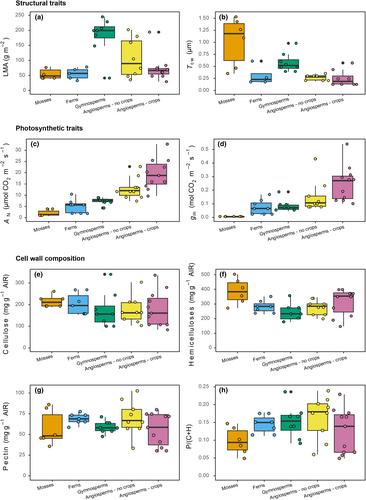
The exploration of the variation in structural and physiological traits, as well as those related to cell wall composition, across several land plant groups reveals significant insights (Figs 1, S2). Contrary to common assumptions, our findings suggest that there is no dependence of Tcw on LMA across phylogenetic scales (Figs 1a,b, S2). Instead, the patterns for AN and gm show remarkable similarities across different plant lineages, as already highlighted by Gago et al. (2019) and Huang et al. (2022) (Fig. 1c,d). This observation underscores the notion that limitations imposed by gm are dominant throughout land plants' phylogeny (Gago et al., 2019).
It has been described that LMA scales positively with Tcw in vascular plants (Onoda et al., 2017). The data included here support this view except for mosses (Fig. S2). This finding emphasizes the complexity of plant adaptations, revealing that factors influencing Tcw do not necessarily correlate with leaf mass. Instead, the inverse but strong phylogenetic patterns observed in Tcw compared to AN and gm indicate that these structural and physiological traits are more closely linked, even when mosses are included. Moreover, our analysis shows that there are no major differences among groups in main cell wall compounds contents or in the pectin to hemicellulose and cellulose ratio: intra-group variations appear to be more pronounced than inter-group variations (Fig. 1e–h). The same applies to the leaf cell wall fraction considered as alcohol-insoluble residues (AIR) (Fig. S3). Interestingly, hemicellulose and cellulose contents correlate independently of pectin content, which further reinforces our findings. This is analogous to the well-documented relationship between LMA and Tcw in vascular plants. While this correlation has been thoroughly substantiated and its mechanistic basis is well understood (Onoda et al., 2017; Wuyun et al., 2024), our data show that mosses exhibit a distinct pattern (Fig. S2).
Contrary to expectations based on Fig. 1, the analysis of the relationships between cell wall composition and gm shown in Fig. 2 reveals several important insights, particularly when distinguishing between crop and noncrop species. As a first approach, we applied both linear (lm) and nonlineal least square (nls) models to assess correlations, choosing for each pair of parameters the function with the lowest Akaike Information Criterion (AIC). However, to account for potential phylogenetical differences in these relationships, we explored alternative options. One option involved applying robust regressions for each phylogenetic group, following Knauer et al. (2022) using the robustbase R package (Maechler et al., 2022). However, due to low-sample sizes within each group, the results of this method did not significantly improve those obtained with standard lm and nls models. Indeed, Knauer et al. (2022) specifically recommend testing relationships only when the number of measurements is ≥ 12, making further exploration of this approach impractical with our dataset. Another approach was to consider linear (lme) and nonlinear (nlme) mixed-effects models, incorporating phylogenetic group as a random factor. In this case, we performed the same pairwise correlations using both lm/nls and lme/nlme and applied ANOVA to discern which model performed better. Additionally, we evaluated the goodness-of-fit metrics for the most suitable statistical model (Table S1). In the nonlinear correlations, nls models performed better than nlme models – for which they are used in Fig. 2(a) – while in the linear correlations lme models performed better than lm models (Fig. 2b,c), indicating a significant phylogenetic effect in these relationships. The different plots in Fig. 2 show the correlations based on the best performance model, that is nls for nonlinear correlations and lme for linear correlations.
As already shown (Evans, 2021; Flexas et al., 2021), gm correlates negatively with Tcw, which is a proxy for the effective path length across the cell wall, following an exponential decay function , as determined by selecting the model with the lowest AIC (Fig. 2a). Additionally, a significant positive linear correlation emerges between gm and the pectin-to-(cellulose + hemicelluloses) fraction (P/(C + H)), a proposed proxy for porosity and tortuosity (Carriquí et al., 2020; Flexas et al., 2021), thus confirming our hypothesis (Fig. 2b). When analyzing all species together, the relationship had a marginal of 0.06, but a conditional of 0.60, indicating a significant phylogenetic influence. Importantly, the strength of this correlation increased when crops were excluded ( = 0.18, = 0.51), and it improved further when noncrop angiosperms were also removed ( = 0.44, = 0.59). These results highlight the influence of phylogenetic and functional group-specific effects on the observed relationship. Notably, a much stronger positive correlation between gm and the ratio of P/(C + H) to Tcw was found (Fig. 2c), indicating the combined importance of path length – Tcw – and porosity/tortuosity – P/(C + H). This finding supports the notion that both factors – path length and porosity/tortuosity – affect gm. When analyzing all species, the was 0.22, and the conditional was 0.55, reflecting moderate explanatory power with notable phylogenetic effects. Again, the relationship in Fig. 2c is especially pronounced when crop species are excluded from our dataset ( = 0.59, = 0.77) but not significantly further improved when noncrop angiosperms were also removed ( = 0.61, = 0.81).
In noncrop species, the pectin fraction in relation to cellulose and hemicellulose plays a crucial role in determining how easily CO₂ can diffuse through the leaf mesophyll, likely because it affects cell wall porosity and tortuosity (Flexas et al., 2021). Conversely, the inclusion of crop species introduces a different dynamic. Please notice that the effect of excluding crops is persistent irrespective of considering or not phylogenetic effects, that is whenever pairwise correlations are better explained by lm/nls or lme/nlme considering the phylogenetic group as a random factor. Crops have indirectly been selectively bred for enhanced photosynthetic efficiency and other agronomically valuable traits (Nadal & Flexas, 2019), which is the consequence of these plants having been derived from wild species with naturally high-photosynthetic capacities (Gomez-Fernandez et al., 2024). They often possess very thin cell walls, which might have weakened the correlation between P/(C + H) and gm because they are optimized for rapid growth and high yield rather than for natural selection pressures influencing photosynthetic efficiency (Xiong, 2023). Consequently, as shown in Fig. 2(b), crops can achieve a large gm despite not necessarily showing a large P/(C + H) ratio. This does not mean that cell wall thickness and/or composition does not affect gm in crops. Indeed, improved photosynthesis and yield has been recently achieved by genetically manipulating cell walls (Salesse-Smith et al., 2024), and empirical relationships between gm and cell wall composition have been shown in different studies subjecting crops to stress conditions (Roig-Oliver et al., 2020a,c, 2021a, 2022). However, it implies that the role in crops is lesser than in wild species and/or that crops may have compensating mechanisms for facilitating CO2 diffusion. Currently, we do not know what these compensatory mechanisms might be. However, it has been suggested that certain aquaporins may play a role in CO2 diffusion, as seen in studies on broad bean, common bean, rice and tobacco (Terashima & Ono, 2002; Hanba et al., 2004; Flexas et al., 2006). Let's hypothesize that this role was acquired relatively recently and only in specific crops. This idea aligns with findings indicating that aquaporins do not appear to have the same role in Arabidopsis (Kromdijk et al., 2020). If this is indeed the case, an increased CO2 diffusion through the plasma membrane – and potentially through chloroplasts (Uehlein et al., 2008)—could enhance gm, despite potential disentangling an impediment of the cell wall composition vs CO2 diffusion. This scenario is analogous to the relationship between LMA and Tcw. While this relationship is well-substantiated and its mechanistic basis is thoroughly understood (Onoda et al., 2017; Wuyun et al., 2024), our study reveals that mosses behave differently. Although this hypothesis is highly speculative, it highlights the critical need for further research in this area. The impact of crop selection on cell wall composition underscores the necessity of focusing on noncrop species to better understand the fundamental connections between cell wall components and photosynthetic traits.
From Eqn 1 the CO₂ conductance across cell walls should depend on ΔLcw and pcw/τcw as the mixed variable, here approached as 1/Tcw × P/(C + H). In fact, the correlation of this parameter with gm across different plant groups becomes notably more significant, with all species having an = 0.22, = 0.55, excluding angiosperms = 0.59, = 0.77, and excluding crops = 0.61, = 0.81. These results suggest that this combined variable significantly explains the variations in gm (Fig. 2c), and emphasizes the relevant role that the pectin fraction plays in regulating gm and, consequently, AN, in wild, nondomesticated plants. To fully comprehend this dependency, it is essential to explore how pectins influence various aspects of cell wall properties – such as porosity and thickness – that affect gas exchange. While the actual physical porosity should not be a major limitation given that CO₂ molecules are small compared to cell wall pore sizes (Carpita et al., 1979; Flexas et al., 2021), pectins possess hydrocolloid characteristics and can retain several times their volume in water. Since CO₂ diffuses in solution, the hydrophilic fraction of the pores could determine its diffusion (Flexas et al., 2021). Moreover, pectins can be under different methyl-esterification states and may interact with other chemical cell wall compounds, altogether affecting the ‘effective’ porosity and, perhaps, tortuosity (Flexas et al., 2021). While cell walls are often considered rigid and fixed structures, instead they are dynamic structures that continuously respond to various stimuli in a regulated manner (Forand et al., 2022; Delmer et al., 2024). Beyond these rough approximations, the relationship between these parameters is likely far more complex. For instance, as shown in Fig. 2, mosses display a unique pattern: despite significant variations in Tcw and P/(C + H), they all maintain similarly low gm values. Interestingly, species with higher Tcw tend to compensate with a higher P/(C + H) ratio, while those with lower P/(C + H) appear to offset it with reduced Tcw. This compensatory mechanism could indicate unique adaptations in mosses, suggesting an area that warrants further investigation. By focusing on these fundamental connections, we can better direct efforts to improve photosynthesis in species with relatively thick cell walls and enhance their physiological performance under contrasting environmental conditions.
This is the very first report to show general relationships by considering species spanning the entire phylogeny of land plants. In doing so, we identify a clear biochemical basis – one that can be traced back to specific genes – for a large component of mesophyll conductance and, thus, photosynthetic capacity. It opens new avenues for improving the photosynthesis of terrestrial plants. Additionally, it suggests that current crops are already optimized and even uncoupled from these general relationships, raising questions about the regulation of gm in crop species.
None declared.
MC, MR-O and JF designed the research. MR-O measured the new studies presented in this study. MC performed the data analysis. MC, MR-O and JF wrote the manuscript, with contributions from MJC-M. All authors revised and approved the manuscript.
The New Phytologist Foundation remains neutral with regard to jurisdictional claims in maps and in any institutional affiliations.
期刊介绍:
New Phytologist is an international electronic journal published 24 times a year. It is owned by the New Phytologist Foundation, a non-profit-making charitable organization dedicated to promoting plant science. The journal publishes excellent, novel, rigorous, and timely research and scholarship in plant science and its applications. The articles cover topics in five sections: Physiology & Development, Environment, Interaction, Evolution, and Transformative Plant Biotechnology. These sections encompass intracellular processes, global environmental change, and encourage cross-disciplinary approaches. The journal recognizes the use of techniques from molecular and cell biology, functional genomics, modeling, and system-based approaches in plant science. Abstracting and Indexing Information for New Phytologist includes Academic Search, AgBiotech News & Information, Agroforestry Abstracts, Biochemistry & Biophysics Citation Index, Botanical Pesticides, CAB Abstracts®, Environment Index, Global Health, and Plant Breeding Abstracts, and others.







 京公网安备 11010802042870号
京ICP备2023020795号-1
京公网安备 11010802042870号
京ICP备2023020795号-1

 分享
分享
 求助内容:
求助内容: 应助结果提醒方式:
 扫码关注我们
