Xiangyu Ren, Guangwei Chen, Pengfei Chang, Shenghong Ju and Yunwen Wu
{"title":"Crystal plane shielding and D-band modulation synergistically achieve durable (100) textured zinc anodes†","authors":"Xiangyu Ren, Guangwei Chen, Pengfei Chang, Shenghong Ju and Yunwen Wu","doi":"10.1039/D4EE04025B","DOIUrl":null,"url":null,"abstract":"<p >Problems of dendrite formation, hydrogen evolution reaction (HER) and zinc anode corrosion have restricted the performance of aqueous zinc-ion batteries (AZIBs). In this work, we introduce 2-butene-1,4-diol (BED) into a ZnSO<small><sub>4</sub></small> (ZSO) electrolyte which can both guide the zinc orientation and suppress the HER reaction <em>via</em> surface reconstruction. The preferential adsorption of BED on zinc (100) guides the vertical deposition of zinc, avoiding the dendrites generated by random deposition. In addition, BED restructures the electronic structure of the zinc surface, which inhibits the conversion of H<small><sup>+</sup></small> to H<small><sub>ad</sub></small>. As a result, the ZSO electrolyte with BED can be stably cycled for more than 3000 h (1 mA cm<small><sup>−2</sup></small>, 1 mA h cm<small><sup>−2</sup></small>). Furthermore, the Zn‖V<small><sub>2</sub></small>O<small><sub>5</sub></small> full cell at 5 A g<small><sup>−1</sup></small> preserves 80.4% of its capacity with 218.1 mA h g<small><sup>−1</sup></small> after 1000 cycles. Our research constructs durable (100) plane anodes and provides new insights into the mechanisms by which additives enhance the performance of zinc anodes.</p>","PeriodicalId":72,"journal":{"name":"Energy & Environmental Science","volume":" 4","pages":" 1867-1878"},"PeriodicalIF":30.8000,"publicationDate":"2025-01-07","publicationTypes":"Journal Article","fieldsOfStudy":null,"isOpenAccess":false,"openAccessPdf":"","citationCount":"0","resultStr":null,"platform":"Semanticscholar","paperid":null,"PeriodicalName":"Energy & Environmental Science","FirstCategoryId":"88","ListUrlMain":"https://pubs.rsc.org/en/content/articlelanding/2025/ee/d4ee04025b","RegionNum":1,"RegionCategory":"材料科学","ArticlePicture":[],"TitleCN":null,"AbstractTextCN":null,"PMCID":null,"EPubDate":"","PubModel":"","JCR":"Q1","JCRName":"CHEMISTRY, MULTIDISCIPLINARY","Score":null,"Total":0}
引用次数: 0
Abstract
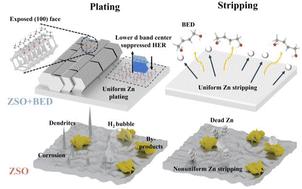
Problems of dendrite formation, hydrogen evolution reaction (HER) and zinc anode corrosion have restricted the performance of aqueous zinc-ion batteries (AZIBs). In this work, we introduce 2-butene-1,4-diol (BED) into a ZnSO4 (ZSO) electrolyte which can both guide the zinc orientation and suppress the HER reaction via surface reconstruction. The preferential adsorption of BED on zinc (100) guides the vertical deposition of zinc, avoiding the dendrites generated by random deposition. In addition, BED restructures the electronic structure of the zinc surface, which inhibits the conversion of H+ to Had. As a result, the ZSO electrolyte with BED can be stably cycled for more than 3000 h (1 mA cm−2, 1 mA h cm−2). Furthermore, the Zn‖V2O5 full cell at 5 A g−1 preserves 80.4% of its capacity with 218.1 mA h g−1 after 1000 cycles. Our research constructs durable (100) plane anodes and provides new insights into the mechanisms by which additives enhance the performance of zinc anodes.
枝晶形成、析氢反应(HER)和锌阳极腐蚀等问题制约了水锌离子电池的性能。本研究将2-丁烯-1,4-二醇(BED)引入到ZnSO4 (ZSO)电解质中,通过表面重构既能引导锌取向又能抑制HER反应。BED对锌(100)的优先吸附引导了锌的垂直沉积,避免了随机沉积产生的枝晶。此外,BED重构了锌表面的电子结构,抑制了H+向Had的转化。结果表明,含BED的ZSO电解质可稳定循环3000 h以上(1 mA cm-2, 1 mA h cm-2)。此外,在5 A g-1条件下,zzn ||V2O5电池在1000次循环后,以218.1 mA h g-1保持80.4%的容量。我们的研究构建了耐用的(100)平面阳极,并为添加剂提高锌阳极性能的机制提供了新的见解。
期刊介绍:
Energy & Environmental Science, a peer-reviewed scientific journal, publishes original research and review articles covering interdisciplinary topics in the (bio)chemical and (bio)physical sciences, as well as chemical engineering disciplines. Published monthly by the Royal Society of Chemistry (RSC), a not-for-profit publisher, Energy & Environmental Science is recognized as a leading journal. It boasts an impressive impact factor of 8.500 as of 2009, ranking 8th among 140 journals in the category "Chemistry, Multidisciplinary," second among 71 journals in "Energy & Fuels," second among 128 journals in "Engineering, Chemical," and first among 181 scientific journals in "Environmental Sciences."
Energy & Environmental Science publishes various types of articles, including Research Papers (original scientific work), Review Articles, Perspectives, and Minireviews (feature review-type articles of broad interest), Communications (original scientific work of an urgent nature), Opinions (personal, often speculative viewpoints or hypotheses on current topics), and Analysis Articles (in-depth examination of energy-related issues).



 京公网安备 11010802042870号
京ICP备2023020795号-1
京公网安备 11010802042870号
京ICP备2023020795号-1

 分享
分享
 求助内容:
求助内容: 应助结果提醒方式:
 扫码关注我们
