{"title":"2D monolayer electrocatalysts for CO2 electroreduction","authors":"Xuemin An and Deren Yang","doi":"10.1039/D4NR04109G","DOIUrl":null,"url":null,"abstract":"<p >The electrocatalytic carbon dioxide reduction reaction (CO<small><sub>2</sub></small>RR) is an attractive method for converting atmospheric CO<small><sub>2</sub></small> into value-added chemicals and fuels. In order to overcome the low efficiency and durability that hinder its practical application, a significant amount of research has been dedicated to designing novel catalysts at the nanoscale and even the atomic scale. Two-dimensional (2D) monolayer materials inherit the merits of both 2D materials and single-atom materials. Through bridging the gap between heterogeneous and homogeneous catalysis, 2D monolayer materials exhibit great potential in the CO<small><sub>2</sub></small>RR due to their unique structural/electronic properties, high atom utilization, low mass transfer resistance and uniform active sites. Here, we systematically overview the development and application of 2D monolayer catalysts for the electrocatalytic CO<small><sub>2</sub></small>RR. First, an overview of the CO<small><sub>2</sub></small>RR technology is presented. Subsequently, a comprehensive discussion is undertaken on various types of 2D monolayer electrocatalysts, such as 2D graphene-based materials, 2D monolayer metal–organic frameworks (MOFs), 2D monolayer covalent organic frameworks (COFs) and 2D monolayer metal-based materials. Their respective electrocatalytic performances are also systematically analyzed. More importantly, novel perspectives on the primary challenges and opportunities associated with the utilization of 2D monolayer materials in the CO<small><sub>2</sub></small>RR are presented. Achieving high-quality 2D monolayer materials and producing highly selective multi-carbon products remain the two major challenges in the design, synthesis and application of 2D monolayer electrocatalysts. Addressing these synthesis-related and performance-related issues is significant for the progression and practical utilization of 2D monolayer materials in the CO<small><sub>2</sub></small>RR.</p>","PeriodicalId":92,"journal":{"name":"Nanoscale","volume":" 8","pages":" 4212-4225"},"PeriodicalIF":5.1000,"publicationDate":"2025-01-07","publicationTypes":"Journal Article","fieldsOfStudy":null,"isOpenAccess":false,"openAccessPdf":"","citationCount":"0","resultStr":null,"platform":"Semanticscholar","paperid":null,"PeriodicalName":"Nanoscale","FirstCategoryId":"88","ListUrlMain":"https://pubs.rsc.org/en/content/articlelanding/2025/nr/d4nr04109g","RegionNum":3,"RegionCategory":"材料科学","ArticlePicture":[],"TitleCN":null,"AbstractTextCN":null,"PMCID":null,"EPubDate":"","PubModel":"","JCR":"Q1","JCRName":"CHEMISTRY, MULTIDISCIPLINARY","Score":null,"Total":0}
引用次数: 0
Abstract
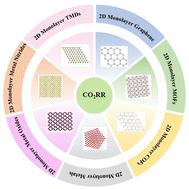
The electrocatalytic carbon dioxide reduction reaction (CO2RR) is an attractive method for converting atmospheric CO2 into value-added chemicals and fuels. In order to overcome the low efficiency and durability that hinder its practical application, a significant amount of research has been dedicated to designing novel catalysts at the nanoscale and even the atomic scale. Two-dimensional (2D) monolayer materials inherit the merits of both 2D materials and single-atom materials. Through bridging the gap between heterogeneous and homogeneous catalysis, 2D monolayer materials exhibit great potential in the CO2RR due to their unique structural/electronic properties, high atom utilization, low mass transfer resistance and uniform active sites. Here, we systematically overview the development and application of 2D monolayer catalysts for the electrocatalytic CO2RR. First, an overview of the CO2RR technology is presented. Subsequently, a comprehensive discussion is undertaken on various types of 2D monolayer electrocatalysts, such as 2D graphene-based materials, 2D monolayer metal–organic frameworks (MOFs), 2D monolayer covalent organic frameworks (COFs) and 2D monolayer metal-based materials. Their respective electrocatalytic performances are also systematically analyzed. More importantly, novel perspectives on the primary challenges and opportunities associated with the utilization of 2D monolayer materials in the CO2RR are presented. Achieving high-quality 2D monolayer materials and producing highly selective multi-carbon products remain the two major challenges in the design, synthesis and application of 2D monolayer electrocatalysts. Addressing these synthesis-related and performance-related issues is significant for the progression and practical utilization of 2D monolayer materials in the CO2RR.
期刊介绍:
Nanoscale is a high-impact international journal, publishing high-quality research across nanoscience and nanotechnology. Nanoscale publishes a full mix of research articles on experimental and theoretical work, including reviews, communications, and full papers.Highly interdisciplinary, this journal appeals to scientists, researchers and professionals interested in nanoscience and nanotechnology, quantum materials and quantum technology, including the areas of physics, chemistry, biology, medicine, materials, energy/environment, information technology, detection science, healthcare and drug discovery, and electronics.



 京公网安备 11010802042870号
京ICP备2023020795号-1
京公网安备 11010802042870号
京ICP备2023020795号-1

 分享
分享
 求助内容:
求助内容: 应助结果提醒方式:
 扫码关注我们
