Hyung Joo Lee, Hyeon-Seung Jung, Jong Gyeong Kim, Yong Won Kim, Chanho Pak
{"title":"Cost-Effective Electrode Fabrication Method Using Hydroxypropyl Methylcellulose Binder for Proton Exchange Membrane Water Electrolysis","authors":"Hyung Joo Lee, Hyeon-Seung Jung, Jong Gyeong Kim, Yong Won Kim, Chanho Pak","doi":"10.1021/acsami.4c15501","DOIUrl":null,"url":null,"abstract":"This study explores improving proton exchange membrane water electrolysis (PEMWE) by achieving both cost-effectiveness and enhanced efficiency through the replacement of the costly and environmentally challenging Nafion ionomer with hydroxypropyl methylcellulose (HPMC) as an anode binder. HPMC, an eco-friendly and cost-effective material, was cross-linked with citric acid to form a durable hydrogel that enhances water and proton transport within the catalyst layer. Using the cross-linked HPMC binder allowed a reduction in cost to 1/54 compared to Nafion ionomer, while the performance of the cross-linked HPMC electrodes remained comparable to Nafion electrodes. After investigating with varying temperatures to determine the appropriate cross-linking temperature, it is suggested that 140 °C was the most suitable. The cross-linked HPMC demonstrated superior hydrophilicity and ionic conductivity compared to the Nafion ionomer, demonstrating its potential as a viable alternative. Initial performance in the single cell revealed that the HPMC-based anode outperformed the Nafion-based anode, with a voltage of 1.782 V vs 1.796 V at 2 A/cm<sup>2</sup>. However, despite this improved initial performance, the higher voltage decay rate of the HPMC binder (0.305 mV/h vs 0.250 mV/h) over 200 h indicates the need for further elaboration on its long-term durability. These findings suggest that the cross-linked HPMC holds promise as a cost-effective and efficient binder for PEMWE anodes, with the potential for further optimization for durability.","PeriodicalId":5,"journal":{"name":"ACS Applied Materials & Interfaces","volume":"14 1","pages":""},"PeriodicalIF":8.2000,"publicationDate":"2025-01-07","publicationTypes":"Journal Article","fieldsOfStudy":null,"isOpenAccess":false,"openAccessPdf":"","citationCount":"0","resultStr":null,"platform":"Semanticscholar","paperid":null,"PeriodicalName":"ACS Applied Materials & Interfaces","FirstCategoryId":"88","ListUrlMain":"https://doi.org/10.1021/acsami.4c15501","RegionNum":2,"RegionCategory":"材料科学","ArticlePicture":[],"TitleCN":null,"AbstractTextCN":null,"PMCID":null,"EPubDate":"","PubModel":"","JCR":"Q1","JCRName":"MATERIALS SCIENCE, MULTIDISCIPLINARY","Score":null,"Total":0}
引用次数: 0
Abstract
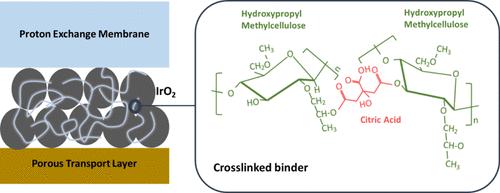
This study explores improving proton exchange membrane water electrolysis (PEMWE) by achieving both cost-effectiveness and enhanced efficiency through the replacement of the costly and environmentally challenging Nafion ionomer with hydroxypropyl methylcellulose (HPMC) as an anode binder. HPMC, an eco-friendly and cost-effective material, was cross-linked with citric acid to form a durable hydrogel that enhances water and proton transport within the catalyst layer. Using the cross-linked HPMC binder allowed a reduction in cost to 1/54 compared to Nafion ionomer, while the performance of the cross-linked HPMC electrodes remained comparable to Nafion electrodes. After investigating with varying temperatures to determine the appropriate cross-linking temperature, it is suggested that 140 °C was the most suitable. The cross-linked HPMC demonstrated superior hydrophilicity and ionic conductivity compared to the Nafion ionomer, demonstrating its potential as a viable alternative. Initial performance in the single cell revealed that the HPMC-based anode outperformed the Nafion-based anode, with a voltage of 1.782 V vs 1.796 V at 2 A/cm2. However, despite this improved initial performance, the higher voltage decay rate of the HPMC binder (0.305 mV/h vs 0.250 mV/h) over 200 h indicates the need for further elaboration on its long-term durability. These findings suggest that the cross-linked HPMC holds promise as a cost-effective and efficient binder for PEMWE anodes, with the potential for further optimization for durability.
本研究通过用羟丙基甲基纤维素(HPMC)作为阳极粘合剂取代昂贵且具有环境挑战性的Nafion离子单体,探索改善质子交换膜电解(PEMWE)的成本效益和效率。HPMC是一种环保且具有成本效益的材料,它与柠檬酸交联,形成耐用的水凝胶,增强催化剂层内水和质子的传输。使用交联HPMC粘合剂可以将成本降低到Nafion离子单体的1/54,而交联HPMC电极的性能仍然与Nafion电极相当。通过对不同温度的研究,确定了合适的交联温度,建议140℃为最合适的交联温度。与Nafion离子聚体相比,交联HPMC表现出优越的亲水性和离子电导率,证明了其作为可行替代品的潜力。在单个电池中的初始性能表明,hpmc基阳极优于nafion基阳极,在2 a /cm2时电压为1.782 V vs 1.796 V。然而,尽管初始性能有所改善,但在200小时内,HPMC粘合剂的电压衰减率较高(0.305 mV/h vs 0.250 mV/h),这表明需要进一步阐述其长期耐久性。这些发现表明,交联HPMC有望成为一种经济高效的PEMWE阳极粘合剂,并具有进一步优化耐久性的潜力。
期刊介绍:
ACS Applied Materials & Interfaces is a leading interdisciplinary journal that brings together chemists, engineers, physicists, and biologists to explore the development and utilization of newly-discovered materials and interfacial processes for specific applications. Our journal has experienced remarkable growth since its establishment in 2009, both in terms of the number of articles published and the impact of the research showcased. We are proud to foster a truly global community, with the majority of published articles originating from outside the United States, reflecting the rapid growth of applied research worldwide.



 京公网安备 11010802042870号
京ICP备2023020795号-1
京公网安备 11010802042870号
京ICP备2023020795号-1

 分享
分享
 求助内容:
求助内容: 应助结果提醒方式:
 扫码关注我们
