Xin Zhao, Jiaping Fu, Ming Chen, Yao Wang, Cong Huang, Kun Qian, Guang Feng, Baohua Li, Dong Zhou, Feiyu Kang
{"title":"A Self-Phase Separated Electrolyte toward Durable and Rollover-Stable Zinc Metal Batteries","authors":"Xin Zhao, Jiaping Fu, Ming Chen, Yao Wang, Cong Huang, Kun Qian, Guang Feng, Baohua Li, Dong Zhou, Feiyu Kang","doi":"10.1021/jacs.4c15132","DOIUrl":null,"url":null,"abstract":"Aqueous zinc (Zn) metal batteries (ZMBs) have received great attention due to their safety and environmental friendliness. Although aqueous electrolytes facilitate fast kinetics in metal oxide cathodes, their incompatibility with the Zn metal anodes triggers severe hydrogen evolution reaction (HER) and dendrite growth. Herein, a self-phase separated electrolyte (SPSE) is proposed to fulfill the contradictory requirements of the anode and cathode in ZMBs. Molecular modeling and experimental investigations verify that the hydrophobic fluorinated solvent with moderate dielectric constant and large Hildebrand parameter disparity relative to water contributes to a spontaneous aqueous–nonaqueous phase separation within the SPSE against stirring and aging. In the as-developed SPSE, the anode nonaqueous phase effectively inhibits the HER and dendrite formation by a synergistic effect of regulated Zn deposition and protective solid electrolyte interphase (SEI). Meanwhile, the aqueous phase in the cathode ensures fast ion insertion/extraction dynamics. Consequently, the SPSE allows for Zn||Zn symmetrical cells with 2500 h cycle life and ultralow corrosion current (0.08 mA cm<sup>–2</sup>). Notably, the Zn|SPSE|V<sub>2</sub>O<sub>5</sub> full cell sustains over 3000 cycles with negligible HER and corrosion, and the pouch cell demonstrates remarkable operation stability against repeated rollover. Our electrolyte design concept paves a promising path for practical ZMBs that combine long-term cyclability, enhanced safety, and durability.","PeriodicalId":49,"journal":{"name":"Journal of the American Chemical Society","volume":"36 1","pages":""},"PeriodicalIF":15.6000,"publicationDate":"2025-01-08","publicationTypes":"Journal Article","fieldsOfStudy":null,"isOpenAccess":false,"openAccessPdf":"","citationCount":"0","resultStr":null,"platform":"Semanticscholar","paperid":null,"PeriodicalName":"Journal of the American Chemical Society","FirstCategoryId":"92","ListUrlMain":"https://doi.org/10.1021/jacs.4c15132","RegionNum":1,"RegionCategory":"化学","ArticlePicture":[],"TitleCN":null,"AbstractTextCN":null,"PMCID":null,"EPubDate":"","PubModel":"","JCR":"Q1","JCRName":"CHEMISTRY, MULTIDISCIPLINARY","Score":null,"Total":0}
引用次数: 0
Abstract
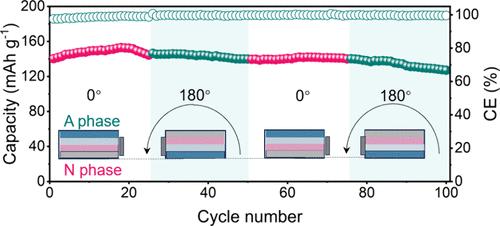
Aqueous zinc (Zn) metal batteries (ZMBs) have received great attention due to their safety and environmental friendliness. Although aqueous electrolytes facilitate fast kinetics in metal oxide cathodes, their incompatibility with the Zn metal anodes triggers severe hydrogen evolution reaction (HER) and dendrite growth. Herein, a self-phase separated electrolyte (SPSE) is proposed to fulfill the contradictory requirements of the anode and cathode in ZMBs. Molecular modeling and experimental investigations verify that the hydrophobic fluorinated solvent with moderate dielectric constant and large Hildebrand parameter disparity relative to water contributes to a spontaneous aqueous–nonaqueous phase separation within the SPSE against stirring and aging. In the as-developed SPSE, the anode nonaqueous phase effectively inhibits the HER and dendrite formation by a synergistic effect of regulated Zn deposition and protective solid electrolyte interphase (SEI). Meanwhile, the aqueous phase in the cathode ensures fast ion insertion/extraction dynamics. Consequently, the SPSE allows for Zn||Zn symmetrical cells with 2500 h cycle life and ultralow corrosion current (0.08 mA cm–2). Notably, the Zn|SPSE|V2O5 full cell sustains over 3000 cycles with negligible HER and corrosion, and the pouch cell demonstrates remarkable operation stability against repeated rollover. Our electrolyte design concept paves a promising path for practical ZMBs that combine long-term cyclability, enhanced safety, and durability.
水锌金属电池(zmb)因其安全性和环保性而受到广泛关注。尽管水电解质在金属氧化物阴极中促进了快速动力学,但它们与锌金属阳极的不相容性引发了严重的析氢反应(HER)和枝晶生长。本文提出了一种自相分离电解质(SPSE),以满足zmb中阳极和阴极的矛盾要求。分子模型和实验研究证实,具有中等介电常数和相对于水的较大希尔德布兰德参数差的疏水氟化溶剂有助于SPSE内自发的水-非水相分离,防止搅拌和老化。在SPSE中,阳极非水相通过调节Zn沉积和保护性固体电解质界面(SEI)的协同作用,有效地抑制了HER和枝晶的形成。同时,阴极的水相确保了快速的离子插入/提取动力学。因此,SPSE允许锌||锌对称电池具有2500小时的循环寿命和超低腐蚀电流(0.08 mA cm-2)。值得注意的是,Zn|SPSE|V2O5全电池可维持超过3000次循环,其HER和腐蚀可以忽略不计,而袋状电池在反复翻转时表现出卓越的操作稳定性。我们的电解质设计理念为实用的zmb铺平了一条充满希望的道路,该zmb结合了长期可循环性,增强的安全性和耐用性。
期刊介绍:
The flagship journal of the American Chemical Society, known as the Journal of the American Chemical Society (JACS), has been a prestigious publication since its establishment in 1879. It holds a preeminent position in the field of chemistry and related interdisciplinary sciences. JACS is committed to disseminating cutting-edge research papers, covering a wide range of topics, and encompasses approximately 19,000 pages of Articles, Communications, and Perspectives annually. With a weekly publication frequency, JACS plays a vital role in advancing the field of chemistry by providing essential research.



 京公网安备 11010802042870号
京ICP备2023020795号-1
京公网安备 11010802042870号
京ICP备2023020795号-1

 分享
分享
 求助内容:
求助内容: 应助结果提醒方式:
 扫码关注我们
