{"title":"Cathode Design Based on Nitrogen Redox and Linear Coordination of Cu Center for All-Solid-State Fluoride-Ion Batteries","authors":"Datong Zhang, Kentaro Yamamoto, Zulai Cao, Yanchang Wang, Zhuoyan Zhong, Hisao Kiuchi, Toshiki Watanabe, Toshiyuki Matsunaga, Koji Nakanishi, Hidenori Miki, Hideki Iba, Yoshihisa Harada, Koji Amezawa, Kazuhiko Maeda, Hiroshi Kageyama, Yoshiharu Uchimoto","doi":"10.1021/jacs.4c12391","DOIUrl":null,"url":null,"abstract":"All-solid-state fluoride-ion batteries (FIBs) have attracted extensive attention as candidates for next-generation energy storage devices; however, promising cathodes with high energy density are still lacking. In this study, Cu<sub>3</sub>N is investigated as a cathode material for all-solid-state fluoride-ion batteries, which offers enough anionic vacancies around the 2-fold coordinated Cu center for F<sup>–</sup> intercalation, thereby enabling a multielectron-transferred fluorination process. The contribution of both cationic and anionic redox to charge compensation, in particular, the generation of molecular nitrogen species in highly charged states, has been proved by several synchrotron-radiation-based spectroscopic technologies. As a result, Cu<sub>3</sub>N exhibits a high reversible capacity of ∼550 mAh g<sup>–1</sup>, exceeding many conventional fluoride-ion cathodes. It is believed that the new charge compensation chemistry as well as the unique intercalation behaviors of novel mixed-anion Cu–N/F local structures could bring new insights into energy storage materials.","PeriodicalId":49,"journal":{"name":"Journal of the American Chemical Society","volume":"26 1","pages":""},"PeriodicalIF":15.6000,"publicationDate":"2025-01-13","publicationTypes":"Journal Article","fieldsOfStudy":null,"isOpenAccess":false,"openAccessPdf":"","citationCount":"0","resultStr":null,"platform":"Semanticscholar","paperid":null,"PeriodicalName":"Journal of the American Chemical Society","FirstCategoryId":"92","ListUrlMain":"https://doi.org/10.1021/jacs.4c12391","RegionNum":1,"RegionCategory":"化学","ArticlePicture":[],"TitleCN":null,"AbstractTextCN":null,"PMCID":null,"EPubDate":"","PubModel":"","JCR":"Q1","JCRName":"CHEMISTRY, MULTIDISCIPLINARY","Score":null,"Total":0}
引用次数: 0
Abstract
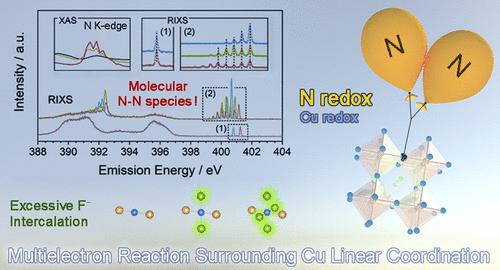
All-solid-state fluoride-ion batteries (FIBs) have attracted extensive attention as candidates for next-generation energy storage devices; however, promising cathodes with high energy density are still lacking. In this study, Cu3N is investigated as a cathode material for all-solid-state fluoride-ion batteries, which offers enough anionic vacancies around the 2-fold coordinated Cu center for F– intercalation, thereby enabling a multielectron-transferred fluorination process. The contribution of both cationic and anionic redox to charge compensation, in particular, the generation of molecular nitrogen species in highly charged states, has been proved by several synchrotron-radiation-based spectroscopic technologies. As a result, Cu3N exhibits a high reversible capacity of ∼550 mAh g–1, exceeding many conventional fluoride-ion cathodes. It is believed that the new charge compensation chemistry as well as the unique intercalation behaviors of novel mixed-anion Cu–N/F local structures could bring new insights into energy storage materials.
全固态氟离子电池(FIBs)作为下一代储能器件的候选材料引起了广泛的关注;然而,目前仍缺乏具有高能量密度的极体。在本研究中,研究了Cu3N作为全固态氟离子电池的正极材料,它在2倍配位Cu中心周围提供了足够的阴离子空位用于F -插入,从而实现了多电子转移的氟化过程。阳离子和阴离子氧化还原对电荷补偿的贡献,特别是在高电荷状态下分子氮的产生,已经被几种基于同步辐射的光谱技术所证明。结果,Cu3N表现出高可逆容量约550 mAh g-1,超过许多传统的氟离子阴极。新型混合阴离子Cu-N /F局部结构的电荷补偿化学和独特的插层行为将为储能材料带来新的见解。
期刊介绍:
The flagship journal of the American Chemical Society, known as the Journal of the American Chemical Society (JACS), has been a prestigious publication since its establishment in 1879. It holds a preeminent position in the field of chemistry and related interdisciplinary sciences. JACS is committed to disseminating cutting-edge research papers, covering a wide range of topics, and encompasses approximately 19,000 pages of Articles, Communications, and Perspectives annually. With a weekly publication frequency, JACS plays a vital role in advancing the field of chemistry by providing essential research.



 京公网安备 11010802042870号
京ICP备2023020795号-1
京公网安备 11010802042870号
京ICP备2023020795号-1

 分享
分享
 求助内容:
求助内容: 应助结果提醒方式:
 扫码关注我们
