Odda Ruiz de Ballesteros, Andrea Rispo, Giuseppe Femina, Simone Davide, Francesca Nocella, Roberta Romano, Roberta Cipullo, Finizia Auriemma
{"title":"Compatibilization of isotactic polypropylene (iPP) and polyethylene (PE) with PP-based olefin block copolymers","authors":"Odda Ruiz de Ballesteros, Andrea Rispo, Giuseppe Femina, Simone Davide, Francesca Nocella, Roberta Romano, Roberta Cipullo, Finizia Auriemma","doi":"10.1016/j.polymer.2025.128040","DOIUrl":null,"url":null,"abstract":"<div><div>The role of entanglements and co-crystallization in the compatibilization of iPP/PE blends with PP-based diblock copolymers (BCs) was investigated. A smart design of experiments was set up, based on the selection of two different BCs, iPP/HDPE and iPP/LDPE blends (30/70 wt%/wt%), and different processing conditions. The selected BCs were a hard-hard copolymer with crystalline iPP and PE blocks (BC1), and a hard-soft copolymer with iPP blocks linked to amorphous EP blocks (BC2). Both BCs significantly improved blend morphology by inducing a fine dispersion of the minority iPP phase in the PE matrix, even at low loads (3–5 wt%). However, they exert different compatibilization effectiveness. In iPP/HDPE blends, trapped entanglements are coupled with well-formed co-crystals of large lamellar thickness, and only 3 wt% of BC1 is sufficient to ensure good ductility and toughness. For iPP/LDPE blends, larger BC1 content (over 5 wt%) was needed due to formation of thinner co-crystals. In contrast, BC2, which does not co-crystallize with PE, only ensures good adhesion in rapidly cooled samples due to the “freezing” of trapped entanglements.</div></div>","PeriodicalId":405,"journal":{"name":"Polymer","volume":"319 ","pages":"Article 128040"},"PeriodicalIF":4.5000,"publicationDate":"2025-02-14","publicationTypes":"Journal Article","fieldsOfStudy":null,"isOpenAccess":false,"openAccessPdf":"","citationCount":"0","resultStr":null,"platform":"Semanticscholar","paperid":null,"PeriodicalName":"Polymer","FirstCategoryId":"92","ListUrlMain":"https://www.sciencedirect.com/science/article/pii/S0032386125000266","RegionNum":2,"RegionCategory":"化学","ArticlePicture":[],"TitleCN":null,"AbstractTextCN":null,"PMCID":null,"EPubDate":"2025/1/8 0:00:00","PubModel":"Epub","JCR":"Q2","JCRName":"POLYMER SCIENCE","Score":null,"Total":0}
引用次数: 0
Abstract
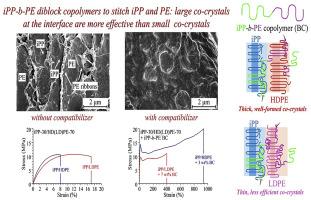
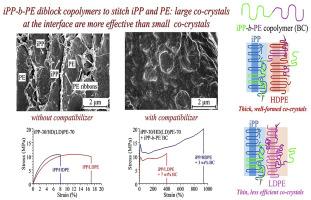
The role of entanglements and co-crystallization in the compatibilization of iPP/PE blends with PP-based diblock copolymers (BCs) was investigated. A smart design of experiments was set up, based on the selection of two different BCs, iPP/HDPE and iPP/LDPE blends (30/70 wt%/wt%), and different processing conditions. The selected BCs were a hard-hard copolymer with crystalline iPP and PE blocks (BC1), and a hard-soft copolymer with iPP blocks linked to amorphous EP blocks (BC2). Both BCs significantly improved blend morphology by inducing a fine dispersion of the minority iPP phase in the PE matrix, even at low loads (3–5 wt%). However, they exert different compatibilization effectiveness. In iPP/HDPE blends, trapped entanglements are coupled with well-formed co-crystals of large lamellar thickness, and only 3 wt% of BC1 is sufficient to ensure good ductility and toughness. For iPP/LDPE blends, larger BC1 content (over 5 wt%) was needed due to formation of thinner co-crystals. In contrast, BC2, which does not co-crystallize with PE, only ensures good adhesion in rapidly cooled samples due to the “freezing” of trapped entanglements.
期刊介绍:
Polymer is an interdisciplinary journal dedicated to publishing innovative and significant advances in Polymer Physics, Chemistry and Technology. We welcome submissions on polymer hybrids, nanocomposites, characterisation and self-assembly. Polymer also publishes work on the technological application of polymers in energy and optoelectronics.
The main scope is covered but not limited to the following core areas:
Polymer Materials
Nanocomposites and hybrid nanomaterials
Polymer blends, films, fibres, networks and porous materials
Physical Characterization
Characterisation, modelling and simulation* of molecular and materials properties in bulk, solution, and thin films
Polymer Engineering
Advanced multiscale processing methods
Polymer Synthesis, Modification and Self-assembly
Including designer polymer architectures, mechanisms and kinetics, and supramolecular polymerization
Technological Applications
Polymers for energy generation and storage
Polymer membranes for separation technology
Polymers for opto- and microelectronics.



 京公网安备 11010802042870号
京ICP备2023020795号-1
京公网安备 11010802042870号
京ICP备2023020795号-1

 分享
分享
 求助内容:
求助内容: 应助结果提醒方式:
 扫码关注我们
