Gabriele Pasquale, Paulo E. Faria Junior, Shun Feng, Eloi Collette, Kenji Watanabe, Takashi Taniguchi, Jaroslav Fabian, Andras Kis
{"title":"Spin polarization detection via chirality-induced tunnelling currents in indium selenide","authors":"Gabriele Pasquale, Paulo E. Faria Junior, Shun Feng, Eloi Collette, Kenji Watanabe, Takashi Taniguchi, Jaroslav Fabian, Andras Kis","doi":"10.1038/s41563-024-02067-9","DOIUrl":null,"url":null,"abstract":"Chirality, a basic property of symmetry breaking, is crucial for fields such as biology and physics. Recent advances in the study of chiral systems have stimulated interest in the discovery of symmetry-breaking states that enable exotic phenomena such as spontaneous gyrotropic order and superconductivity. Here we examine the interaction between light chirality and electron spins in indium selenide and study the effect of magnetic field on emerging tunnelling photocurrents at the Van Hove singularity. Although the effect is symmetric under linearly polarized light excitation, a non-symmetric signal emerges when the excitation is circularly polarized, making it possible to electrically detect light’s chirality. Our study shows a negligible out-of-plane g-factor for few-layer indium selenide at the valence band edge, resulting in an unbalanced Zeeman splitting in hexagonal boron nitride spin bands. This finding allows us to measure the change in energy barrier height with exceptional resolution (~15 μeV). Furthermore, we confirm the long-standing theoretical prediction of spin-polarized hole accumulation in the flat valence band at increasing laser powers. Light chirality and electron spin interactions and the dependence of tunnelling photocurrent on the magnetic field are studied in indium selenide, exploiting its non-symmetric response to circularly polarized light to electrically detect chirality.","PeriodicalId":19058,"journal":{"name":"Nature Materials","volume":"24 2","pages":"212-218"},"PeriodicalIF":38.5000,"publicationDate":"2025-01-08","publicationTypes":"Journal Article","fieldsOfStudy":null,"isOpenAccess":false,"openAccessPdf":"https://www.nature.com/articles/s41563-024-02067-9.pdf","citationCount":"0","resultStr":null,"platform":"Semanticscholar","paperid":null,"PeriodicalName":"Nature Materials","FirstCategoryId":"88","ListUrlMain":"https://www.nature.com/articles/s41563-024-02067-9","RegionNum":1,"RegionCategory":"材料科学","ArticlePicture":[],"TitleCN":null,"AbstractTextCN":null,"PMCID":null,"EPubDate":"","PubModel":"","JCR":"Q1","JCRName":"CHEMISTRY, PHYSICAL","Score":null,"Total":0}
引用次数: 0
Abstract
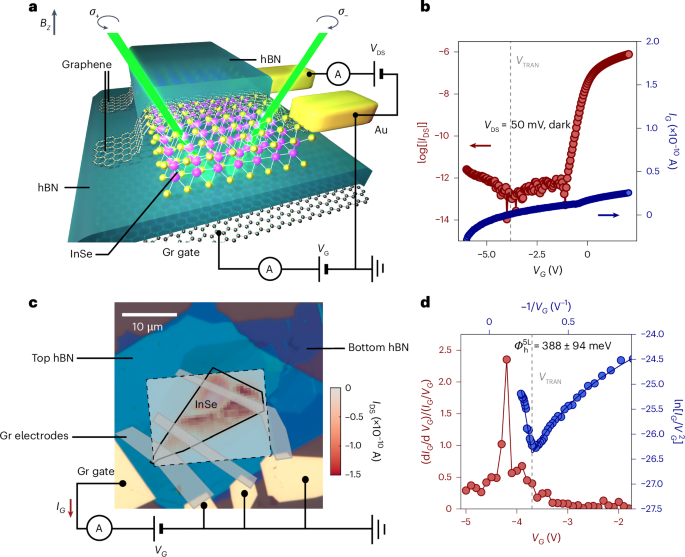
Chirality, a basic property of symmetry breaking, is crucial for fields such as biology and physics. Recent advances in the study of chiral systems have stimulated interest in the discovery of symmetry-breaking states that enable exotic phenomena such as spontaneous gyrotropic order and superconductivity. Here we examine the interaction between light chirality and electron spins in indium selenide and study the effect of magnetic field on emerging tunnelling photocurrents at the Van Hove singularity. Although the effect is symmetric under linearly polarized light excitation, a non-symmetric signal emerges when the excitation is circularly polarized, making it possible to electrically detect light’s chirality. Our study shows a negligible out-of-plane g-factor for few-layer indium selenide at the valence band edge, resulting in an unbalanced Zeeman splitting in hexagonal boron nitride spin bands. This finding allows us to measure the change in energy barrier height with exceptional resolution (~15 μeV). Furthermore, we confirm the long-standing theoretical prediction of spin-polarized hole accumulation in the flat valence band at increasing laser powers. Light chirality and electron spin interactions and the dependence of tunnelling photocurrent on the magnetic field are studied in indium selenide, exploiting its non-symmetric response to circularly polarized light to electrically detect chirality.
期刊介绍:
Nature Materials is a monthly multi-disciplinary journal aimed at bringing together cutting-edge research across the entire spectrum of materials science and engineering. It covers all applied and fundamental aspects of the synthesis/processing, structure/composition, properties, and performance of materials. The journal recognizes that materials research has an increasing impact on classical disciplines such as physics, chemistry, and biology.
Additionally, Nature Materials provides a forum for the development of a common identity among materials scientists and encourages interdisciplinary collaboration. It takes an integrated and balanced approach to all areas of materials research, fostering the exchange of ideas between scientists involved in different disciplines.
Nature Materials is an invaluable resource for scientists in academia and industry who are active in discovering and developing materials and materials-related concepts. It offers engaging and informative papers of exceptional significance and quality, with the aim of influencing the development of society in the future.




 京公网安备 11010802042870号
京ICP备2023020795号-1
京公网安备 11010802042870号
京ICP备2023020795号-1

 分享
分享
 求助内容:
求助内容: 应助结果提醒方式:
 扫码关注我们
