{"title":"Integrated irrigation and nitrogen optimization is a resource-efficient adaptation strategy for US maize and soybean production","authors":"Chenchen Ren, Liyin He, Lorenzo Rosa","doi":"10.1038/s43016-024-01107-6","DOIUrl":null,"url":null,"abstract":"Climate change poses substantial challenges to agriculture and crop production, but the combined role of nitrogen and water inputs in adaptation has been largely overlooked. Here, by developing regression models using US county-level data (2008–2020), we demonstrate that integrated optimization of irrigation and nitrogen inputs represents the most resource-efficient strategy to offset the climate-related yield losses. Under the 1.5 °C (3 °C) warming scenario, this approach involves increasing irrigation water withdrawals for maize by 62% (67%) and reducing it for soybean by 65% (58%), while increasing nitrogen inputs for maize by 4% (13%) and for soybean by 10% (130%) annually. This strategy reduces unsustainable irrigation water withdrawals by 73% (56%) for maize and 26% (28%) for soybean, enhancing water sustainability. Cost–benefit analysis indicates this optimization is cost-effective for over 80% of US maize and soybean productions, underscoring its critical role for climate change adaptation. Adjusting nutrient and irrigation inputs can enhance crop growth, yet their combined role in adapting crop production to global warming has been largely overlooked. This study develops an integrated strategy by optimizing irrigation and nitrogen inputs to provide effective and sustainable solutions for climate change adaptation in US agriculture.","PeriodicalId":94151,"journal":{"name":"Nature food","volume":"6 4","pages":"389-400"},"PeriodicalIF":21.9000,"publicationDate":"2025-01-08","publicationTypes":"Journal Article","fieldsOfStudy":null,"isOpenAccess":false,"openAccessPdf":"","citationCount":"0","resultStr":null,"platform":"Semanticscholar","paperid":null,"PeriodicalName":"Nature food","FirstCategoryId":"1085","ListUrlMain":"https://www.nature.com/articles/s43016-024-01107-6","RegionNum":0,"RegionCategory":null,"ArticlePicture":[],"TitleCN":null,"AbstractTextCN":null,"PMCID":null,"EPubDate":"","PubModel":"","JCR":"Q1","JCRName":"FOOD SCIENCE & TECHNOLOGY","Score":null,"Total":0}
引用次数: 0
Abstract
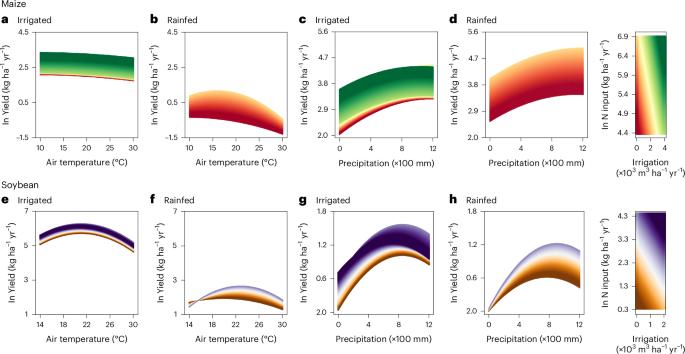
Climate change poses substantial challenges to agriculture and crop production, but the combined role of nitrogen and water inputs in adaptation has been largely overlooked. Here, by developing regression models using US county-level data (2008–2020), we demonstrate that integrated optimization of irrigation and nitrogen inputs represents the most resource-efficient strategy to offset the climate-related yield losses. Under the 1.5 °C (3 °C) warming scenario, this approach involves increasing irrigation water withdrawals for maize by 62% (67%) and reducing it for soybean by 65% (58%), while increasing nitrogen inputs for maize by 4% (13%) and for soybean by 10% (130%) annually. This strategy reduces unsustainable irrigation water withdrawals by 73% (56%) for maize and 26% (28%) for soybean, enhancing water sustainability. Cost–benefit analysis indicates this optimization is cost-effective for over 80% of US maize and soybean productions, underscoring its critical role for climate change adaptation. Adjusting nutrient and irrigation inputs can enhance crop growth, yet their combined role in adapting crop production to global warming has been largely overlooked. This study develops an integrated strategy by optimizing irrigation and nitrogen inputs to provide effective and sustainable solutions for climate change adaptation in US agriculture.




 京公网安备 11010802042870号
京ICP备2023020795号-1
京公网安备 11010802042870号
京ICP备2023020795号-1

 分享
分享

 求助内容:
求助内容: 应助结果提醒方式:
 扫码关注我们
