Xu-Dong Shi, Rui-tang Guo, Heng-fei Cui, Cong Liu and Wei-guo Pan
{"title":"Electrocatalytic reduction of CO2 to produce the C2+ products: from selectivity to rational catalyst design","authors":"Xu-Dong Shi, Rui-tang Guo, Heng-fei Cui, Cong Liu and Wei-guo Pan","doi":"10.1039/D4NR04159C","DOIUrl":null,"url":null,"abstract":"<p >Electrocatalytic reduction of CO<small><sub>2</sub></small> (eCO<small><sub>2</sub></small>RR) into valuable multi-carbon (C<small><sub>2+</sub></small>) products is an effective strategy for combating climate change and mitigating energy crises. The high-energy density and diverse applications of C<small><sub>2+</sub></small> products have attracted considerable interest. However, the complexity of the reaction pathways and the high energy barriers to C–C coupling lead to lower selectivity and faradaic efficiency for C<small><sub>2+</sub></small> products than for C<small><sub>1</sub></small> products. Therefore, a thorough understanding of the underlying mechanisms and identification of reaction conditions that influence selectivity, followed by the rational design of catalysts, are considered promising methods for the efficient and selective synthesis of multi-carbon products. This review first introduces the critical steps involved in forming multi-carbon products. Then, we discuss the reaction conditions that influence the selectivity of C<small><sub>2+</sub></small> products and explore different catalyst design strategies to enhance the selective production of C<small><sub>2+</sub></small> products. Finally, we summarize the significant challenges currently facing the eCO<small><sub>2</sub></small>RR field and suggest future research directions to address these challenges.</p>","PeriodicalId":92,"journal":{"name":"Nanoscale","volume":" 8","pages":" 4338-4364"},"PeriodicalIF":5.1000,"publicationDate":"2025-01-08","publicationTypes":"Journal Article","fieldsOfStudy":null,"isOpenAccess":false,"openAccessPdf":"","citationCount":"0","resultStr":null,"platform":"Semanticscholar","paperid":null,"PeriodicalName":"Nanoscale","FirstCategoryId":"88","ListUrlMain":"https://pubs.rsc.org/en/content/articlelanding/2025/nr/d4nr04159c","RegionNum":3,"RegionCategory":"材料科学","ArticlePicture":[],"TitleCN":null,"AbstractTextCN":null,"PMCID":null,"EPubDate":"","PubModel":"","JCR":"Q1","JCRName":"CHEMISTRY, MULTIDISCIPLINARY","Score":null,"Total":0}
引用次数: 0
Abstract
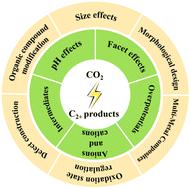
Electrocatalytic reduction of CO2 (eCO2RR) into valuable multi-carbon (C2+) products is an effective strategy for combating climate change and mitigating energy crises. The high-energy density and diverse applications of C2+ products have attracted considerable interest. However, the complexity of the reaction pathways and the high energy barriers to C–C coupling lead to lower selectivity and faradaic efficiency for C2+ products than for C1 products. Therefore, a thorough understanding of the underlying mechanisms and identification of reaction conditions that influence selectivity, followed by the rational design of catalysts, are considered promising methods for the efficient and selective synthesis of multi-carbon products. This review first introduces the critical steps involved in forming multi-carbon products. Then, we discuss the reaction conditions that influence the selectivity of C2+ products and explore different catalyst design strategies to enhance the selective production of C2+ products. Finally, we summarize the significant challenges currently facing the eCO2RR field and suggest future research directions to address these challenges.
期刊介绍:
Nanoscale is a high-impact international journal, publishing high-quality research across nanoscience and nanotechnology. Nanoscale publishes a full mix of research articles on experimental and theoretical work, including reviews, communications, and full papers.Highly interdisciplinary, this journal appeals to scientists, researchers and professionals interested in nanoscience and nanotechnology, quantum materials and quantum technology, including the areas of physics, chemistry, biology, medicine, materials, energy/environment, information technology, detection science, healthcare and drug discovery, and electronics.



 京公网安备 11010802042870号
京ICP备2023020795号-1
京公网安备 11010802042870号
京ICP备2023020795号-1

 分享
分享
 求助内容:
求助内容: 应助结果提醒方式:
 扫码关注我们
