Gianluigi Savarese, Christian Basile, Marianna Adamo, Stefan D. Anker, Antoni Bayes-Genis, Michael Böhm, Erwan Donal, Gerasimos S. Filippatos, Francesco Maisano, Piotr Ponikowski, Giuseppe M.C. Rosano, Ralph Stephan von Bardeleben, Marco Metra, Javed Butler
{"title":"Registries on transcatheter edge-to-edge repair in heart failure: Current evidence and future perspectives","authors":"Gianluigi Savarese, Christian Basile, Marianna Adamo, Stefan D. Anker, Antoni Bayes-Genis, Michael Böhm, Erwan Donal, Gerasimos S. Filippatos, Francesco Maisano, Piotr Ponikowski, Giuseppe M.C. Rosano, Ralph Stephan von Bardeleben, Marco Metra, Javed Butler","doi":"10.1002/ejhf.3573","DOIUrl":null,"url":null,"abstract":"<div>\n \n \n <section>\n \n <h3> Aims</h3>\n \n <p>Secondary mitral regurgitation (SMR) and tricuspid regurgitation (TR) are the most common valvular heart diseases in patients with heart failure (HF). Transcatheter edge-to-edge repair (TEER) devices designed for treating MR and TR have been successfully tested in randomized controlled trials, but methodological issues have often challenged their interpretation. This manuscript aimed to provide an overview of TEER registries on SMR and TR in HF, highlighting their key features, describing clinical characteristics and outcomes of patients receiving these devices, and exploring the available data limitations.</p>\n </section>\n \n <section>\n \n <h3> Methods and results</h3>\n \n <p>PubMed, Web of Science, and EMBASE were searched for registries reporting on TEER in SMR or TR. Registries were excluded if single-centre and with <100 patients. Twenty-six registries (46% prospective, 12% ongoing), including a total cohort of 18 925 patients, were retrieved for TEER in SMR, and six registries (50% retrospective, 33% ongoing) reported on the use of TEER for TR in a total cohort of 1412 patients. Limited geographical representativity outside North America and Europe, high number of missing values, and inconsistency in data reporting were the main existing evidence limitations.</p>\n </section>\n \n <section>\n \n <h3> Conclusion</h3>\n \n <p>Registries on TEER represent a key data source in a setting where it is difficult to conduct randomized controlled trials. However, limitations in design, patient characterization, and outcomes reporting restrain their use. A novel conceptual framework for future prospective TEER registries, as proposed in this document, might inform current practice, address relevant clinical questions and future trial design.</p>\n </section>\n </div>","PeriodicalId":164,"journal":{"name":"European Journal of Heart Failure","volume":"27 8","pages":"1523-1538"},"PeriodicalIF":10.8000,"publicationDate":"2025-01-08","publicationTypes":"Journal Article","fieldsOfStudy":null,"isOpenAccess":false,"openAccessPdf":"https://onlinelibrary.wiley.com/doi/epdf/10.1002/ejhf.3573","citationCount":"0","resultStr":null,"platform":"Semanticscholar","paperid":null,"PeriodicalName":"European Journal of Heart Failure","FirstCategoryId":"3","ListUrlMain":"https://onlinelibrary.wiley.com/doi/10.1002/ejhf.3573","RegionNum":1,"RegionCategory":"医学","ArticlePicture":[],"TitleCN":null,"AbstractTextCN":null,"PMCID":null,"EPubDate":"","PubModel":"","JCR":"Q1","JCRName":"CARDIAC & CARDIOVASCULAR SYSTEMS","Score":null,"Total":0}
引用次数: 0
Abstract
Aims
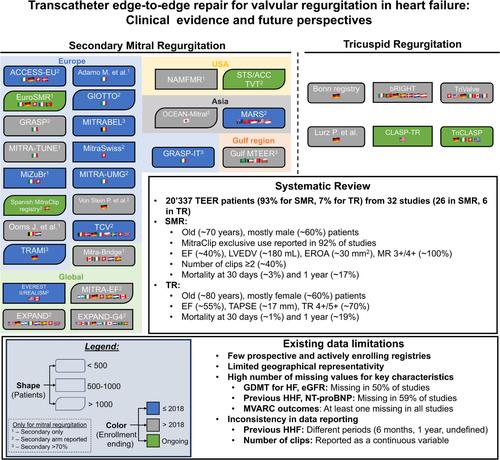
Secondary mitral regurgitation (SMR) and tricuspid regurgitation (TR) are the most common valvular heart diseases in patients with heart failure (HF). Transcatheter edge-to-edge repair (TEER) devices designed for treating MR and TR have been successfully tested in randomized controlled trials, but methodological issues have often challenged their interpretation. This manuscript aimed to provide an overview of TEER registries on SMR and TR in HF, highlighting their key features, describing clinical characteristics and outcomes of patients receiving these devices, and exploring the available data limitations.
Methods and results
PubMed, Web of Science, and EMBASE were searched for registries reporting on TEER in SMR or TR. Registries were excluded if single-centre and with <100 patients. Twenty-six registries (46% prospective, 12% ongoing), including a total cohort of 18 925 patients, were retrieved for TEER in SMR, and six registries (50% retrospective, 33% ongoing) reported on the use of TEER for TR in a total cohort of 1412 patients. Limited geographical representativity outside North America and Europe, high number of missing values, and inconsistency in data reporting were the main existing evidence limitations.
Conclusion
Registries on TEER represent a key data source in a setting where it is difficult to conduct randomized controlled trials. However, limitations in design, patient characterization, and outcomes reporting restrain their use. A novel conceptual framework for future prospective TEER registries, as proposed in this document, might inform current practice, address relevant clinical questions and future trial design.
期刊介绍:
European Journal of Heart Failure is an international journal dedicated to advancing knowledge in the field of heart failure management. The journal publishes reviews and editorials aimed at improving understanding, prevention, investigation, and treatment of heart failure. It covers various disciplines such as molecular and cellular biology, pathology, physiology, electrophysiology, pharmacology, clinical sciences, social sciences, and population sciences. The journal welcomes submissions of manuscripts on basic, clinical, and population sciences, as well as original contributions on nursing, care of the elderly, primary care, health economics, and other related specialist fields. It is published monthly and has a readership that includes cardiologists, emergency room physicians, intensivists, internists, general physicians, cardiac nurses, diabetologists, epidemiologists, basic scientists focusing on cardiovascular research, and those working in rehabilitation. The journal is abstracted and indexed in various databases such as Academic Search, Embase, MEDLINE/PubMed, and Science Citation Index.