Haoxuan Li, Guanqun Wang, Chang Ye, Zhongyu Zou, Bochen Jiang, Fan Yang, Kayla He, Chengwei Ju, Lisheng Zhang, Boyang Gao, Shun Liu, Yanming Chen, Jianhua Zhang, Chuan He
{"title":"Quantitative RNA pseudouridine maps reveal multilayered translation control through plant rRNA, tRNA and mRNA pseudouridylation","authors":"Haoxuan Li, Guanqun Wang, Chang Ye, Zhongyu Zou, Bochen Jiang, Fan Yang, Kayla He, Chengwei Ju, Lisheng Zhang, Boyang Gao, Shun Liu, Yanming Chen, Jianhua Zhang, Chuan He","doi":"10.1038/s41477-024-01894-7","DOIUrl":null,"url":null,"abstract":"Pseudouridine (Ψ) is the most abundant RNA modification, yet studies of Ψ have been hindered by a lack of robust methods to profile comprehensive Ψ maps. Here we utilize bisulfite-induced deletion sequencing to generate transcriptome-wide Ψ maps at single-base resolution across various plant species. Integrating ribosomal RNA, transfer RNA and messenger RNA Ψ stoichiometry with mRNA abundance and polysome profiling data, we uncover a multilayered regulation of translation efficiency through Ψ modifications. rRNA pseudouridylation could globally control translation, although the effects vary at different rRNA Ψ sites. Ψ in the tRNA T-arm loop shows strong positive correlations between Ψ stoichiometry and the translation efficiency of their respective codons. We observed a general inverse correlation between Ψ level and mRNA stability, but a positive correlation with translation efficiency in Arabidopsis seedlings. In conclusion, our study provides critical resources for Ψ research in plants and proposes prevalent translation regulation through rRNA, tRNA and mRNA pseudouridylation. The comprehensive and quantitative mapping of pseudouridine (Ψ) sites across four plant species provides critical resources for plant Ψ research, and reveals multilayered translation regulation through rRNA, tRNA and mRNA pseudouridylation in plants.","PeriodicalId":18904,"journal":{"name":"Nature Plants","volume":"11 2","pages":"234-247"},"PeriodicalIF":13.6000,"publicationDate":"2025-01-09","publicationTypes":"Journal Article","fieldsOfStudy":null,"isOpenAccess":false,"openAccessPdf":"","citationCount":"0","resultStr":null,"platform":"Semanticscholar","paperid":null,"PeriodicalName":"Nature Plants","FirstCategoryId":"99","ListUrlMain":"https://www.nature.com/articles/s41477-024-01894-7","RegionNum":1,"RegionCategory":"生物学","ArticlePicture":[],"TitleCN":null,"AbstractTextCN":null,"PMCID":null,"EPubDate":"","PubModel":"","JCR":"Q1","JCRName":"PLANT SCIENCES","Score":null,"Total":0}
引用次数: 0
Abstract
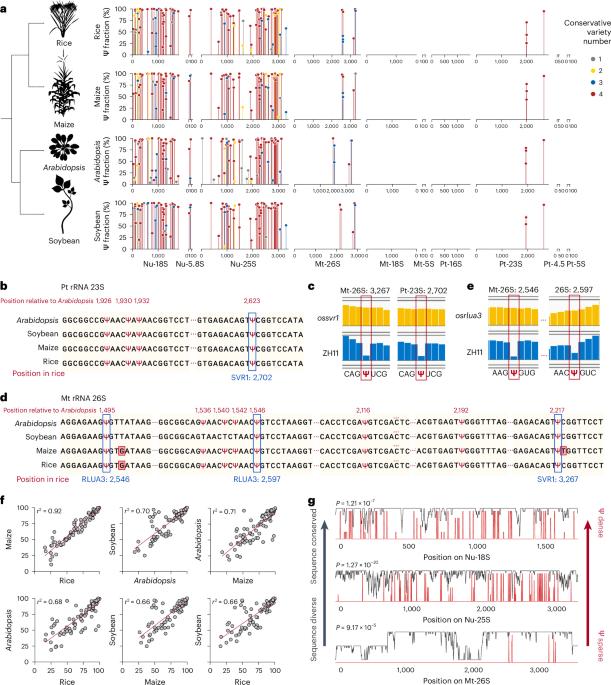
Pseudouridine (Ψ) is the most abundant RNA modification, yet studies of Ψ have been hindered by a lack of robust methods to profile comprehensive Ψ maps. Here we utilize bisulfite-induced deletion sequencing to generate transcriptome-wide Ψ maps at single-base resolution across various plant species. Integrating ribosomal RNA, transfer RNA and messenger RNA Ψ stoichiometry with mRNA abundance and polysome profiling data, we uncover a multilayered regulation of translation efficiency through Ψ modifications. rRNA pseudouridylation could globally control translation, although the effects vary at different rRNA Ψ sites. Ψ in the tRNA T-arm loop shows strong positive correlations between Ψ stoichiometry and the translation efficiency of their respective codons. We observed a general inverse correlation between Ψ level and mRNA stability, but a positive correlation with translation efficiency in Arabidopsis seedlings. In conclusion, our study provides critical resources for Ψ research in plants and proposes prevalent translation regulation through rRNA, tRNA and mRNA pseudouridylation. The comprehensive and quantitative mapping of pseudouridine (Ψ) sites across four plant species provides critical resources for plant Ψ research, and reveals multilayered translation regulation through rRNA, tRNA and mRNA pseudouridylation in plants.
期刊介绍:
Nature Plants is an online-only, monthly journal publishing the best research on plants — from their evolution, development, metabolism and environmental interactions to their societal significance.



 京公网安备 11010802042870号
京ICP备2023020795号-1
京公网安备 11010802042870号
京ICP备2023020795号-1

 分享
分享
 求助内容:
求助内容: 应助结果提醒方式:
 扫码关注我们
