Philipp Münick, Alexander Strubel, Dimitrios-Ilias Balourdas, Julianne S. Funk, Marco Mernberger, Christian Osterburg, Birgit Dreier, Jonas V. Schaefer, Marcel Tuppi, Büşra Yüksel, Birgit Schäfer, Stefan Knapp, Andreas Plückthun, Thorsten Stiewe, Andreas C. Joerger, Volker Dötsch
{"title":"DARPin-induced reactivation of p53 in HPV-positive cells","authors":"Philipp Münick, Alexander Strubel, Dimitrios-Ilias Balourdas, Julianne S. Funk, Marco Mernberger, Christian Osterburg, Birgit Dreier, Jonas V. Schaefer, Marcel Tuppi, Büşra Yüksel, Birgit Schäfer, Stefan Knapp, Andreas Plückthun, Thorsten Stiewe, Andreas C. Joerger, Volker Dötsch","doi":"10.1038/s41594-024-01456-7","DOIUrl":null,"url":null,"abstract":"Infection of cells with high-risk strains of the human papillomavirus (HPV) causes cancer in various types of epithelial tissue. HPV infections are responsible for ~4.5% of all cancers worldwide. Tumorigenesis is based on the inactivation of key cellular control mechanisms by the viral proteins E6 and E7. The HPV E6 protein interacts with the cellular E3 ligase E6AP, and this complex binds to the p53 DNA-binding domain, which results in degradation of p53. Inhibition of this interaction has the potential to reactivate p53, thus preventing oncogenic transformation. Here we describe the characterization of a designed ankyrin repeat protein that binds to the same site as the HPV E6 protein, thereby displacing the E3 ligase and stabilizing p53. Interaction with the designed ankyrin repeat protein does not affect p53 DNA binding or the crucial MDM2 negative feedback loop but reactivates a p53-dependent transcriptional program in HeLa (HPV18-positive) and SiHa (HPV16-positive) cells, suggesting a potential therapeutic use. The binding of a DARPin to p53 displaces the human papillomavirus (HPV) E6 protein and stabilizes p53 in HPV-infected cells. This interaction reactivates a p53-dependent transcriptional program, suggesting a potential new therapeutic strategy for treating HPV-induced cancers.","PeriodicalId":49141,"journal":{"name":"Nature Structural & Molecular Biology","volume":"32 5","pages":"790-801"},"PeriodicalIF":10.1000,"publicationDate":"2025-01-09","publicationTypes":"Journal Article","fieldsOfStudy":null,"isOpenAccess":false,"openAccessPdf":"","citationCount":"0","resultStr":null,"platform":"Semanticscholar","paperid":null,"PeriodicalName":"Nature Structural & Molecular Biology","FirstCategoryId":"99","ListUrlMain":"https://www.nature.com/articles/s41594-024-01456-7","RegionNum":1,"RegionCategory":"生物学","ArticlePicture":[],"TitleCN":null,"AbstractTextCN":null,"PMCID":null,"EPubDate":"","PubModel":"","JCR":"Q1","JCRName":"BIOCHEMISTRY & MOLECULAR BIOLOGY","Score":null,"Total":0}
引用次数: 0
Abstract
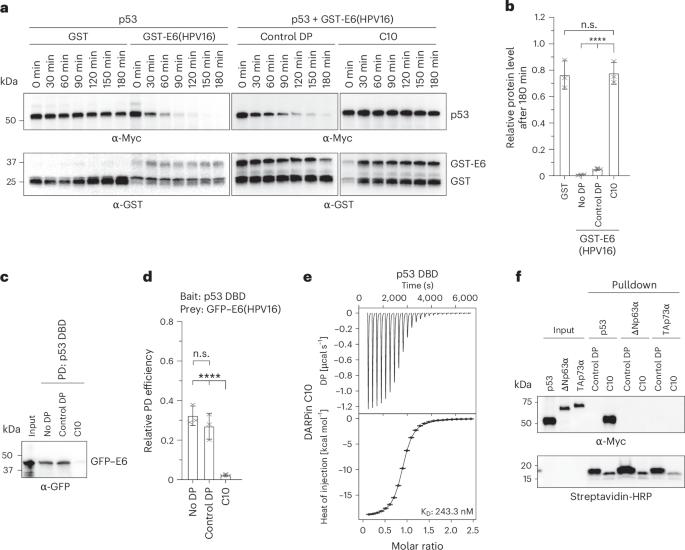
Infection of cells with high-risk strains of the human papillomavirus (HPV) causes cancer in various types of epithelial tissue. HPV infections are responsible for ~4.5% of all cancers worldwide. Tumorigenesis is based on the inactivation of key cellular control mechanisms by the viral proteins E6 and E7. The HPV E6 protein interacts with the cellular E3 ligase E6AP, and this complex binds to the p53 DNA-binding domain, which results in degradation of p53. Inhibition of this interaction has the potential to reactivate p53, thus preventing oncogenic transformation. Here we describe the characterization of a designed ankyrin repeat protein that binds to the same site as the HPV E6 protein, thereby displacing the E3 ligase and stabilizing p53. Interaction with the designed ankyrin repeat protein does not affect p53 DNA binding or the crucial MDM2 negative feedback loop but reactivates a p53-dependent transcriptional program in HeLa (HPV18-positive) and SiHa (HPV16-positive) cells, suggesting a potential therapeutic use. The binding of a DARPin to p53 displaces the human papillomavirus (HPV) E6 protein and stabilizes p53 in HPV-infected cells. This interaction reactivates a p53-dependent transcriptional program, suggesting a potential new therapeutic strategy for treating HPV-induced cancers.
期刊介绍:
Nature Structural & Molecular Biology is a comprehensive platform that combines structural and molecular research. Our journal focuses on exploring the functional and mechanistic aspects of biological processes, emphasizing how molecular components collaborate to achieve a particular function. While structural data can shed light on these insights, our publication does not require them as a prerequisite.



 京公网安备 11010802042870号
京ICP备2023020795号-1
京公网安备 11010802042870号
京ICP备2023020795号-1

 分享
分享
 求助内容:
求助内容: 应助结果提醒方式:
 扫码关注我们
