Marco Springmann, Eugenia Dinivitzer, Florian Freund, Jørgen Dejgård Jensen, Clara G. Bouyssou
{"title":"A reform of value-added taxes on foods can have health, environmental and economic benefits in Europe","authors":"Marco Springmann, Eugenia Dinivitzer, Florian Freund, Jørgen Dejgård Jensen, Clara G. Bouyssou","doi":"10.1038/s43016-024-01097-5","DOIUrl":null,"url":null,"abstract":"Fiscal policies can provide important incentives for encouraging the dietary changes needed to achieve global policy targets. Across Europe, the foods relevant to health and the environment often incur reduced but non-zero value-added tax (VAT) rates at about half the maximum rates, which allows for providing both incentives and disincentives. Integrating economic, health and environmental modelling, we show that reforming VAT rates on foods, including increasing rates on meat and dairy, and reducing VAT rates on fruits and vegetables can improve diets and result in health, environmental and economic benefits in most European countries. The health improvements were primarily driven by reductions in VAT rates on fruits and vegetables, whereas most of the environmental and revenue benefits were driven by increased rates on meat and dairy. Our findings suggest that differentiating VAT rates based on health and environmental considerations can support changes towards healthier and more sustainable diets in Europe. Fiscal incentives on consumption can encourage dietary changes towards healthier and more sustainable foods. Integrated modelling reveals the potential health, environmental and economic impacts of aligning VAT rates on food with health and environmental considerations in Europe.","PeriodicalId":94151,"journal":{"name":"Nature food","volume":"6 2","pages":"161-169"},"PeriodicalIF":21.9000,"publicationDate":"2025-01-09","publicationTypes":"Journal Article","fieldsOfStudy":null,"isOpenAccess":false,"openAccessPdf":"https://www.nature.com/articles/s43016-024-01097-5.pdf","citationCount":"0","resultStr":null,"platform":"Semanticscholar","paperid":null,"PeriodicalName":"Nature food","FirstCategoryId":"1085","ListUrlMain":"https://www.nature.com/articles/s43016-024-01097-5","RegionNum":0,"RegionCategory":null,"ArticlePicture":[],"TitleCN":null,"AbstractTextCN":null,"PMCID":null,"EPubDate":"","PubModel":"","JCR":"Q1","JCRName":"FOOD SCIENCE & TECHNOLOGY","Score":null,"Total":0}
引用次数: 0
Abstract
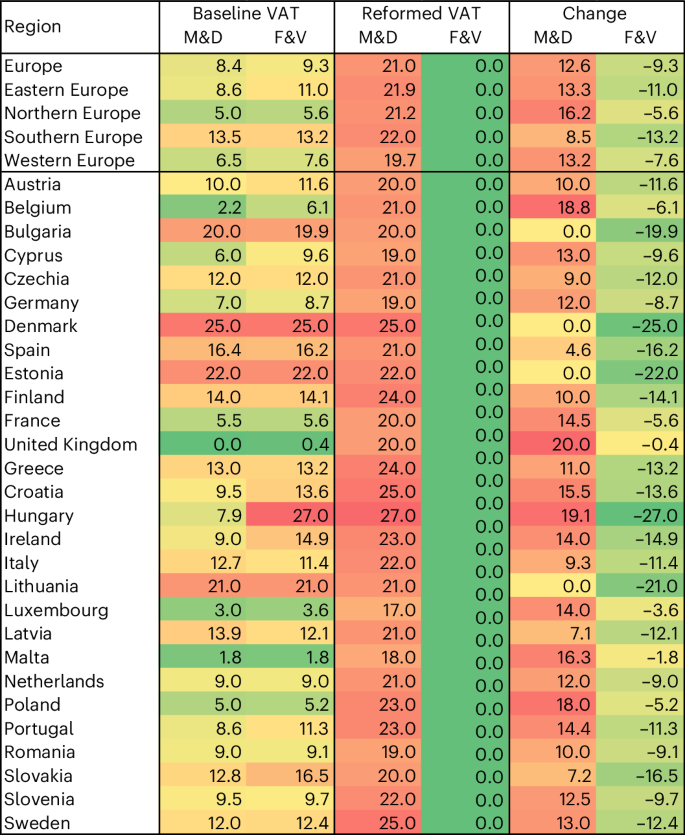
Fiscal policies can provide important incentives for encouraging the dietary changes needed to achieve global policy targets. Across Europe, the foods relevant to health and the environment often incur reduced but non-zero value-added tax (VAT) rates at about half the maximum rates, which allows for providing both incentives and disincentives. Integrating economic, health and environmental modelling, we show that reforming VAT rates on foods, including increasing rates on meat and dairy, and reducing VAT rates on fruits and vegetables can improve diets and result in health, environmental and economic benefits in most European countries. The health improvements were primarily driven by reductions in VAT rates on fruits and vegetables, whereas most of the environmental and revenue benefits were driven by increased rates on meat and dairy. Our findings suggest that differentiating VAT rates based on health and environmental considerations can support changes towards healthier and more sustainable diets in Europe. Fiscal incentives on consumption can encourage dietary changes towards healthier and more sustainable foods. Integrated modelling reveals the potential health, environmental and economic impacts of aligning VAT rates on food with health and environmental considerations in Europe.




 京公网安备 11010802042870号
京ICP备2023020795号-1
京公网安备 11010802042870号
京ICP备2023020795号-1

 分享
分享

 求助内容:
求助内容: 应助结果提醒方式:
 扫码关注我们
