Róża Dziewiątkowska, Joanna Krzeszczakowska, Marta Głodek, Michał Łomzik, Damian Plażuk and Anna Makal
{"title":"Pressure-induced phase transitions in a new luminescent gold(i)–arylacetylide†","authors":"Róża Dziewiątkowska, Joanna Krzeszczakowska, Marta Głodek, Michał Łomzik, Damian Plażuk and Anna Makal","doi":"10.1039/D4DT03036B","DOIUrl":null,"url":null,"abstract":"<p >Stimulus-responsive molecular materials are highly desirable because of the wide range of their potential applications. In particular, switching of physical properties opens application pathways for molecular materials as sensors or actuators. Property switching in solids can be achieved by inducing single-crystal-to-single-crystal (SCSC) phase transitions. Elucidating the mechanisms of such transformations and identifying the factors and (supra)molecular motifs that increase their probability is thus paramount to understanding property switching and materials design. Here, we present a new compound, (<em>p</em>-methoxy-phenylacetylide)(triethylphosphine)gold(<small>I</small>) (<strong>ArPEt</strong>), combining the photoluminescent core of gold(<small>I</small>) acetylide with triethylphosphine that should provide a rich conformational landscape and favor SCSC phase transitions due to low-energy interconversion pathways. We demonstrate its potential to undergo multiple pressure-induced SCSC transformations at ≈0.5 GPa and ≈2 GPa, the obtainable phases being dependent on the types of applied pressure-transmitting media. We describe structures of polymorphs of <strong>ArPEt</strong> and the mechanism of pressure-induced structural reorganizations based on very high-quality single-crystal X-ray diffraction data.</p>","PeriodicalId":71,"journal":{"name":"Dalton Transactions","volume":" 8","pages":" 3362-3374"},"PeriodicalIF":3.3000,"publicationDate":"2025-01-09","publicationTypes":"Journal Article","fieldsOfStudy":null,"isOpenAccess":false,"openAccessPdf":"https://pubs.rsc.org/en/content/articlepdf/2025/dt/d4dt03036b?page=search","citationCount":"0","resultStr":null,"platform":"Semanticscholar","paperid":null,"PeriodicalName":"Dalton Transactions","FirstCategoryId":"92","ListUrlMain":"https://pubs.rsc.org/en/content/articlelanding/2025/dt/d4dt03036b","RegionNum":3,"RegionCategory":"化学","ArticlePicture":[],"TitleCN":null,"AbstractTextCN":null,"PMCID":null,"EPubDate":"","PubModel":"","JCR":"Q2","JCRName":"CHEMISTRY, INORGANIC & NUCLEAR","Score":null,"Total":0}
引用次数: 0
Abstract
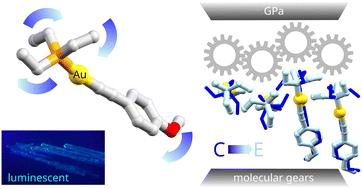
Stimulus-responsive molecular materials are highly desirable because of the wide range of their potential applications. In particular, switching of physical properties opens application pathways for molecular materials as sensors or actuators. Property switching in solids can be achieved by inducing single-crystal-to-single-crystal (SCSC) phase transitions. Elucidating the mechanisms of such transformations and identifying the factors and (supra)molecular motifs that increase their probability is thus paramount to understanding property switching and materials design. Here, we present a new compound, (p-methoxy-phenylacetylide)(triethylphosphine)gold(I) (ArPEt), combining the photoluminescent core of gold(I) acetylide with triethylphosphine that should provide a rich conformational landscape and favor SCSC phase transitions due to low-energy interconversion pathways. We demonstrate its potential to undergo multiple pressure-induced SCSC transformations at ≈0.5 GPa and ≈2 GPa, the obtainable phases being dependent on the types of applied pressure-transmitting media. We describe structures of polymorphs of ArPEt and the mechanism of pressure-induced structural reorganizations based on very high-quality single-crystal X-ray diffraction data.
期刊介绍:
Dalton Transactions is a journal for all areas of inorganic chemistry, which encompasses the organometallic, bioinorganic and materials chemistry of the elements, with applications including synthesis, catalysis, energy conversion/storage, electrical devices and medicine. Dalton Transactions welcomes high-quality, original submissions in all of these areas and more, where the advancement of knowledge in inorganic chemistry is significant.



 京公网安备 11010802042870号
京ICP备2023020795号-1
京公网安备 11010802042870号
京ICP备2023020795号-1

 分享
分享
 求助内容:
求助内容: 应助结果提醒方式:
 扫码关注我们
