Peter M. Visscher, Christopher Gyngell, Loic Yengo, Julian Savulescu
{"title":"Heritable polygenic editing: the next frontier in genomic medicine?","authors":"Peter M. Visscher, Christopher Gyngell, Loic Yengo, Julian Savulescu","doi":"10.1038/s41586-024-08300-4","DOIUrl":null,"url":null,"abstract":"Polygenic genome editing in human embryos and germ cells is predicted to become feasible in the next three decades. Several recent books and academic papers have outlined the ethical concerns raised by germline genome editing and the opportunities that it may present1–3. To date, no attempts have been made to predict the consequences of altering specific variants associated with polygenic diseases. In this Analysis, we show that polygenic genome editing could theoretically yield extreme reductions in disease susceptibility. For example, editing a relatively small number of genomic variants could make a substantial difference to an individual’s risk of developing coronary artery disease, Alzheimer’s disease, major depressive disorder, diabetes and schizophrenia. Similarly, large changes in risk factors, such as low-density lipoprotein cholesterol and blood pressure, could, in theory, be achieved by polygenic editing. Although heritable polygenic editing (HPE) is still speculative, we completed calculations to discuss the underlying ethical issues. Our modelling demonstrates how the putatively positive consequences of gene editing at an individual level may deepen health inequalities. Further, as single or multiple gene variants can increase the risk of some diseases while decreasing that of others, HPE raises ethical challenges related to pleiotropy and genetic diversity. We conclude by arguing for a collectivist perspective on the ethical issues raised by HPE, which accounts for its effects on individuals, their families, communities and society4. We discuss the potential consequences and ethical concerns of polygenic genome editing of human embryos to alter specific variants associated with polygenic diseases, highlighting the possibility of reducing disease susceptibility while exacerbating health inequalities.","PeriodicalId":18787,"journal":{"name":"Nature","volume":"637 8046","pages":"637-645"},"PeriodicalIF":48.5000,"publicationDate":"2025-01-08","publicationTypes":"Journal Article","fieldsOfStudy":null,"isOpenAccess":false,"openAccessPdf":"https://www.nature.com/articles/s41586-024-08300-4.pdf","citationCount":"0","resultStr":null,"platform":"Semanticscholar","paperid":null,"PeriodicalName":"Nature","FirstCategoryId":"103","ListUrlMain":"https://www.nature.com/articles/s41586-024-08300-4","RegionNum":1,"RegionCategory":"综合性期刊","ArticlePicture":[],"TitleCN":null,"AbstractTextCN":null,"PMCID":null,"EPubDate":"","PubModel":"","JCR":"Q1","JCRName":"MULTIDISCIPLINARY SCIENCES","Score":null,"Total":0}
引用次数: 0
Abstract
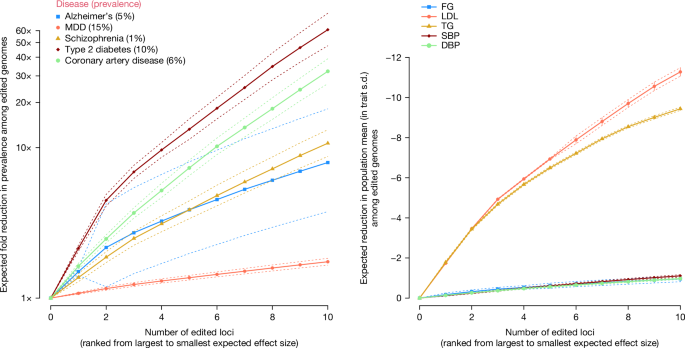
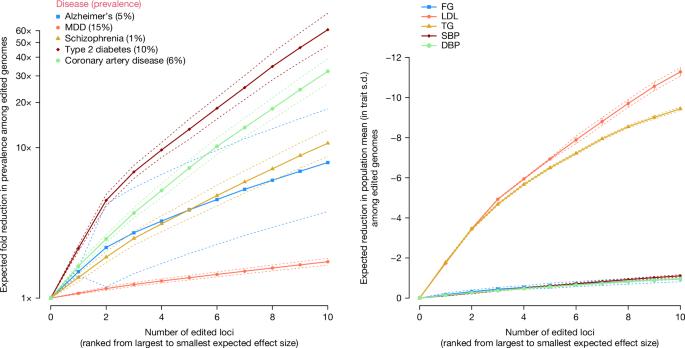
Polygenic genome editing in human embryos and germ cells is predicted to become feasible in the next three decades. Several recent books and academic papers have outlined the ethical concerns raised by germline genome editing and the opportunities that it may present1–3. To date, no attempts have been made to predict the consequences of altering specific variants associated with polygenic diseases. In this Analysis, we show that polygenic genome editing could theoretically yield extreme reductions in disease susceptibility. For example, editing a relatively small number of genomic variants could make a substantial difference to an individual’s risk of developing coronary artery disease, Alzheimer’s disease, major depressive disorder, diabetes and schizophrenia. Similarly, large changes in risk factors, such as low-density lipoprotein cholesterol and blood pressure, could, in theory, be achieved by polygenic editing. Although heritable polygenic editing (HPE) is still speculative, we completed calculations to discuss the underlying ethical issues. Our modelling demonstrates how the putatively positive consequences of gene editing at an individual level may deepen health inequalities. Further, as single or multiple gene variants can increase the risk of some diseases while decreasing that of others, HPE raises ethical challenges related to pleiotropy and genetic diversity. We conclude by arguing for a collectivist perspective on the ethical issues raised by HPE, which accounts for its effects on individuals, their families, communities and society4. We discuss the potential consequences and ethical concerns of polygenic genome editing of human embryos to alter specific variants associated with polygenic diseases, highlighting the possibility of reducing disease susceptibility while exacerbating health inequalities.
期刊介绍:
Nature is a prestigious international journal that publishes peer-reviewed research in various scientific and technological fields. The selection of articles is based on criteria such as originality, importance, interdisciplinary relevance, timeliness, accessibility, elegance, and surprising conclusions. In addition to showcasing significant scientific advances, Nature delivers rapid, authoritative, insightful news, and interpretation of current and upcoming trends impacting science, scientists, and the broader public. The journal serves a dual purpose: firstly, to promptly share noteworthy scientific advances and foster discussions among scientists, and secondly, to ensure the swift dissemination of scientific results globally, emphasizing their significance for knowledge, culture, and daily life.



 京公网安备 11010802042870号
京ICP备2023020795号-1
京公网安备 11010802042870号
京ICP备2023020795号-1

 分享
分享
 求助内容:
求助内容: 应助结果提醒方式:
 扫码关注我们
