Sarah Kakadellis, Selena Mao, Asch Harwood, Edward S. Spang
{"title":"State-level policies alone are insufficient to meet the federal food waste reduction goal in the United States","authors":"Sarah Kakadellis, Selena Mao, Asch Harwood, Edward S. Spang","doi":"10.1038/s43016-024-01092-w","DOIUrl":null,"url":null,"abstract":"The United States Food Loss and Waste Reduction Goal seeks to reduce national food waste by 50%, down to 74 kg per capita, by 2030. Here we investigate state policies’ alignment with the federal goal across four policy categories. We develop a policy scoring matrix and apply it to wasted food solutions listed in the non-profit ReFED’s database to derive ranges of food waste diversion potential and projected generation across states. On the basis of state policies alone, no state can meet the federal target. We estimated a diversion potential of 5–14 kg per capita and a food waste generation of 149 kg per capita nationally in 2022, equivalent to the 2016 baseline. Without additional intervention at the state and federal level promoting a shift from food waste recycling towards prevention, rescue and repurposing, food generation in the United States will probably remain high. A modelling study shows that the emphasis on recycling food waste over prevention, rescue and redirection impedes the progress of the United States Food Loss and Waste Reduction Goal to halve food waste by 2030.","PeriodicalId":94151,"journal":{"name":"Nature food","volume":"6 2","pages":"196-204"},"PeriodicalIF":21.9000,"publicationDate":"2025-01-09","publicationTypes":"Journal Article","fieldsOfStudy":null,"isOpenAccess":false,"openAccessPdf":"https://www.nature.com/articles/s43016-024-01092-w.pdf","citationCount":"0","resultStr":null,"platform":"Semanticscholar","paperid":null,"PeriodicalName":"Nature food","FirstCategoryId":"1085","ListUrlMain":"https://www.nature.com/articles/s43016-024-01092-w","RegionNum":0,"RegionCategory":null,"ArticlePicture":[],"TitleCN":null,"AbstractTextCN":null,"PMCID":null,"EPubDate":"","PubModel":"","JCR":"Q1","JCRName":"FOOD SCIENCE & TECHNOLOGY","Score":null,"Total":0}
引用次数: 0
Abstract
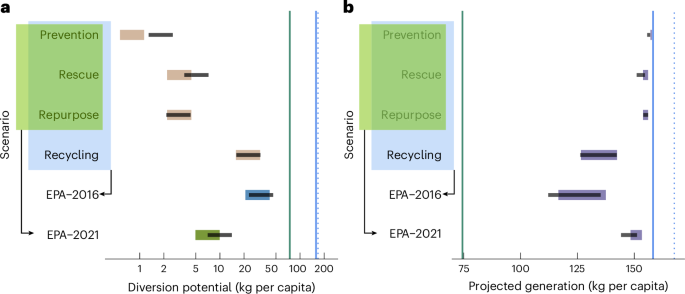
The United States Food Loss and Waste Reduction Goal seeks to reduce national food waste by 50%, down to 74 kg per capita, by 2030. Here we investigate state policies’ alignment with the federal goal across four policy categories. We develop a policy scoring matrix and apply it to wasted food solutions listed in the non-profit ReFED’s database to derive ranges of food waste diversion potential and projected generation across states. On the basis of state policies alone, no state can meet the federal target. We estimated a diversion potential of 5–14 kg per capita and a food waste generation of 149 kg per capita nationally in 2022, equivalent to the 2016 baseline. Without additional intervention at the state and federal level promoting a shift from food waste recycling towards prevention, rescue and repurposing, food generation in the United States will probably remain high. A modelling study shows that the emphasis on recycling food waste over prevention, rescue and redirection impedes the progress of the United States Food Loss and Waste Reduction Goal to halve food waste by 2030.




 京公网安备 11010802042870号
京ICP备2023020795号-1
京公网安备 11010802042870号
京ICP备2023020795号-1

 分享
分享

 求助内容:
求助内容: 应助结果提醒方式:
 扫码关注我们
