{"title":"Speckle-Free 3D Holography in the Wigner Domain","authors":"Dapu Pi, Yiqi Ye, Ke Cheng, Min Gu, Xinyuan Fang","doi":"10.1002/lpor.202401828","DOIUrl":null,"url":null,"abstract":"<p>Computer-generated hologram (CGH) provides an approach to modulate the 3D coherent wavefront and has been widely used in many optical applications. Over the past few decades, extensive efforts have been made to design optimization models for high-quality reconstruction. However, the reconstruction quality is still limited due to the mismatch of the bandwidth between the reconstructed field of interest and the reconstructed complex amplitude field in 3D space. Here, an ideal numerical light field mapping physical model from the hologram plane to the 3D image plane for speckle-free 3D holography in the Wigner domain is established. With the aid of the Wigner distribution function (WDF), which allows the analysis of a light field from not only the space domain but also the spatial frequency domain, the bandwidth properties of the reconstructed field in 3D space are analyzed, which provides a guideline for the sampling of the reconstructed field to efficiently describe the speckles and artifacts. Accordingly, a comprehensive CGH optimization method in the Wigner domain is proposed to constrain the reconstructed intensity fluctuations without errors and omissions for high-quality reconstruction. As such, this method enables speckle-free and artifact-free reconstruction with a twice improvement in peak signal-to-noise ratio (PSNR) and a five times improvement in structural similarity index measure (SSIM) compared to conventional phase-only holograms. The optical experimental results show that this method paves the road for the future implementation of speckle-free color 3D holography harnessing the advanced integrated photonic devices, and also offers an efficient and practical route for various optical applications, such as 3D display, optical encryption, beam shaping, optical computing and so on.</p>","PeriodicalId":204,"journal":{"name":"Laser & Photonics Reviews","volume":"19 10","pages":""},"PeriodicalIF":10.0000,"publicationDate":"2025-01-10","publicationTypes":"Journal Article","fieldsOfStudy":null,"isOpenAccess":false,"openAccessPdf":"","citationCount":"0","resultStr":null,"platform":"Semanticscholar","paperid":null,"PeriodicalName":"Laser & Photonics Reviews","FirstCategoryId":"101","ListUrlMain":"https://onlinelibrary.wiley.com/doi/10.1002/lpor.202401828","RegionNum":1,"RegionCategory":"物理与天体物理","ArticlePicture":[],"TitleCN":null,"AbstractTextCN":null,"PMCID":null,"EPubDate":"","PubModel":"","JCR":"Q1","JCRName":"OPTICS","Score":null,"Total":0}
引用次数: 0
Abstract
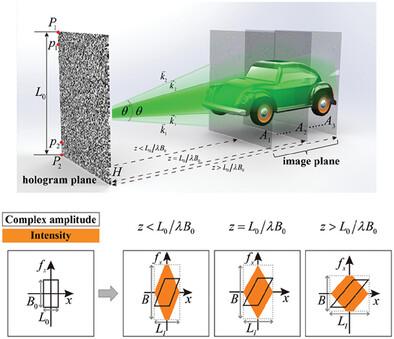
Computer-generated hologram (CGH) provides an approach to modulate the 3D coherent wavefront and has been widely used in many optical applications. Over the past few decades, extensive efforts have been made to design optimization models for high-quality reconstruction. However, the reconstruction quality is still limited due to the mismatch of the bandwidth between the reconstructed field of interest and the reconstructed complex amplitude field in 3D space. Here, an ideal numerical light field mapping physical model from the hologram plane to the 3D image plane for speckle-free 3D holography in the Wigner domain is established. With the aid of the Wigner distribution function (WDF), which allows the analysis of a light field from not only the space domain but also the spatial frequency domain, the bandwidth properties of the reconstructed field in 3D space are analyzed, which provides a guideline for the sampling of the reconstructed field to efficiently describe the speckles and artifacts. Accordingly, a comprehensive CGH optimization method in the Wigner domain is proposed to constrain the reconstructed intensity fluctuations without errors and omissions for high-quality reconstruction. As such, this method enables speckle-free and artifact-free reconstruction with a twice improvement in peak signal-to-noise ratio (PSNR) and a five times improvement in structural similarity index measure (SSIM) compared to conventional phase-only holograms. The optical experimental results show that this method paves the road for the future implementation of speckle-free color 3D holography harnessing the advanced integrated photonic devices, and also offers an efficient and practical route for various optical applications, such as 3D display, optical encryption, beam shaping, optical computing and so on.
期刊介绍:
Laser & Photonics Reviews is a reputable journal that publishes high-quality Reviews, original Research Articles, and Perspectives in the field of photonics and optics. It covers both theoretical and experimental aspects, including recent groundbreaking research, specific advancements, and innovative applications.
As evidence of its impact and recognition, Laser & Photonics Reviews boasts a remarkable 2022 Impact Factor of 11.0, according to the Journal Citation Reports from Clarivate Analytics (2023). Moreover, it holds impressive rankings in the InCites Journal Citation Reports: in 2021, it was ranked 6th out of 101 in the field of Optics, 15th out of 161 in Applied Physics, and 12th out of 69 in Condensed Matter Physics.
The journal uses the ISSN numbers 1863-8880 for print and 1863-8899 for online publications.




 京公网安备 11010802042870号
京ICP备2023020795号-1
京公网安备 11010802042870号
京ICP备2023020795号-1

 分享
分享
 求助内容:
求助内容: 应助结果提醒方式:
 扫码关注我们
