{"title":"Unleashing the Underestimated Rate Capability of Graphite Anode for Potassium-Ion Batteries by Sn(OTf)2 Electrolyte Additive","authors":"Yueteng Gao, Xiaodie Ma, Yangtian Yan, Shuhua Zhang, Jin Liang, Baohua Li, Feiyu Kang, Dengyun Zhai","doi":"10.1002/aenm.202404913","DOIUrl":null,"url":null,"abstract":"<p>Graphite stands out as the most promising anode material for potassium-ion batteries (PIBs) due to its cost-effectiveness and ideal low-potential platform. However, the perceived poor rate capability of graphite has become a key concern for its commercial application in PIBs. Herein, the above understanding on the poor rate capability of graphite is updated. Without modifying graphite structure, by simply introducing a tin trifluoromethanesulfonate (Sn(OTf)<sub>2</sub>) additive in phosphate-based electrolyte, the graphite in K||graphite half-cell can deliver a capacity of 240 mAh g<sup>−1</sup> at a high rate of 2 C (1 C = 279 mA g<sup>−1</sup>) and operates for 1000 cycles with negligible degradation. Moreover, an unprecedented rate capacity of ≈200 mAh g<sup>−1</sup> for graphite anode at 4 C is achieved in a three-electrode K|K ref|graphite cell configuration where the interference of the K metal counter electrode is eliminated. Unlike structure modification strategies, such remarkable rate performance is originated from the low-impedance inorganic-rich KF/SnF<sub>2</sub> hybrid interphase on graphite. Thus, the effectiveness of the electrolyte regulation strategy highlights the underestimated rate capability of graphite anode. This renewed insight dispels the concern regarding the commercial applicability of graphite anode and enriches the advantages of PIBs for high-power density.</p>","PeriodicalId":111,"journal":{"name":"Advanced Energy Materials","volume":"15 19","pages":""},"PeriodicalIF":26.0000,"publicationDate":"2025-01-10","publicationTypes":"Journal Article","fieldsOfStudy":null,"isOpenAccess":false,"openAccessPdf":"","citationCount":"0","resultStr":null,"platform":"Semanticscholar","paperid":null,"PeriodicalName":"Advanced Energy Materials","FirstCategoryId":"88","ListUrlMain":"https://advanced.onlinelibrary.wiley.com/doi/10.1002/aenm.202404913","RegionNum":1,"RegionCategory":"材料科学","ArticlePicture":[],"TitleCN":null,"AbstractTextCN":null,"PMCID":null,"EPubDate":"","PubModel":"","JCR":"Q1","JCRName":"CHEMISTRY, PHYSICAL","Score":null,"Total":0}
引用次数: 0
Abstract
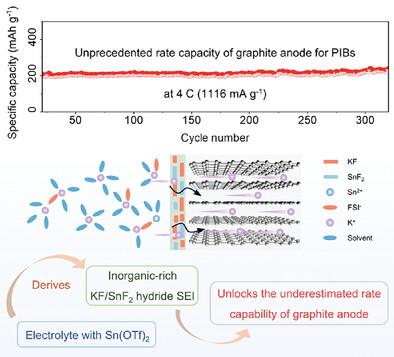
Graphite stands out as the most promising anode material for potassium-ion batteries (PIBs) due to its cost-effectiveness and ideal low-potential platform. However, the perceived poor rate capability of graphite has become a key concern for its commercial application in PIBs. Herein, the above understanding on the poor rate capability of graphite is updated. Without modifying graphite structure, by simply introducing a tin trifluoromethanesulfonate (Sn(OTf)2) additive in phosphate-based electrolyte, the graphite in K||graphite half-cell can deliver a capacity of 240 mAh g−1 at a high rate of 2 C (1 C = 279 mA g−1) and operates for 1000 cycles with negligible degradation. Moreover, an unprecedented rate capacity of ≈200 mAh g−1 for graphite anode at 4 C is achieved in a three-electrode K|K ref|graphite cell configuration where the interference of the K metal counter electrode is eliminated. Unlike structure modification strategies, such remarkable rate performance is originated from the low-impedance inorganic-rich KF/SnF2 hybrid interphase on graphite. Thus, the effectiveness of the electrolyte regulation strategy highlights the underestimated rate capability of graphite anode. This renewed insight dispels the concern regarding the commercial applicability of graphite anode and enriches the advantages of PIBs for high-power density.
石墨因其成本效益和理想的低电位平台而成为钾离子电池最有前途的负极材料。然而,石墨的低速率性能已成为其在PIBs中商业应用的关键问题。在此,更新了上述对石墨不良倍率能力的认识。在不改变石墨结构的情况下,通过在磷酸盐基电解质中简单地引入三氟甲烷磺酸锡(Sn(OTf)2)添加剂,K||石墨半电池中的石墨可以在2c (1c = 279 mA g - 1)的高速率下提供240 mAh g - 1的容量,并且可以运行1000次循环,而降解可以忽略不计。此外,在消除了K金属对电极干扰的三电极K|K ref|石墨电池结构中,石墨阳极在4℃时达到了前所未有的≈200 mAh g−1的倍率容量。与结构修饰策略不同,这种显著的速率性能源于石墨上的低阻抗富无机KF/SnF2杂化界面。因此,电解质调节策略的有效性突出了石墨阳极被低估的速率能力。这一新的见解消除了对石墨阳极商业适用性的担忧,并丰富了pib在高功率密度方面的优势。
期刊介绍:
Established in 2011, Advanced Energy Materials is an international, interdisciplinary, English-language journal that focuses on materials used in energy harvesting, conversion, and storage. It is regarded as a top-quality journal alongside Advanced Materials, Advanced Functional Materials, and Small.
With a 2022 Impact Factor of 27.8, Advanced Energy Materials is considered a prime source for the best energy-related research. The journal covers a wide range of topics in energy-related research, including organic and inorganic photovoltaics, batteries and supercapacitors, fuel cells, hydrogen generation and storage, thermoelectrics, water splitting and photocatalysis, solar fuels and thermosolar power, magnetocalorics, and piezoelectronics.
The readership of Advanced Energy Materials includes materials scientists, chemists, physicists, and engineers in both academia and industry. The journal is indexed in various databases and collections, such as Advanced Technologies & Aerospace Database, FIZ Karlsruhe, INSPEC (IET), Science Citation Index Expanded, Technology Collection, and Web of Science, among others.







 京公网安备 11010802042870号
京ICP备2023020795号-1
京公网安备 11010802042870号
京ICP备2023020795号-1

 分享
分享
 求助内容:
求助内容: 应助结果提醒方式:
 扫码关注我们
