Nina Nouhravesh, Alexander H. Gunn, Derek Cyr, Adrian F. Hernandez, David A. Morrow, Eric J. Velazquez, Jonathan H. Ward, Samiha Sarwat, Kavita Sharma, Kristin M. Williamson, Randall C. Starling, Serge Lepage, Shelley Zieroth, Scott D. Solomon, Robert J. Mentz
{"title":"Sacubitril/valsartan versus valsartan initiation in patients naïve to renin–angiotensin system inhibitors: Insights from PARAGLIDE-HF","authors":"Nina Nouhravesh, Alexander H. Gunn, Derek Cyr, Adrian F. Hernandez, David A. Morrow, Eric J. Velazquez, Jonathan H. Ward, Samiha Sarwat, Kavita Sharma, Kristin M. Williamson, Randall C. Starling, Serge Lepage, Shelley Zieroth, Scott D. Solomon, Robert J. Mentz","doi":"10.1002/ejhf.3579","DOIUrl":null,"url":null,"abstract":"<div>\n \n \n <section>\n \n <h3> Aims</h3>\n \n <p>Whether prior treatment with angiotensin-converting enzyme inhibitors (ACEi) or angiotensin receptor blockers (ARBs) modifies efficacy and safety of sacubitril/valsartan (Sac/Val) in patients with heart failure (HF) and ejection fraction (EF) >40% is unclear, thus Sac/Val according to ACEi/ARB status at baseline was assessed.</p>\n </section>\n \n <section>\n \n <h3> Methods and results</h3>\n \n <p>This was a pre-specified analysis of Prospective comparison of ARNI with ARB Given following stabiLization In DEcompensated HFpEF (PARAGLIDE-HF), a double-blind, randomized controlled trial of Sac/Val versus valsartan, categorizing patients according to baseline ACEi/ARB status. The primary endpoint was time-averaged proportional change in N-terminal pro-B-type natriuretic peptide (NT-proBNP) from baseline through weeks 4 and 8. Secondary analyses included a win-ratio analysis of the hierarchical outcome of (i) cardiovascular death; (ii) HF hospitalizations; (iii) urgent HF visits; and (iv) time-averaged proportional change in NT-proBNP from baseline to weeks 4 and 8, in addition to safety outcomes. Among 466 patients, 107 (23%) were ACEi/ARB naïve at the time of randomization. NT-proBNP favoured Sac/Val irrespective of ACEi/ARB status (naïve: 0.76, 95% confidence interval [CI] 0.51–1.13; users: 0.88, 95% CI 0.74–1.05; <i>p</i><sub>interaction</sub> = 0.52). The win ratio of the hierarchical outcome was 1.13 (95% CI 0.86–1.49) for ACEi/ARB users and 1.38 (95% CI 0.81–2.37) for ACEi/ARB naïve (<i>p</i><sub>interaction</sub> = 0.51). Safety endpoints showed non-significant interactions by ACEi/ARB status, with odds ratio of 1.79 (95% CI 0.68–4.72) and 0.71 (95% CI 0.29–1.78) for symptomatic hypotension and worsening renal function, respectively for ACEi/ARB naïve.</p>\n </section>\n \n <section>\n \n <h3> Conclusion</h3>\n \n <p>In HF with EF >40% stabilized after worsening HF, safety and efficacy were similar irrespective of ACEi/ARB status at baseline, supporting early initiation irrespective of prior ACEi/ARB use.</p>\n </section>\n </div>","PeriodicalId":164,"journal":{"name":"European Journal of Heart Failure","volume":"27 8","pages":"1418-1425"},"PeriodicalIF":10.8000,"publicationDate":"2025-01-10","publicationTypes":"Journal Article","fieldsOfStudy":null,"isOpenAccess":false,"openAccessPdf":"https://onlinelibrary.wiley.com/doi/epdf/10.1002/ejhf.3579","citationCount":"0","resultStr":null,"platform":"Semanticscholar","paperid":null,"PeriodicalName":"European Journal of Heart Failure","FirstCategoryId":"3","ListUrlMain":"https://onlinelibrary.wiley.com/doi/10.1002/ejhf.3579","RegionNum":1,"RegionCategory":"医学","ArticlePicture":[],"TitleCN":null,"AbstractTextCN":null,"PMCID":null,"EPubDate":"","PubModel":"","JCR":"Q1","JCRName":"CARDIAC & CARDIOVASCULAR SYSTEMS","Score":null,"Total":0}
引用次数: 0
Abstract
Aims
Whether prior treatment with angiotensin-converting enzyme inhibitors (ACEi) or angiotensin receptor blockers (ARBs) modifies efficacy and safety of sacubitril/valsartan (Sac/Val) in patients with heart failure (HF) and ejection fraction (EF) >40% is unclear, thus Sac/Val according to ACEi/ARB status at baseline was assessed.
Methods and results
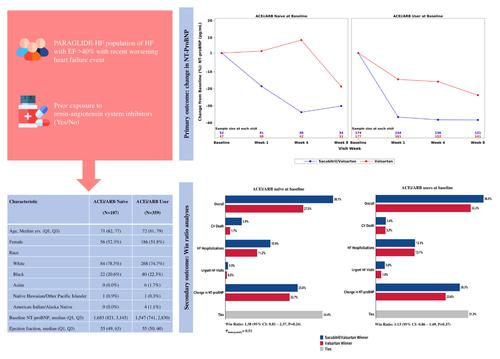
This was a pre-specified analysis of Prospective comparison of ARNI with ARB Given following stabiLization In DEcompensated HFpEF (PARAGLIDE-HF), a double-blind, randomized controlled trial of Sac/Val versus valsartan, categorizing patients according to baseline ACEi/ARB status. The primary endpoint was time-averaged proportional change in N-terminal pro-B-type natriuretic peptide (NT-proBNP) from baseline through weeks 4 and 8. Secondary analyses included a win-ratio analysis of the hierarchical outcome of (i) cardiovascular death; (ii) HF hospitalizations; (iii) urgent HF visits; and (iv) time-averaged proportional change in NT-proBNP from baseline to weeks 4 and 8, in addition to safety outcomes. Among 466 patients, 107 (23%) were ACEi/ARB naïve at the time of randomization. NT-proBNP favoured Sac/Val irrespective of ACEi/ARB status (naïve: 0.76, 95% confidence interval [CI] 0.51–1.13; users: 0.88, 95% CI 0.74–1.05; pinteraction = 0.52). The win ratio of the hierarchical outcome was 1.13 (95% CI 0.86–1.49) for ACEi/ARB users and 1.38 (95% CI 0.81–2.37) for ACEi/ARB naïve (pinteraction = 0.51). Safety endpoints showed non-significant interactions by ACEi/ARB status, with odds ratio of 1.79 (95% CI 0.68–4.72) and 0.71 (95% CI 0.29–1.78) for symptomatic hypotension and worsening renal function, respectively for ACEi/ARB naïve.
Conclusion
In HF with EF >40% stabilized after worsening HF, safety and efficacy were similar irrespective of ACEi/ARB status at baseline, supporting early initiation irrespective of prior ACEi/ARB use.
期刊介绍:
European Journal of Heart Failure is an international journal dedicated to advancing knowledge in the field of heart failure management. The journal publishes reviews and editorials aimed at improving understanding, prevention, investigation, and treatment of heart failure. It covers various disciplines such as molecular and cellular biology, pathology, physiology, electrophysiology, pharmacology, clinical sciences, social sciences, and population sciences. The journal welcomes submissions of manuscripts on basic, clinical, and population sciences, as well as original contributions on nursing, care of the elderly, primary care, health economics, and other related specialist fields. It is published monthly and has a readership that includes cardiologists, emergency room physicians, intensivists, internists, general physicians, cardiac nurses, diabetologists, epidemiologists, basic scientists focusing on cardiovascular research, and those working in rehabilitation. The journal is abstracted and indexed in various databases such as Academic Search, Embase, MEDLINE/PubMed, and Science Citation Index.