Robinson A Yrene-Cubas, Jesus Perez-Castilla, Daniel E Reynaga-Cottle, Maria José Bringas, David R Soriano-Moreno, Daniel Fernandez-Guzman, Jose A Gonzales-Zamora
{"title":"The impact of the COVID-19 pandemic on HIV testing in Peru: an interrupted time series analysis from 2014 to 2022.","authors":"Robinson A Yrene-Cubas, Jesus Perez-Castilla, Daniel E Reynaga-Cottle, Maria José Bringas, David R Soriano-Moreno, Daniel Fernandez-Guzman, Jose A Gonzales-Zamora","doi":"10.1186/s12879-024-10407-y","DOIUrl":null,"url":null,"abstract":"<p><strong>Objectives: </strong>Our objective was to evaluate the impact of COVID-19 on the proportion of past-year HIV testing in Peru.</p><p><strong>Methods: </strong>Utilizing data from the National Demographic and Health Survey of Peru from 2014 to 2022, we conducted an interrupted time series analysis. The proportion of past-year HIV testing per quarter of each year was considered our unit of analysis. Statistical analysis involved segmented regression with Newey-West standard errors, dividing each year of evaluation into four quarters. Additionally, we applied an Autoregressive Integrated Moving Average (ARIMA) model.</p><p><strong>Results: </strong>We included 211,359 participants aged 15 to 49 years. The proportion of past-year HIV testing in Peru showed a mean decrease of 8.33% (95%CI: -10.73% to -5.93%) after the COVID-19 lockdown (from August-2020) compared to the previous period (before March-2020). Prior to lockdown, there was a mean quarterly increase of 0.30% (95%CI: 0.21-0.40%) in testing proportion, while after the lockdown, there was a mean quarterly decrease of -0.24% (95%CI: -0.56-0.09%). HIV testing declined in 23 of the 25 regions, ranging from - 23.7% to -3.0%, except in Amazonas and Cajamarca, where increases of 5.3% and 6.8% were observed. Predictions of counterfactual values without the pandemic using the ARIMA model revealed a percentage drop of -9.20% (95%CI: -13.70 to -4.80) in observed compared to predicted values.</p><p><strong>Conclusions: </strong>This study highlights the decrease in proportion of past-year HIV testing in Peru following the COVID-19 lockdown, emphasizing the urgent need for targeted interventions to address disparities and ensure equitable access to testing services.</p>","PeriodicalId":8981,"journal":{"name":"BMC Infectious Diseases","volume":"25 1","pages":"39"},"PeriodicalIF":3.0000,"publicationDate":"2025-01-07","publicationTypes":"Journal Article","fieldsOfStudy":null,"isOpenAccess":false,"openAccessPdf":"https://www.ncbi.nlm.nih.gov/pmc/articles/PMC11707859/pdf/","citationCount":"0","resultStr":null,"platform":"Semanticscholar","paperid":null,"PeriodicalName":"BMC Infectious Diseases","FirstCategoryId":"3","ListUrlMain":"https://doi.org/10.1186/s12879-024-10407-y","RegionNum":3,"RegionCategory":"医学","ArticlePicture":[],"TitleCN":null,"AbstractTextCN":null,"PMCID":null,"EPubDate":"","PubModel":"","JCR":"Q2","JCRName":"INFECTIOUS DISEASES","Score":null,"Total":0}
引用次数: 0
Abstract
Objectives: Our objective was to evaluate the impact of COVID-19 on the proportion of past-year HIV testing in Peru.
Methods: Utilizing data from the National Demographic and Health Survey of Peru from 2014 to 2022, we conducted an interrupted time series analysis. The proportion of past-year HIV testing per quarter of each year was considered our unit of analysis. Statistical analysis involved segmented regression with Newey-West standard errors, dividing each year of evaluation into four quarters. Additionally, we applied an Autoregressive Integrated Moving Average (ARIMA) model.
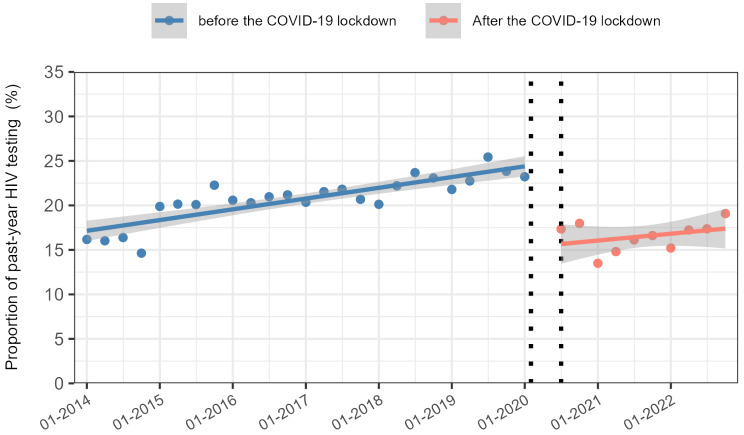
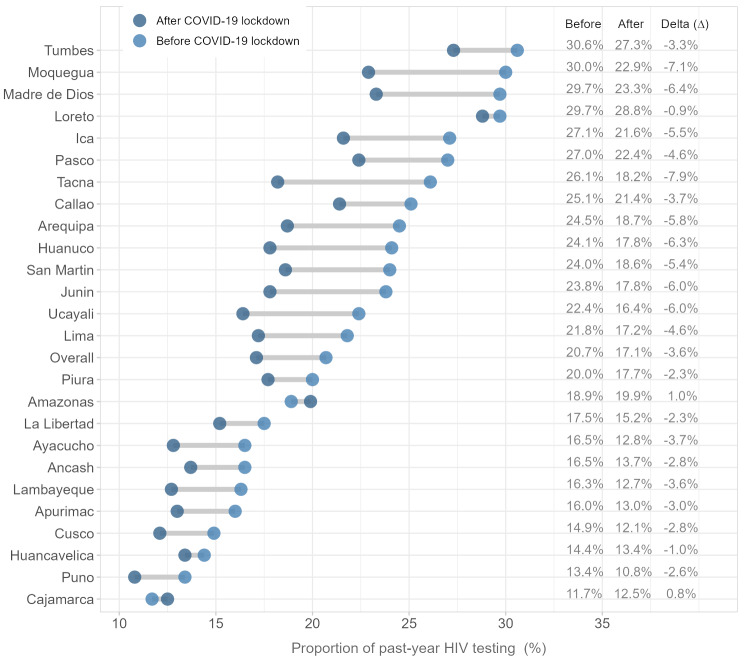
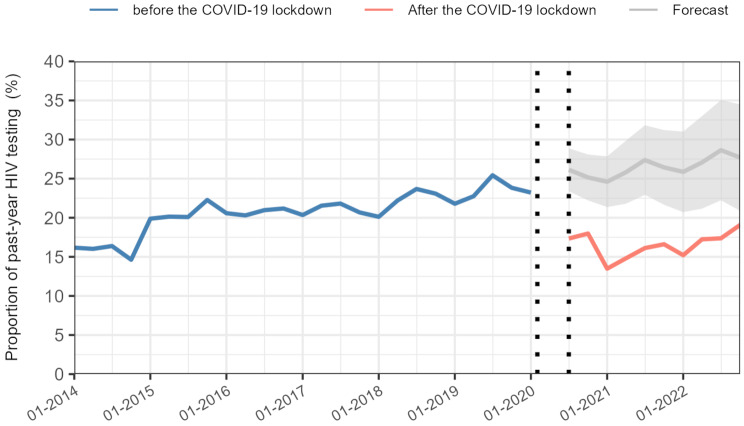
Results: We included 211,359 participants aged 15 to 49 years. The proportion of past-year HIV testing in Peru showed a mean decrease of 8.33% (95%CI: -10.73% to -5.93%) after the COVID-19 lockdown (from August-2020) compared to the previous period (before March-2020). Prior to lockdown, there was a mean quarterly increase of 0.30% (95%CI: 0.21-0.40%) in testing proportion, while after the lockdown, there was a mean quarterly decrease of -0.24% (95%CI: -0.56-0.09%). HIV testing declined in 23 of the 25 regions, ranging from - 23.7% to -3.0%, except in Amazonas and Cajamarca, where increases of 5.3% and 6.8% were observed. Predictions of counterfactual values without the pandemic using the ARIMA model revealed a percentage drop of -9.20% (95%CI: -13.70 to -4.80) in observed compared to predicted values.
Conclusions: This study highlights the decrease in proportion of past-year HIV testing in Peru following the COVID-19 lockdown, emphasizing the urgent need for targeted interventions to address disparities and ensure equitable access to testing services.
期刊介绍:
BMC Infectious Diseases is an open access, peer-reviewed journal that considers articles on all aspects of the prevention, diagnosis and management of infectious and sexually transmitted diseases in humans, as well as related molecular genetics, pathophysiology, and epidemiology.




 京公网安备 11010802042870号
京ICP备2023020795号-1
京公网安备 11010802042870号
京ICP备2023020795号-1

 分享
分享
 求助内容:
求助内容: 应助结果提醒方式:
 扫码关注我们
