{"title":"The association of Helicobacter pylori infection with the risk of anemia in children: systematic review and meta-analysis.","authors":"Muluken Walle, Addisu Tesfaye, Melaku Mekonnen Agidew, Muluken Semaw, Surafel Mekuria, Fasil Getu","doi":"10.1186/s12879-024-10427-8","DOIUrl":null,"url":null,"abstract":"<p><strong>Background: </strong>Children are among the most vulnerable groups for Helicobacter pylori (H. pylori) infection, which was linked with an increased risk of anemia. H. pylori infection may cause the development of anemia through affecting the absorption of different micronutrients and increasing hepcidin production from hepatocytes. This study aimed to assess the effect of H. pylori infection on the occurrence of anemia in children.</p><p><strong>Methodology: </strong>Previously published articles were systematically searched on major databases including Science Direct, PubMed, Embase, Scopus, Cochrane Library, and Science Citation Index using search terms. The search results were imported into EndNote X9 to organize and remove duplicates. Then, relevant data was extracted and analyzed using STATA version 16.0. The pooled odds ratio (OR) was calculated to evaluate the associations of H. pylori infection with Anemia. Moreover, pooled standardized mean difference (SMD) of Hemoglobin (Hgb) and Serum ferritin (SF) levels between cases and controls were calculated for group comparisons.</p><p><strong>Results: </strong>A total of nine published articles were included in this study. The result showed that H. pylori-infected children had 2.68 times more risk of developing anemia compared to H. pylori-negative children (OR: 2.68:95% CI:1.44-4.99, p = 0.002). Subgroup analyses based on study design showed an increased significant association between H. pylori infection and anemia among case-control studies (OR:3.792:95%CI;1.767, 8.142, p = 0.001). Subgroup analyses based on the H. pylori detection method indicated an increased significant association between H. pylori infection and anemia when the stool antigen test method was used (OR:3.801;95%CI:1.090,13.250, p = 0.036). Moreover, there was a significant decrement of Hgb and SF levels in the H. pylori positive group compared to the negative group with SMD of -0.54(95%CI: -0.65, -0.42, p < 0.001) and - 0.49(95% CI: -0.91, -0.08, p < 0.020), respectively.</p><p><strong>Conclusions: </strong>This study revealed that children with H. pylori infection are at a higher risk of developing anemia as compared to non-infected children. Moreover, the observed decrease in Hgb and SF levels in infected children suggests that H. pylori may contribute to the development of anemia. Future research need to focus on the mechanisms by which H. pylori infection contributes to anemia, as well as the potential benefits of targeted interventions in reducing both H. pylori prevalence and anemia rates in children.</p>","PeriodicalId":8981,"journal":{"name":"BMC Infectious Diseases","volume":"25 1","pages":"23"},"PeriodicalIF":3.0000,"publicationDate":"2025-01-06","publicationTypes":"Journal Article","fieldsOfStudy":null,"isOpenAccess":false,"openAccessPdf":"https://www.ncbi.nlm.nih.gov/pmc/articles/PMC11702240/pdf/","citationCount":"0","resultStr":null,"platform":"Semanticscholar","paperid":null,"PeriodicalName":"BMC Infectious Diseases","FirstCategoryId":"3","ListUrlMain":"https://doi.org/10.1186/s12879-024-10427-8","RegionNum":3,"RegionCategory":"医学","ArticlePicture":[],"TitleCN":null,"AbstractTextCN":null,"PMCID":null,"EPubDate":"","PubModel":"","JCR":"Q2","JCRName":"INFECTIOUS DISEASES","Score":null,"Total":0}
引用次数: 0
Abstract
Background: Children are among the most vulnerable groups for Helicobacter pylori (H. pylori) infection, which was linked with an increased risk of anemia. H. pylori infection may cause the development of anemia through affecting the absorption of different micronutrients and increasing hepcidin production from hepatocytes. This study aimed to assess the effect of H. pylori infection on the occurrence of anemia in children.
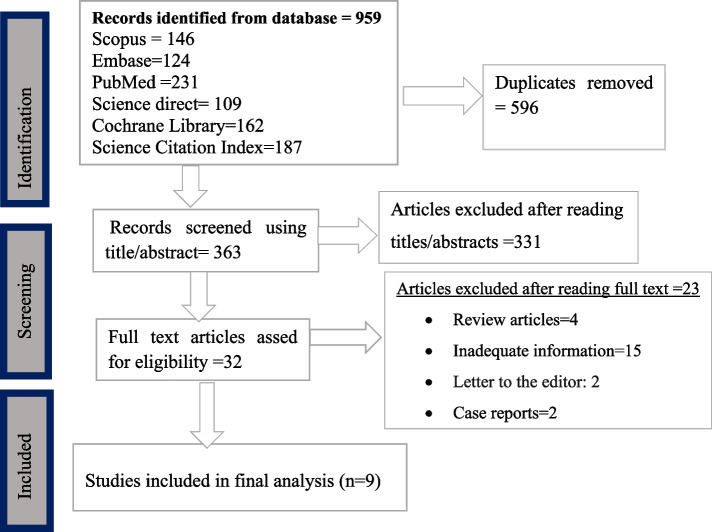
Methodology: Previously published articles were systematically searched on major databases including Science Direct, PubMed, Embase, Scopus, Cochrane Library, and Science Citation Index using search terms. The search results were imported into EndNote X9 to organize and remove duplicates. Then, relevant data was extracted and analyzed using STATA version 16.0. The pooled odds ratio (OR) was calculated to evaluate the associations of H. pylori infection with Anemia. Moreover, pooled standardized mean difference (SMD) of Hemoglobin (Hgb) and Serum ferritin (SF) levels between cases and controls were calculated for group comparisons.
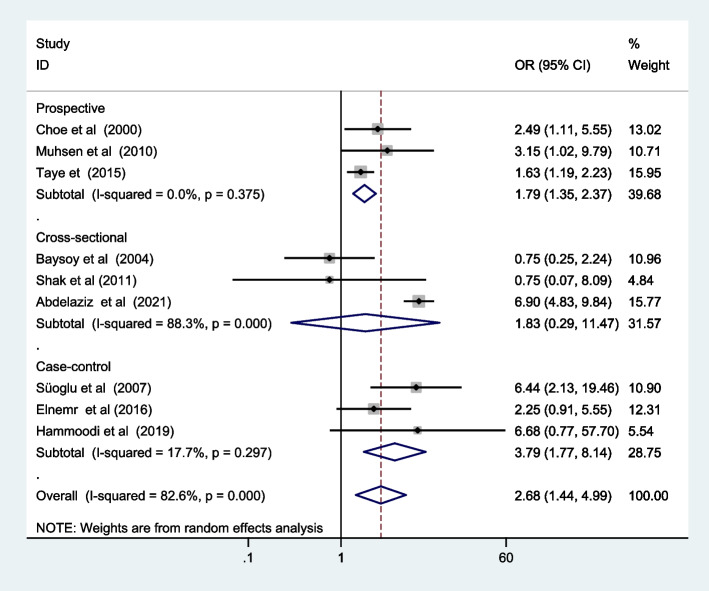
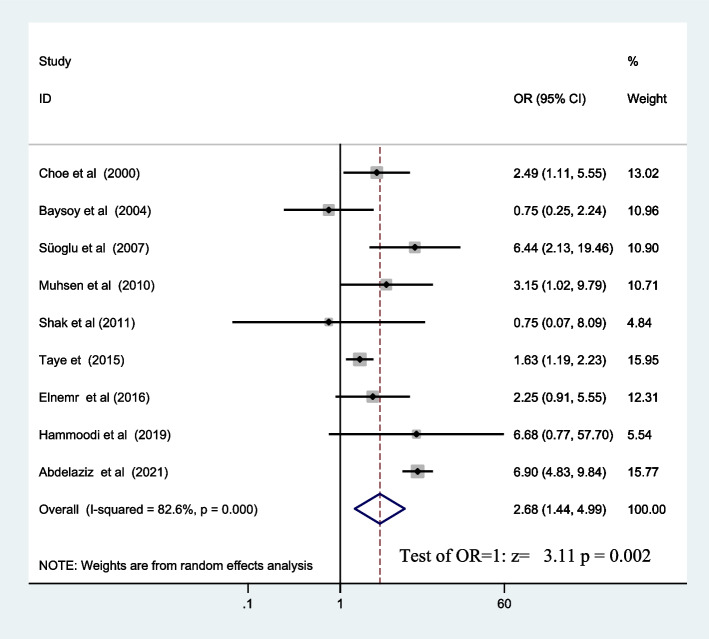
Results: A total of nine published articles were included in this study. The result showed that H. pylori-infected children had 2.68 times more risk of developing anemia compared to H. pylori-negative children (OR: 2.68:95% CI:1.44-4.99, p = 0.002). Subgroup analyses based on study design showed an increased significant association between H. pylori infection and anemia among case-control studies (OR:3.792:95%CI;1.767, 8.142, p = 0.001). Subgroup analyses based on the H. pylori detection method indicated an increased significant association between H. pylori infection and anemia when the stool antigen test method was used (OR:3.801;95%CI:1.090,13.250, p = 0.036). Moreover, there was a significant decrement of Hgb and SF levels in the H. pylori positive group compared to the negative group with SMD of -0.54(95%CI: -0.65, -0.42, p < 0.001) and - 0.49(95% CI: -0.91, -0.08, p < 0.020), respectively.
Conclusions: This study revealed that children with H. pylori infection are at a higher risk of developing anemia as compared to non-infected children. Moreover, the observed decrease in Hgb and SF levels in infected children suggests that H. pylori may contribute to the development of anemia. Future research need to focus on the mechanisms by which H. pylori infection contributes to anemia, as well as the potential benefits of targeted interventions in reducing both H. pylori prevalence and anemia rates in children.
期刊介绍:
BMC Infectious Diseases is an open access, peer-reviewed journal that considers articles on all aspects of the prevention, diagnosis and management of infectious and sexually transmitted diseases in humans, as well as related molecular genetics, pathophysiology, and epidemiology.



 京公网安备 11010802042870号
京ICP备2023020795号-1
京公网安备 11010802042870号
京ICP备2023020795号-1

 分享
分享
 求助内容:
求助内容: 应助结果提醒方式:
 扫码关注我们
