{"title":"A Digital Program for Daily Life Management With Endometriosis: Pilot Cohort Study on Symptoms and Quality of Life Among Participants.","authors":"Zélia Breton, Emilie Stern, Mathilde Pinault, Delphine Lhuillery, Erick Petit, Pierre Panel, Maïa Alexaline","doi":"10.2196/58262","DOIUrl":null,"url":null,"abstract":"<p><strong>Background: </strong>After experiencing symptoms for an average of 7 years before diagnosis, patients with endometriosis are usually left with more questions than answers about managing their symptoms in the absence of a cure. To help women with endometriosis after their diagnosis, we developed a digital program combining user research, evidence-based medicine, and clinical expertise. Structured around cognitive behavioral therapy and the quality of life metrics from the Endometriosis Health Profile score, the program was designed to guide participants for 3 months.</p><p><strong>Objective: </strong>This cohort study was designed to measure the impact of a digital health program on the symptoms and quality of life levels of women with endometriosis.</p><p><strong>Methods: </strong>In total, 63% (92/146) of the participants were included in the pilot study, recruited either free of charge through employer health insurance or via individual direct access. A control group of 404 women with endometriosis who did not follow the program, recruited through social media and mailing campaigns, was sampled (n=149, 36.9%) according to initial pain levels to ensure a similar pain profile to participants. Questionnaires assessing quality of life and symptom levels were emailed to both groups at baseline and 3 months. Descriptive statistics and statistical tests were used to analyze intragroup and intergroup differences, with Cohen d measuring effect sizes for significant results.</p><p><strong>Results: </strong>Over 3 months, participants showed substantial improvements in global symptom burden, general pain level, anxiety, depression, dysmenorrhea, dysuria, chronic fatigue, neuropathic pain, and endo belly. These improvements were significantly different from the control group for global symptom burden (participants: mean -0.7, SD 1.6; controls: mean -0.3, SD 1.3; P=.048; small effect size), anxiety (participants: mean -1.1, SD 2.8; controls: mean 0.2, SD 2.5; P<.001; medium effect size), depression (participants: mean -0.9, SD 2.5; controls: mean 0.0, SD 3.1; P=.04; small effect size), neuropathic pain (participants: mean -1.0, SD 2.7; controls: mean -0.1, SD 2.6; P=.004; small effect size), and endo belly (participants: mean -0.9, SD 2.5; controls: mean -0.3, SD 2.4; P=.03; small effect size). Participants' quality of life improved between baseline and 3 months and significantly differed from that of the control group for the core part of the Endometriosis Health Profile-5 (participants: mean -5.9, SD 21.0; controls: mean 1.0, SD 14.8; P=.03; small effect size) and the EQ-5D (participants: mean 0.1, SD 0.1; controls: mean -0.0, SD 0.1; P=.001; medium effect size). Perceived knowledge of endometriosis was significantly greater at 3 months among participants compared to the control group (P<.001).</p><p><strong>Conclusions: </strong>This study's results suggest that a digital health program providing medical and scientific information about endometriosis and multidisciplinary self-management tools may be useful to reduce global symptom burden, anxiety, depression, neuropathic pain, and endo belly while improving knowledge on endometriosis and quality of life among participants.</p>","PeriodicalId":14841,"journal":{"name":"JMIR Formative Research","volume":" ","pages":"e58262"},"PeriodicalIF":2.0000,"publicationDate":"2025-02-28","publicationTypes":"Journal Article","fieldsOfStudy":null,"isOpenAccess":false,"openAccessPdf":"https://www.ncbi.nlm.nih.gov/pmc/articles/PMC11909486/pdf/","citationCount":"0","resultStr":null,"platform":"Semanticscholar","paperid":null,"PeriodicalName":"JMIR Formative Research","FirstCategoryId":"1085","ListUrlMain":"https://doi.org/10.2196/58262","RegionNum":0,"RegionCategory":null,"ArticlePicture":[],"TitleCN":null,"AbstractTextCN":null,"PMCID":null,"EPubDate":"","PubModel":"","JCR":"Q3","JCRName":"HEALTH CARE SCIENCES & SERVICES","Score":null,"Total":0}
引用次数: 0
Abstract
Background: After experiencing symptoms for an average of 7 years before diagnosis, patients with endometriosis are usually left with more questions than answers about managing their symptoms in the absence of a cure. To help women with endometriosis after their diagnosis, we developed a digital program combining user research, evidence-based medicine, and clinical expertise. Structured around cognitive behavioral therapy and the quality of life metrics from the Endometriosis Health Profile score, the program was designed to guide participants for 3 months.
Objective: This cohort study was designed to measure the impact of a digital health program on the symptoms and quality of life levels of women with endometriosis.
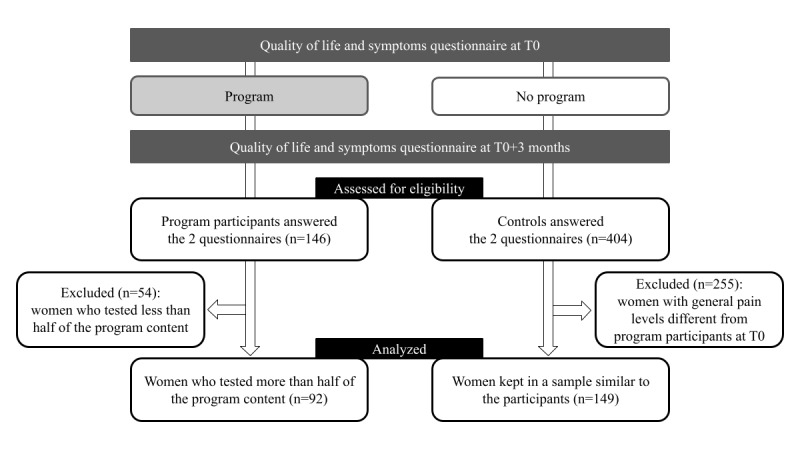
Methods: In total, 63% (92/146) of the participants were included in the pilot study, recruited either free of charge through employer health insurance or via individual direct access. A control group of 404 women with endometriosis who did not follow the program, recruited through social media and mailing campaigns, was sampled (n=149, 36.9%) according to initial pain levels to ensure a similar pain profile to participants. Questionnaires assessing quality of life and symptom levels were emailed to both groups at baseline and 3 months. Descriptive statistics and statistical tests were used to analyze intragroup and intergroup differences, with Cohen d measuring effect sizes for significant results.
Results: Over 3 months, participants showed substantial improvements in global symptom burden, general pain level, anxiety, depression, dysmenorrhea, dysuria, chronic fatigue, neuropathic pain, and endo belly. These improvements were significantly different from the control group for global symptom burden (participants: mean -0.7, SD 1.6; controls: mean -0.3, SD 1.3; P=.048; small effect size), anxiety (participants: mean -1.1, SD 2.8; controls: mean 0.2, SD 2.5; P<.001; medium effect size), depression (participants: mean -0.9, SD 2.5; controls: mean 0.0, SD 3.1; P=.04; small effect size), neuropathic pain (participants: mean -1.0, SD 2.7; controls: mean -0.1, SD 2.6; P=.004; small effect size), and endo belly (participants: mean -0.9, SD 2.5; controls: mean -0.3, SD 2.4; P=.03; small effect size). Participants' quality of life improved between baseline and 3 months and significantly differed from that of the control group for the core part of the Endometriosis Health Profile-5 (participants: mean -5.9, SD 21.0; controls: mean 1.0, SD 14.8; P=.03; small effect size) and the EQ-5D (participants: mean 0.1, SD 0.1; controls: mean -0.0, SD 0.1; P=.001; medium effect size). Perceived knowledge of endometriosis was significantly greater at 3 months among participants compared to the control group (P<.001).
Conclusions: This study's results suggest that a digital health program providing medical and scientific information about endometriosis and multidisciplinary self-management tools may be useful to reduce global symptom burden, anxiety, depression, neuropathic pain, and endo belly while improving knowledge on endometriosis and quality of life among participants.





 京公网安备 11010802042870号
京ICP备2023020795号-1
京公网安备 11010802042870号
京ICP备2023020795号-1

 分享
分享
 求助内容:
求助内容: 应助结果提醒方式:
 扫码关注我们
