Akashlal M, Pratibha P Nair, Devi R Nair, Azeem Ahmad, B Chandrasekhararao, D Sudhakar, Srikanth Narayanam, Rabinarayan Acharya
{"title":"A Systematic Review on Safety and Efficacy of Ayurvedic Interventions in Hemiplegia (<i>Pakshaghata</i>).","authors":"Akashlal M, Pratibha P Nair, Devi R Nair, Azeem Ahmad, B Chandrasekhararao, D Sudhakar, Srikanth Narayanam, Rabinarayan Acharya","doi":"10.1177/2515690X241304523","DOIUrl":null,"url":null,"abstract":"<p><p>The study's objective is to conduct a comprehensive systematic review for assessing the safety and efficacy of Ayurvedic interventions in managing hemiplegia/Pakshaghata. The study involved a search across multiple online databases and online clinical trial registries. Additionally, major Ayurveda postgraduate institutes were contacted to acquire unpublished trial data related to hemiplegia/Pakshaghata. The review covered articles published until July 2023. Two reviewers independently performed data extraction and risk of bias assessment. The risk of bias assessment utilised the RoB 2 tool for randomised trials and the ROBINS-I tool for non-randomised trials. The screening process identified 28 articles from online databases and two dissertations from online repositories. However, practical challenges prevented access to grey literature from Ayurveda institutes. The 30 studies selected for this review, comprises nine randomised controlled trials (RCTs), eight non-randomised comparative trials, and thirteen pre-post studies. Quantitative analysis was unfeasible due to inadequate studies, leading to a qualitative analysis. All studies, except one, exhibited substantial bias upon risk of bias assessment. Moreover, most studies demonstrated methodological weaknesses attributed to a lack of masking, improper sampling techniques, non-validated outcome measurement tools, inadequate follow-up procedures, and confounding factors. The trials frequently did not document safety parameters, adverse events (AE), and adverse drug reactions (ADR). Current review could not definitively establish the efficacy and safety of Ayurvedic interventions in hemiplegia/Pakshaghata. Hence, the authors strongly advocate for good quality research incorporating proper methodology.</p>","PeriodicalId":15714,"journal":{"name":"Journal of Evidence-based Integrative Medicine","volume":"30 ","pages":"2515690X241304523"},"PeriodicalIF":3.3000,"publicationDate":"2025-01-01","publicationTypes":"Journal Article","fieldsOfStudy":null,"isOpenAccess":false,"openAccessPdf":"https://www.ncbi.nlm.nih.gov/pmc/articles/PMC11705355/pdf/","citationCount":"0","resultStr":null,"platform":"Semanticscholar","paperid":null,"PeriodicalName":"Journal of Evidence-based Integrative Medicine","FirstCategoryId":"1085","ListUrlMain":"https://doi.org/10.1177/2515690X241304523","RegionNum":0,"RegionCategory":null,"ArticlePicture":[],"TitleCN":null,"AbstractTextCN":null,"PMCID":null,"EPubDate":"","PubModel":"","JCR":"Q1","JCRName":"INTEGRATIVE & COMPLEMENTARY MEDICINE","Score":null,"Total":0}
引用次数: 0
Abstract
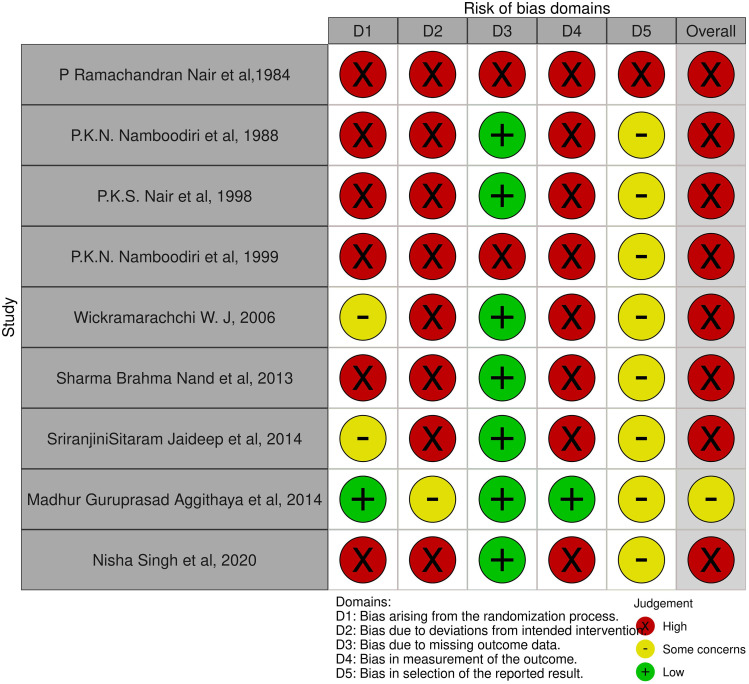
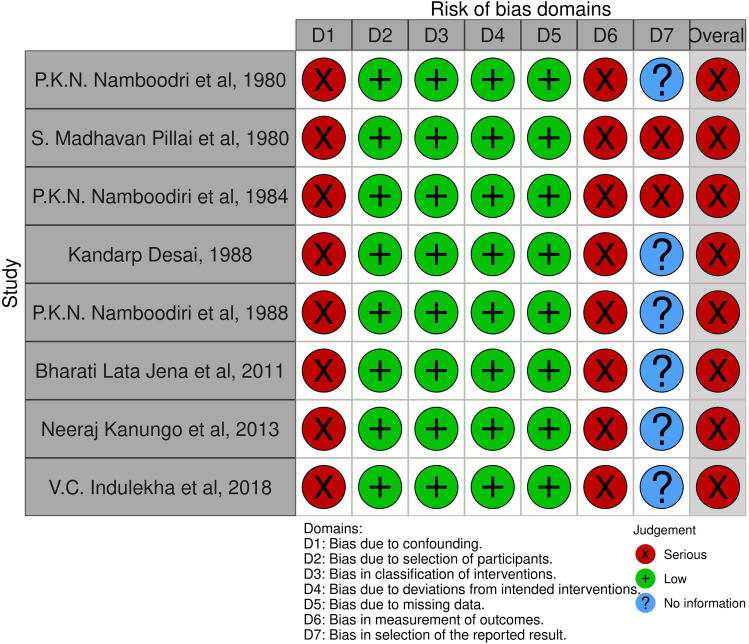
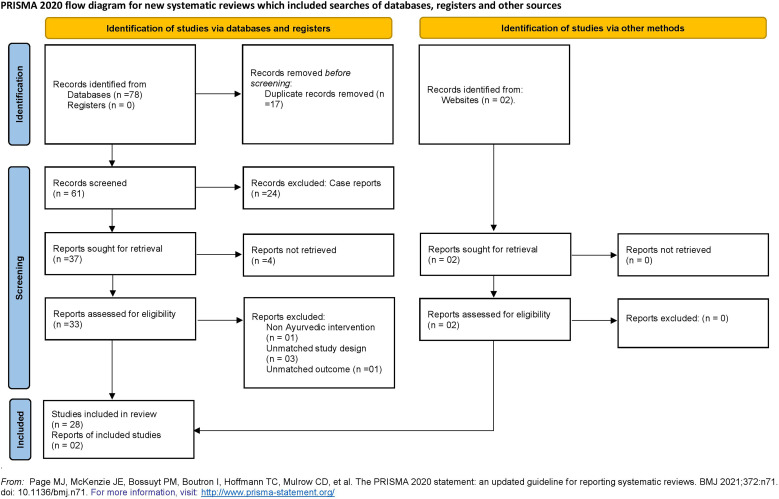
The study's objective is to conduct a comprehensive systematic review for assessing the safety and efficacy of Ayurvedic interventions in managing hemiplegia/Pakshaghata. The study involved a search across multiple online databases and online clinical trial registries. Additionally, major Ayurveda postgraduate institutes were contacted to acquire unpublished trial data related to hemiplegia/Pakshaghata. The review covered articles published until July 2023. Two reviewers independently performed data extraction and risk of bias assessment. The risk of bias assessment utilised the RoB 2 tool for randomised trials and the ROBINS-I tool for non-randomised trials. The screening process identified 28 articles from online databases and two dissertations from online repositories. However, practical challenges prevented access to grey literature from Ayurveda institutes. The 30 studies selected for this review, comprises nine randomised controlled trials (RCTs), eight non-randomised comparative trials, and thirteen pre-post studies. Quantitative analysis was unfeasible due to inadequate studies, leading to a qualitative analysis. All studies, except one, exhibited substantial bias upon risk of bias assessment. Moreover, most studies demonstrated methodological weaknesses attributed to a lack of masking, improper sampling techniques, non-validated outcome measurement tools, inadequate follow-up procedures, and confounding factors. The trials frequently did not document safety parameters, adverse events (AE), and adverse drug reactions (ADR). Current review could not definitively establish the efficacy and safety of Ayurvedic interventions in hemiplegia/Pakshaghata. Hence, the authors strongly advocate for good quality research incorporating proper methodology.




 京公网安备 11010802042870号
京ICP备2023020795号-1
京公网安备 11010802042870号
京ICP备2023020795号-1

 分享
分享
 求助内容:
求助内容: 应助结果提醒方式:
 扫码关注我们
