Effect of statins and antihyperglycemics on chronic kidney disease in patients with type 2 diabetes mellitus: a retrospective cohort study with a 12-year follow-up.
Ammar Abdulrahman Jairoun, Chong Chee Ping, Baharudin Ibrahim, Dina Farhan Al Jawamis, Asma Khaled Al Jaberi, Tasnim Dawoud, Khuloud Jamal Mohammed, Faris El-Dahiyat, Moyad Shahwan
{"title":"Effect of statins and antihyperglycemics on chronic kidney disease in patients with type 2 diabetes mellitus: a retrospective cohort study with a 12-year follow-up.","authors":"Ammar Abdulrahman Jairoun, Chong Chee Ping, Baharudin Ibrahim, Dina Farhan Al Jawamis, Asma Khaled Al Jaberi, Tasnim Dawoud, Khuloud Jamal Mohammed, Faris El-Dahiyat, Moyad Shahwan","doi":"10.1080/20523211.2024.2414293","DOIUrl":null,"url":null,"abstract":"<p><strong>Background: </strong>Chronic Kidney Disease (CKD) represents a significant worldwide health challenge, with far-reaching implications for both patients and healthcare systems. This study aimed to identify the incidence of CKD at stages 3-5, analyzed the impact of statin and other antihyperglycemic interventions, on the CKD progression in individuals with T2DM.</p><p><strong>Methods: </strong>This was a single-center retrospective cohort study based on data derived from electronic medical records (EMR) of UAE populations with diabetes mellitus, registered at outpatient clinics at Tawam Hospital in Al Ain, UAE, between January 2011 and December 2021. T2DM patients aged ≥ 18 years who had serum HbA1c level ≥ 6.5% and using one of the statin therapies were inclusion criteria. Patients with T1DM, who had undergone permanent renal replacement therapy, with under 1 year of follow-up and missing or incomplete data were excluded from the study. The collected data encompassed socio-demographics, detailed medical history, anthropometric measurements, laboratory analyses, clinical parameters, disease characteristics, and medications.</p><p><strong>Results: </strong>Our study included a cohort of 1,003 individuals. We observed 388 subjects developed CKD stages 3-5 across an average monitoring duration of 11.7 years. This resulted in a cumulative incidence of 38.7%, translating to an incidence rate of 38 cases per 1000 person-years. There was a statistically significant difference in the cumulative incidence of CKD stages 3 ± 5 according to statin therapy (<i>P</i> = 0.047). High intensity statin users are more likely to develop a CKD stage 3-5 compared to low/moderate intensity users and to no statin users respectively (44.3% vs 37.9%), (44.3% vs 30.9%). Conversely, the use of Biguanides was associated with a decreased probability of CKD progression (37.9% vs. 52.8%; <i>P</i> = 0.001), whereas Insulin users demonstrated a heightened risk (54.2% vs. 34.1%; <i>P</i> < 0.001).</p><p><strong>Conclusion: </strong>The findings emphasise the pivotal role of personalised treatment strategies, particularly concerning statin therapy and other medications, in populations at high risk.</p>","PeriodicalId":16740,"journal":{"name":"Journal of Pharmaceutical Policy and Practice","volume":"18 1","pages":"2414293"},"PeriodicalIF":2.5000,"publicationDate":"2024-12-20","publicationTypes":"Journal Article","fieldsOfStudy":null,"isOpenAccess":false,"openAccessPdf":"https://www.ncbi.nlm.nih.gov/pmc/articles/PMC11703420/pdf/","citationCount":"0","resultStr":null,"platform":"Semanticscholar","paperid":null,"PeriodicalName":"Journal of Pharmaceutical Policy and Practice","FirstCategoryId":"1085","ListUrlMain":"https://doi.org/10.1080/20523211.2024.2414293","RegionNum":0,"RegionCategory":null,"ArticlePicture":[],"TitleCN":null,"AbstractTextCN":null,"PMCID":null,"EPubDate":"2025/1/1 0:00:00","PubModel":"eCollection","JCR":"Q1","JCRName":"HEALTH POLICY & SERVICES","Score":null,"Total":0}
引用次数: 0
Abstract
Background: Chronic Kidney Disease (CKD) represents a significant worldwide health challenge, with far-reaching implications for both patients and healthcare systems. This study aimed to identify the incidence of CKD at stages 3-5, analyzed the impact of statin and other antihyperglycemic interventions, on the CKD progression in individuals with T2DM.
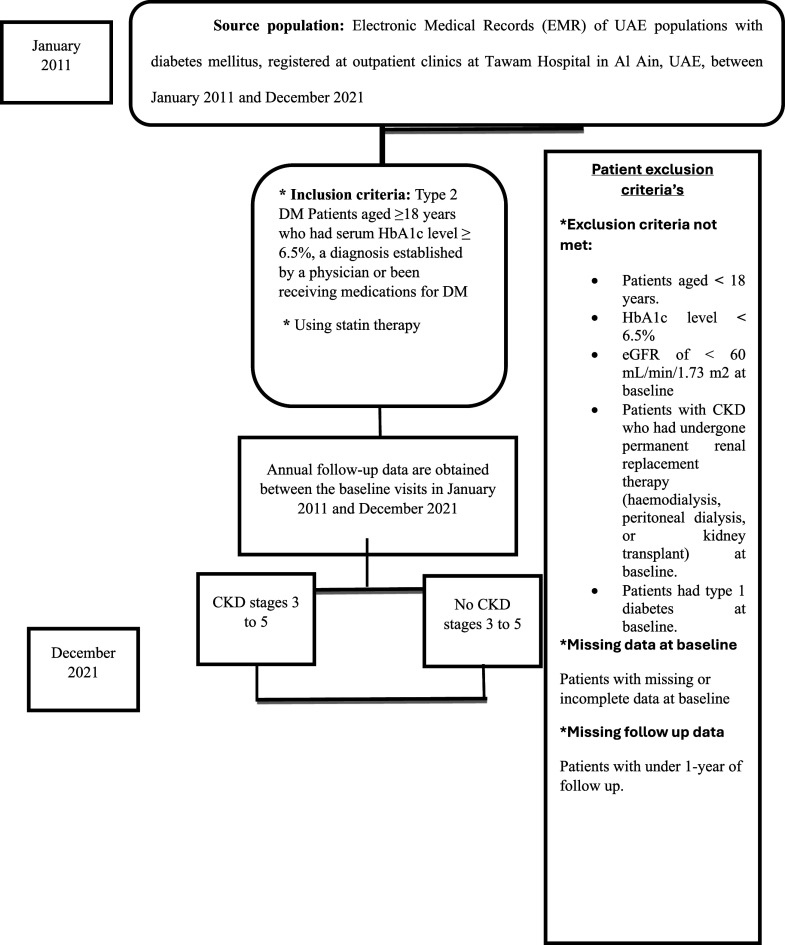
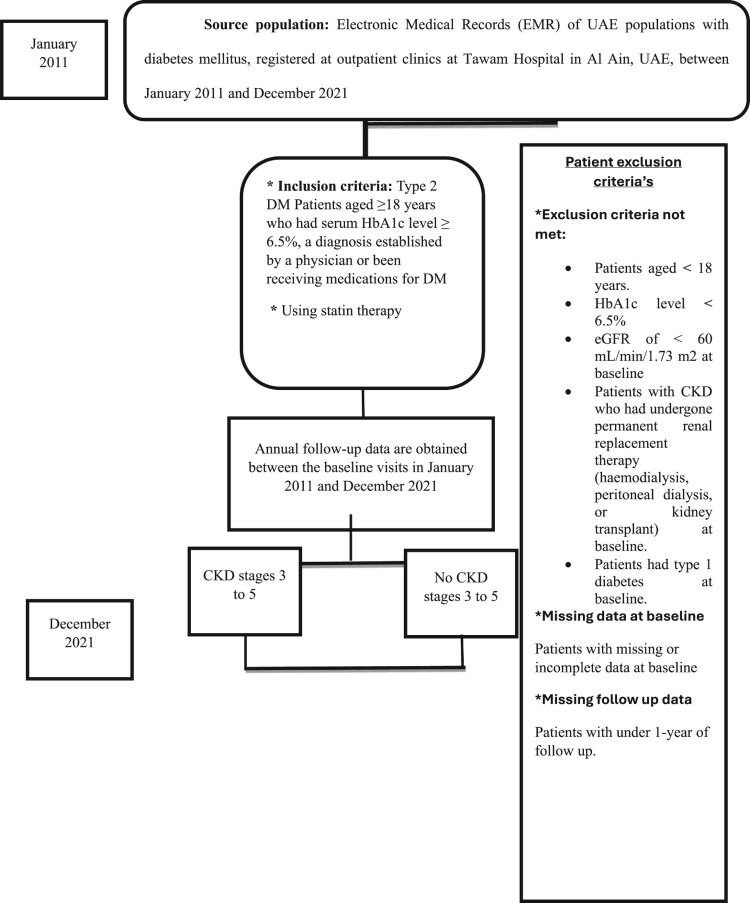
Methods: This was a single-center retrospective cohort study based on data derived from electronic medical records (EMR) of UAE populations with diabetes mellitus, registered at outpatient clinics at Tawam Hospital in Al Ain, UAE, between January 2011 and December 2021. T2DM patients aged ≥ 18 years who had serum HbA1c level ≥ 6.5% and using one of the statin therapies were inclusion criteria. Patients with T1DM, who had undergone permanent renal replacement therapy, with under 1 year of follow-up and missing or incomplete data were excluded from the study. The collected data encompassed socio-demographics, detailed medical history, anthropometric measurements, laboratory analyses, clinical parameters, disease characteristics, and medications.
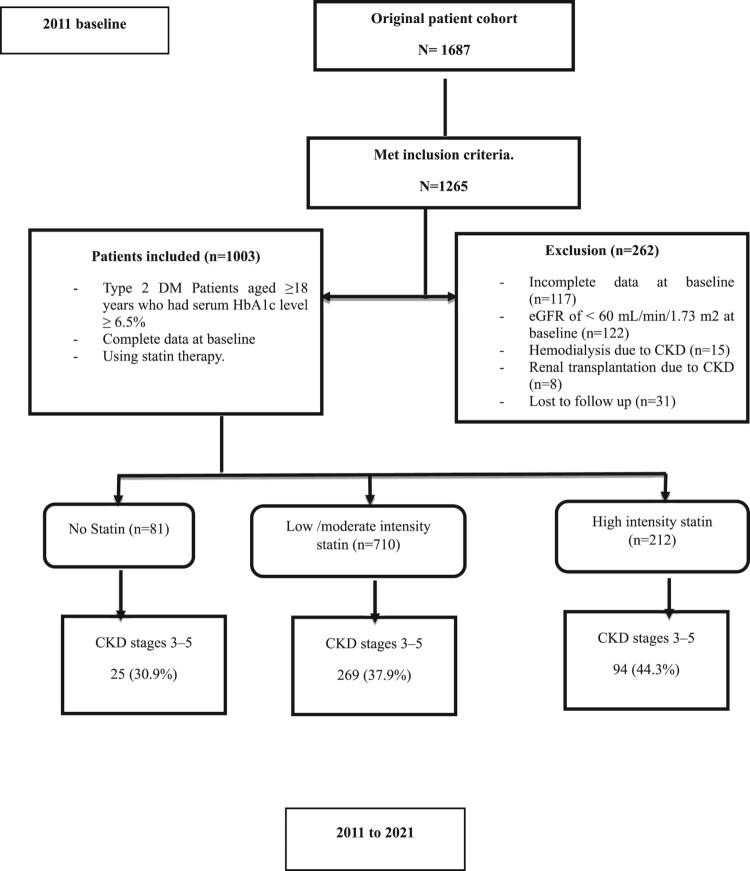
Results: Our study included a cohort of 1,003 individuals. We observed 388 subjects developed CKD stages 3-5 across an average monitoring duration of 11.7 years. This resulted in a cumulative incidence of 38.7%, translating to an incidence rate of 38 cases per 1000 person-years. There was a statistically significant difference in the cumulative incidence of CKD stages 3 ± 5 according to statin therapy (P = 0.047). High intensity statin users are more likely to develop a CKD stage 3-5 compared to low/moderate intensity users and to no statin users respectively (44.3% vs 37.9%), (44.3% vs 30.9%). Conversely, the use of Biguanides was associated with a decreased probability of CKD progression (37.9% vs. 52.8%; P = 0.001), whereas Insulin users demonstrated a heightened risk (54.2% vs. 34.1%; P < 0.001).
Conclusion: The findings emphasise the pivotal role of personalised treatment strategies, particularly concerning statin therapy and other medications, in populations at high risk.
背景:慢性肾脏疾病(CKD)是一项重大的全球健康挑战,对患者和医疗保健系统都有深远的影响。本研究旨在确定3-5期CKD的发生率,分析他汀类药物和其他降糖干预措施对T2DM患者CKD进展的影响。方法:这是一项单中心回顾性队列研究,基于2011年1月至2021年12月期间在阿联酋Al Ain Tawam医院门诊登记的阿联酋糖尿病患者电子病历(EMR)数据。年龄≥18岁且血清HbA1c水平≥6.5%且使用他汀类药物之一的T2DM患者为纳入标准。接受过永久性肾脏替代治疗的T1DM患者,随访时间少于1年,数据缺失或不完整的患者被排除在研究之外。收集的数据包括社会人口统计学、详细的病史、人体测量、实验室分析、临床参数、疾病特征和药物。结果:我们的研究纳入了1003人的队列。我们观察到388名受试者在11.7年的平均监测时间内发展为CKD 3-5期。这导致累计发病率为38.7%,相当于每1000人年38例的发病率。两组CKD 3±5期累积发病率差异有统计学意义(P = 0.047)。高剂量他汀类药物使用者比低/中等剂量他汀类药物使用者和无他汀类药物使用者更容易发展为CKD 3-5期(44.3% vs 37.9%), (44.3% vs 30.9%)。相反,双胍类药物的使用与CKD进展的可能性降低相关(37.9% vs. 52.8%;P = 0.001),而胰岛素使用者表现出更高的风险(54.2% vs. 34.1%;结论:研究结果强调了个性化治疗策略的关键作用,特别是他汀类药物治疗和其他药物治疗在高危人群中的作用。



 京公网安备 11010802042870号
京ICP备2023020795号-1
京公网安备 11010802042870号
京ICP备2023020795号-1

 分享
分享
 求助内容:
求助内容: 应助结果提醒方式:
 扫码关注我们
