Yasmina Rodríguez , Airam Rodríguez , João M. Pereira , Christopher K. Pham
{"title":"Plastics reset in an adult Procellariform seabird species during the breeding season","authors":"Yasmina Rodríguez , Airam Rodríguez , João M. Pereira , Christopher K. Pham","doi":"10.1016/j.marenvres.2024.106939","DOIUrl":null,"url":null,"abstract":"<div><div>Plastic ingestion has been extensively studied in seabirds. However, knowledge gaps remain in understanding how plastic loads behave over time and their residence inside Procellariforms. This study investigated the temporal dynamics of ingested plastics by adult Cory's shearwaters (<em>Calonectris borealis</em>) during the breeding season to shed light on plastic retention times. We analysed the plastic content in the stomachs of 96 adults collected from 2015 to 2022 in the Azores archipelago (NE Atlantic) across distinct nesting periods: pre-laying, incubation, and chick-rearing. Our results revealed a general decrease in plastic loads over the breeding season, resulting in a marked reduction in the number of plastics before the winter pelagic phase. We found that plastic contents in breeders are mainly influenced by the intergenerational transfer of this contaminant to the offspring, indicating that progenitors highly reduce the concentrations of plastics from the stomachs (>80%) during the chick-rearing period. Understanding temporal patterns and retention time of plastic litter in seabirds is crucial for using them as indicators, with our results supporting fledglings of the studied species as the preferable age for fulfilling such a role in the breeding areas. Cory's shearwater breeders may contain plastics from their far-away wintering foraging grounds at the beginning of the breeding season, which would reflect plastics ingested in their transoceanic migrations or wintering regions beyond their breeding colonies. Moreover, they reset their plastic loads when nesting leading to underestimations if they are used as sentinels of plastic contamination during or after chick-rearing.</div></div>","PeriodicalId":18204,"journal":{"name":"Marine environmental research","volume":"204 ","pages":"Article 106939"},"PeriodicalIF":3.2000,"publicationDate":"2025-02-01","publicationTypes":"Journal Article","fieldsOfStudy":null,"isOpenAccess":false,"openAccessPdf":"","citationCount":"0","resultStr":null,"platform":"Semanticscholar","paperid":null,"PeriodicalName":"Marine environmental research","FirstCategoryId":"93","ListUrlMain":"https://www.sciencedirect.com/science/article/pii/S0141113624006007","RegionNum":3,"RegionCategory":"环境科学与生态学","ArticlePicture":[],"TitleCN":null,"AbstractTextCN":null,"PMCID":null,"EPubDate":"","PubModel":"","JCR":"Q2","JCRName":"ENVIRONMENTAL SCIENCES","Score":null,"Total":0}
引用次数: 0
Abstract
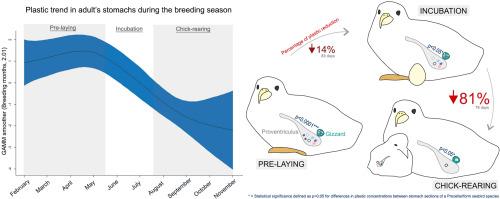
Plastic ingestion has been extensively studied in seabirds. However, knowledge gaps remain in understanding how plastic loads behave over time and their residence inside Procellariforms. This study investigated the temporal dynamics of ingested plastics by adult Cory's shearwaters (Calonectris borealis) during the breeding season to shed light on plastic retention times. We analysed the plastic content in the stomachs of 96 adults collected from 2015 to 2022 in the Azores archipelago (NE Atlantic) across distinct nesting periods: pre-laying, incubation, and chick-rearing. Our results revealed a general decrease in plastic loads over the breeding season, resulting in a marked reduction in the number of plastics before the winter pelagic phase. We found that plastic contents in breeders are mainly influenced by the intergenerational transfer of this contaminant to the offspring, indicating that progenitors highly reduce the concentrations of plastics from the stomachs (>80%) during the chick-rearing period. Understanding temporal patterns and retention time of plastic litter in seabirds is crucial for using them as indicators, with our results supporting fledglings of the studied species as the preferable age for fulfilling such a role in the breeding areas. Cory's shearwater breeders may contain plastics from their far-away wintering foraging grounds at the beginning of the breeding season, which would reflect plastics ingested in their transoceanic migrations or wintering regions beyond their breeding colonies. Moreover, they reset their plastic loads when nesting leading to underestimations if they are used as sentinels of plastic contamination during or after chick-rearing.
期刊介绍:
Marine Environmental Research publishes original research papers on chemical, physical, and biological interactions in the oceans and coastal waters. The journal serves as a forum for new information on biology, chemistry, and toxicology and syntheses that advance understanding of marine environmental processes.
Submission of multidisciplinary studies is encouraged. Studies that utilize experimental approaches to clarify the roles of anthropogenic and natural causes of changes in marine ecosystems are especially welcome, as are those studies that represent new developments of a theoretical or conceptual aspect of marine science. All papers published in this journal are reviewed by qualified peers prior to acceptance and publication. Examples of topics considered to be appropriate for the journal include, but are not limited to, the following:
– The extent, persistence, and consequences of change and the recovery from such change in natural marine systems
– The biochemical, physiological, and ecological consequences of contaminants to marine organisms and ecosystems
– The biogeochemistry of naturally occurring and anthropogenic substances
– Models that describe and predict the above processes
– Monitoring studies, to the extent that their results provide new information on functional processes
– Methodological papers describing improved quantitative techniques for the marine sciences.



 京公网安备 11010802042870号
京ICP备2023020795号-1
京公网安备 11010802042870号
京ICP备2023020795号-1

 分享
分享
 求助内容:
求助内容: 应助结果提醒方式:
 扫码关注我们
