Analytical Equations for the Prediction of the Failure Mode of Reinforced Concrete Beam-Column Joints Based on Interpretable Machine Learning and SHAP Values.
Ioannis Karampinis, Martha Karabini, Theodoros Rousakis, Lazaros Iliadis, Athanasios Karabinis
{"title":"Analytical Equations for the Prediction of the Failure Mode of Reinforced Concrete Beam-Column Joints Based on Interpretable Machine Learning and SHAP Values.","authors":"Ioannis Karampinis, Martha Karabini, Theodoros Rousakis, Lazaros Iliadis, Athanasios Karabinis","doi":"10.3390/s24247955","DOIUrl":null,"url":null,"abstract":"<p><p>One of the most critical components of reinforced concrete structures are beam-column joint systems, which greatly affect the overall behavior of a structure during a major seismic event. According to modern design codes, if the system fails, it should fail due to the flexural yielding of the beam and not due to the shear failure of the joint. Thus, a reliable tool is required for the prediction of the failure mode of the joints in a preexisting population of structures. In the present paper, a novel methodology for the derivation of analytical equations for this task is presented. The formulation is based on SHapley Additive exPlanations values, which are commonly employed as an explainability tool in machine learning. Instead, in the present paper, they were also utilized as a transformed target variable to which the analytical curves were fitted, which approximated the predictions of an underlying machine learning model. A dataset comprising 478 experimental results was utilized and the eXtreme Gradient Boosting algorithm was initially fitted. This achieved an overall accuracy of ≈84%. The derived analytical equations achieved an accuracy of ≈78%. The corresponding metrics of precision, recall, and the F1-score ranged from ≈76% to ≈80% and were close across the two modes, indicating an unbiased model.</p>","PeriodicalId":21698,"journal":{"name":"Sensors","volume":"24 24","pages":""},"PeriodicalIF":3.5000,"publicationDate":"2024-12-12","publicationTypes":"Journal Article","fieldsOfStudy":null,"isOpenAccess":false,"openAccessPdf":"https://www.ncbi.nlm.nih.gov/pmc/articles/PMC11679026/pdf/","citationCount":"0","resultStr":null,"platform":"Semanticscholar","paperid":null,"PeriodicalName":"Sensors","FirstCategoryId":"103","ListUrlMain":"https://doi.org/10.3390/s24247955","RegionNum":3,"RegionCategory":"综合性期刊","ArticlePicture":[],"TitleCN":null,"AbstractTextCN":null,"PMCID":null,"EPubDate":"","PubModel":"","JCR":"Q2","JCRName":"CHEMISTRY, ANALYTICAL","Score":null,"Total":0}
引用次数: 0
Abstract
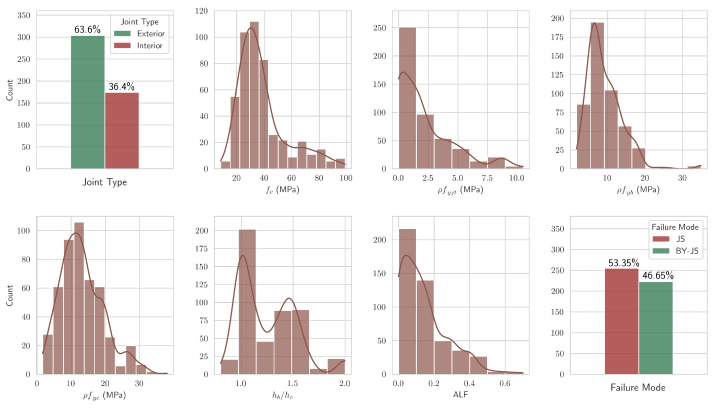
One of the most critical components of reinforced concrete structures are beam-column joint systems, which greatly affect the overall behavior of a structure during a major seismic event. According to modern design codes, if the system fails, it should fail due to the flexural yielding of the beam and not due to the shear failure of the joint. Thus, a reliable tool is required for the prediction of the failure mode of the joints in a preexisting population of structures. In the present paper, a novel methodology for the derivation of analytical equations for this task is presented. The formulation is based on SHapley Additive exPlanations values, which are commonly employed as an explainability tool in machine learning. Instead, in the present paper, they were also utilized as a transformed target variable to which the analytical curves were fitted, which approximated the predictions of an underlying machine learning model. A dataset comprising 478 experimental results was utilized and the eXtreme Gradient Boosting algorithm was initially fitted. This achieved an overall accuracy of ≈84%. The derived analytical equations achieved an accuracy of ≈78%. The corresponding metrics of precision, recall, and the F1-score ranged from ≈76% to ≈80% and were close across the two modes, indicating an unbiased model.
期刊介绍:
Sensors (ISSN 1424-8220) provides an advanced forum for the science and technology of sensors and biosensors. It publishes reviews (including comprehensive reviews on the complete sensors products), regular research papers and short notes. Our aim is to encourage scientists to publish their experimental and theoretical results in as much detail as possible. There is no restriction on the length of the papers. The full experimental details must be provided so that the results can be reproduced.






 京公网安备 11010802042870号
京ICP备2023020795号-1
京公网安备 11010802042870号
京ICP备2023020795号-1

 分享
分享
 求助内容:
求助内容: 应助结果提醒方式:
 扫码关注我们
