Dustin C. Becht, Karthik Selvam, Catherine Lachance, Valérie Côté, Kuai Li, Minh Chau Nguyen, Akshay Pareek, Xiaobing Shi, Hong Wen, M. Andres Blanco, Jacques Côté, Tatiana G. Kutateladze
{"title":"A multivalent engagement of ENL with MOZ","authors":"Dustin C. Becht, Karthik Selvam, Catherine Lachance, Valérie Côté, Kuai Li, Minh Chau Nguyen, Akshay Pareek, Xiaobing Shi, Hong Wen, M. Andres Blanco, Jacques Côté, Tatiana G. Kutateladze","doi":"10.1038/s41594-024-01455-8","DOIUrl":null,"url":null,"abstract":"The epigenetic cofactor ENL (eleven-nineteen-leukemia) and the acetyltransferase MOZ (monocytic leukemia zinc finger) have vital roles in transcriptional regulation and are implicated in aggressive forms of leukemia. Here, we describe the mechanistic basis for the intertwined association of ENL and MOZ. Genomic analysis shows that ENL and MOZ co-occupy active promoters and that MOZ recruits ENL to its gene targets. Structural studies reveal a multivalent assembly of ENL at the intrinsically disordered region (IDR) of MOZ. While the extraterminal (ET) domain of ENL recognizes the canonical ET-binding motif in IDR, the YEATS domains of ENL and homologous AF9 bind to a set of acetylation sites in the MOZ IDR that are generated by the acetyltransferase CBP (CREB-binding protein). Our findings suggest a multifaceted acetylation-dependent and independent coupling of ENL, MOZ and CBP/p300, which may contribute to leukemogenic activities of the ENL–MOZ assembly and chromosomal translocations of ENL, MOZ and CBP/p300. Epigenetic coregulators ENL (eleven-nineteen-leukemia) and MOZ (monocytic leukemia zinc finger) are implicated in leukemias. Here, the authors report the acetylation-dependent and acetylation-independent mechanism for the ENL–MOZ complex formation and show the colocalization of ENL and MOZ at active promoters.","PeriodicalId":49141,"journal":{"name":"Nature Structural & Molecular Biology","volume":"32 4","pages":"709-718"},"PeriodicalIF":10.1000,"publicationDate":"2025-01-10","publicationTypes":"Journal Article","fieldsOfStudy":null,"isOpenAccess":false,"openAccessPdf":"","citationCount":"0","resultStr":null,"platform":"Semanticscholar","paperid":null,"PeriodicalName":"Nature Structural & Molecular Biology","FirstCategoryId":"99","ListUrlMain":"https://www.nature.com/articles/s41594-024-01455-8","RegionNum":1,"RegionCategory":"生物学","ArticlePicture":[],"TitleCN":null,"AbstractTextCN":null,"PMCID":null,"EPubDate":"","PubModel":"","JCR":"Q1","JCRName":"BIOCHEMISTRY & MOLECULAR BIOLOGY","Score":null,"Total":0}
引用次数: 0
Abstract
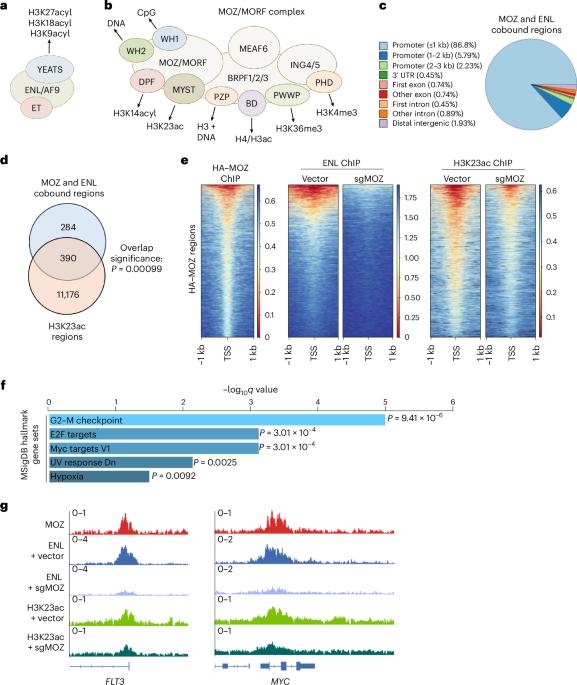
The epigenetic cofactor ENL (eleven-nineteen-leukemia) and the acetyltransferase MOZ (monocytic leukemia zinc finger) have vital roles in transcriptional regulation and are implicated in aggressive forms of leukemia. Here, we describe the mechanistic basis for the intertwined association of ENL and MOZ. Genomic analysis shows that ENL and MOZ co-occupy active promoters and that MOZ recruits ENL to its gene targets. Structural studies reveal a multivalent assembly of ENL at the intrinsically disordered region (IDR) of MOZ. While the extraterminal (ET) domain of ENL recognizes the canonical ET-binding motif in IDR, the YEATS domains of ENL and homologous AF9 bind to a set of acetylation sites in the MOZ IDR that are generated by the acetyltransferase CBP (CREB-binding protein). Our findings suggest a multifaceted acetylation-dependent and independent coupling of ENL, MOZ and CBP/p300, which may contribute to leukemogenic activities of the ENL–MOZ assembly and chromosomal translocations of ENL, MOZ and CBP/p300. Epigenetic coregulators ENL (eleven-nineteen-leukemia) and MOZ (monocytic leukemia zinc finger) are implicated in leukemias. Here, the authors report the acetylation-dependent and acetylation-independent mechanism for the ENL–MOZ complex formation and show the colocalization of ENL and MOZ at active promoters.
期刊介绍:
Nature Structural & Molecular Biology is a comprehensive platform that combines structural and molecular research. Our journal focuses on exploring the functional and mechanistic aspects of biological processes, emphasizing how molecular components collaborate to achieve a particular function. While structural data can shed light on these insights, our publication does not require them as a prerequisite.




 京公网安备 11010802042870号
京ICP备2023020795号-1
京公网安备 11010802042870号
京ICP备2023020795号-1

 分享
分享
 求助内容:
求助内容: 应助结果提醒方式:
 扫码关注我们
