{"title":"Photodissociation of \n \n \n \n \n Cr(CO)\n \n \n 4\n \n \n bpy\n \n $$ \\mathrm{Cr}{\\left(\\mathrm{CO}\\right)}_4\\mathrm{bpy} $$\n : A Non-Adiabatic Dynamics Investigation","authors":"Bartosz Ciborowski, Morgane Vacher","doi":"10.1002/jcc.70021","DOIUrl":null,"url":null,"abstract":"<p>Carbonyl complexes of <span></span><math>\n <semantics>\n <mrow>\n <msup>\n <mrow>\n <mi>d</mi>\n </mrow>\n <mrow>\n <mn>6</mn>\n </mrow>\n </msup>\n </mrow>\n <annotation>$$ {d}^6 $$</annotation>\n </semantics></math> metals with an α-diimine ligand exhibit both emission and ligand-selective photodissociation from MLCT states. Studying this photodissociative mechanism is challenging for experimental approaches due to an ultrafast femtosecond timescale and spectral overlap of multiple photoproducts. The photochemistry of a prototypical system <span></span><math>\n <semantics>\n <mrow>\n <msub>\n <mrow>\n <mtext>Cr(CO)</mtext>\n </mrow>\n <mrow>\n <mn>4</mn>\n </mrow>\n </msub>\n <mtext>bpy</mtext>\n </mrow>\n <annotation>$$ \\mathrm{Cr}{\\left(\\mathrm{CO}\\right)}_4\\mathrm{bpy} $$</annotation>\n </semantics></math> is investigated with non-adiabatic dynamic simulations. Obtained 86 fs lifetime of the bright <span></span><math>\n <semantics>\n <mrow>\n <msub>\n <mrow>\n <mi>S</mi>\n </mrow>\n <mrow>\n <mn>3</mn>\n </mrow>\n </msub>\n </mrow>\n <annotation>$$ {S}_3 $$</annotation>\n </semantics></math> state and 13% quantum yield are in good agreement with experimental data. The present simulations suggest a ballistic mechanism of photodissociation, which is irrespective of the occupied electronic state. This is in contrast to the previously established mechanism of competitive intersystem crossing and dissociation. Selectivity of axial photodissociation is shown to be caused by the absence of an avoided crossing in the equatorial direction.</p>","PeriodicalId":188,"journal":{"name":"Journal of Computational Chemistry","volume":"46 2","pages":""},"PeriodicalIF":4.8000,"publicationDate":"2025-01-11","publicationTypes":"Journal Article","fieldsOfStudy":null,"isOpenAccess":false,"openAccessPdf":"https://onlinelibrary.wiley.com/doi/epdf/10.1002/jcc.70021","citationCount":"0","resultStr":null,"platform":"Semanticscholar","paperid":null,"PeriodicalName":"Journal of Computational Chemistry","FirstCategoryId":"92","ListUrlMain":"https://onlinelibrary.wiley.com/doi/10.1002/jcc.70021","RegionNum":3,"RegionCategory":"化学","ArticlePicture":[],"TitleCN":null,"AbstractTextCN":null,"PMCID":null,"EPubDate":"","PubModel":"","JCR":"Q2","JCRName":"CHEMISTRY, MULTIDISCIPLINARY","Score":null,"Total":0}
引用次数: 0
Abstract
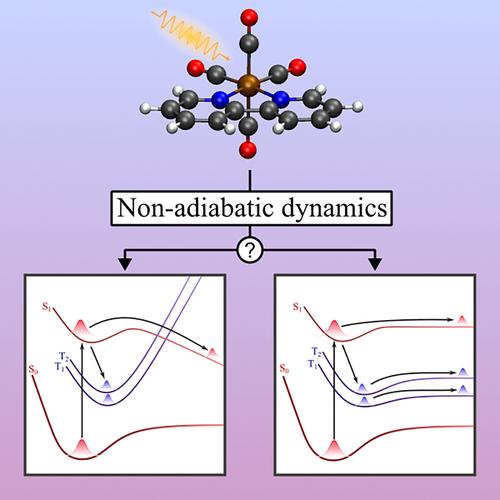
Carbonyl complexes of metals with an α-diimine ligand exhibit both emission and ligand-selective photodissociation from MLCT states. Studying this photodissociative mechanism is challenging for experimental approaches due to an ultrafast femtosecond timescale and spectral overlap of multiple photoproducts. The photochemistry of a prototypical system is investigated with non-adiabatic dynamic simulations. Obtained 86 fs lifetime of the bright state and 13% quantum yield are in good agreement with experimental data. The present simulations suggest a ballistic mechanism of photodissociation, which is irrespective of the occupied electronic state. This is in contrast to the previously established mechanism of competitive intersystem crossing and dissociation. Selectivity of axial photodissociation is shown to be caused by the absence of an avoided crossing in the equatorial direction.
含有α-二亚胺配体的d6 $$ {d}^6 $$金属羰基配合物在MLCT状态下表现出发射和配体选择性光解。由于超快飞秒时间尺度和多个光产物的光谱重叠,研究这种光解机制对实验方法具有挑战性。采用非绝热动力学模拟研究了典型体系Cr(CO)4bpy $$ \mathrm{Cr}{\left(\mathrm{CO}\right)}_4\mathrm{bpy} $$的光化学性质。获得了亮S3 $$ {S}_3 $$状态的86秒寿命和13秒寿命% quantum yield are in good agreement with experimental data. The present simulations suggest a ballistic mechanism of photodissociation, which is irrespective of the occupied electronic state. This is in contrast to the previously established mechanism of competitive intersystem crossing and dissociation. Selectivity of axial photodissociation is shown to be caused by the absence of an avoided crossing in the equatorial direction.
期刊介绍:
This distinguished journal publishes articles concerned with all aspects of computational chemistry: analytical, biological, inorganic, organic, physical, and materials. The Journal of Computational Chemistry presents original research, contemporary developments in theory and methodology, and state-of-the-art applications. Computational areas that are featured in the journal include ab initio and semiempirical quantum mechanics, density functional theory, molecular mechanics, molecular dynamics, statistical mechanics, cheminformatics, biomolecular structure prediction, molecular design, and bioinformatics.




 京公网安备 11010802042870号
京ICP备2023020795号-1
京公网安备 11010802042870号
京ICP备2023020795号-1

 分享
分享
 求助内容:
求助内容: 应助结果提醒方式:
 扫码关注我们
