Yibo Hou, Zhongfu Wang, Yang Wu, Ting Deng, Siyu Yang, Shaohua Ma, Yubo Zhang, Ding Luo, Yanjun Chen, Xiaoyong Dai
{"title":"Sophaline B inhibits non-small cell lung cancer by activating NLRP3/caspase-1/GSDMD-dependent pyroptosis and PI3K/AKT/mTOR-mediated autophagy.","authors":"Yibo Hou, Zhongfu Wang, Yang Wu, Ting Deng, Siyu Yang, Shaohua Ma, Yubo Zhang, Ding Luo, Yanjun Chen, Xiaoyong Dai","doi":"10.1080/14786419.2024.2448839","DOIUrl":null,"url":null,"abstract":"<p><p>Sophaline B (SPB), extracted from the seeds of <i>Sophora alopecuroides</i> L., is a natural bioactive compound that effectively exerts antiviral activities against the hepatitis B virus. This is the first study to demonstrate that SPB exerts anti-tumor effects on NSCLC by inducing pyroptosis and autophagy. SPB promotes NSCLC cell death by increasing the reactive oxygen species (ROS) production to induce pyroptosis <i>via</i> activating the NLRP3/Caspase-1/GSDMD signalling pathway. Meanwhile, SPB inhibits cancer cell proliferation by activating autophagy <i>via</i> blocking the PI3K/AKT/mTOR signalling pathway. Further investigation indicates that SPB inhibits NSCLC cell migration and invasion by increasing <i>E</i>-cadherin while decreasing <i>N</i>-cadherin, vimentin, and snail at the protein level. In addition, our results show that SPB inhibits cancer cell colony formation and human umbilical vein endothelial cell angiogenesis. Our study revealed the mechanisms of SPB triggering pyroptosis and autophagy in NSCLC, thus providing evidence and information on the SPB as an anti-cancer agent in NSCLC.</p>","PeriodicalId":18990,"journal":{"name":"Natural Product Research","volume":" ","pages":"1-13"},"PeriodicalIF":1.6000,"publicationDate":"2025-01-11","publicationTypes":"Journal Article","fieldsOfStudy":null,"isOpenAccess":false,"openAccessPdf":"","citationCount":"0","resultStr":null,"platform":"Semanticscholar","paperid":null,"PeriodicalName":"Natural Product Research","FirstCategoryId":"92","ListUrlMain":"https://doi.org/10.1080/14786419.2024.2448839","RegionNum":3,"RegionCategory":"化学","ArticlePicture":[],"TitleCN":null,"AbstractTextCN":null,"PMCID":null,"EPubDate":"","PubModel":"","JCR":"Q3","JCRName":"CHEMISTRY, APPLIED","Score":null,"Total":0}
引用次数: 0
Abstract
Sophaline B (SPB), extracted from the seeds of Sophora alopecuroides L., is a natural bioactive compound that effectively exerts antiviral activities against the hepatitis B virus. This is the first study to demonstrate that SPB exerts anti-tumor effects on NSCLC by inducing pyroptosis and autophagy. SPB promotes NSCLC cell death by increasing the reactive oxygen species (ROS) production to induce pyroptosis via activating the NLRP3/Caspase-1/GSDMD signalling pathway. Meanwhile, SPB inhibits cancer cell proliferation by activating autophagy via blocking the PI3K/AKT/mTOR signalling pathway. Further investigation indicates that SPB inhibits NSCLC cell migration and invasion by increasing E-cadherin while decreasing N-cadherin, vimentin, and snail at the protein level. In addition, our results show that SPB inhibits cancer cell colony formation and human umbilical vein endothelial cell angiogenesis. Our study revealed the mechanisms of SPB triggering pyroptosis and autophagy in NSCLC, thus providing evidence and information on the SPB as an anti-cancer agent in NSCLC.
Sophaline B (SPB)是从苦豆子(Sophora alopecuroides L.)种子中提取的一种天然生物活性化合物,对乙型肝炎病毒具有有效的抗病毒活性。本研究首次证实SPB通过诱导NSCLC细胞焦亡和自噬发挥抗肿瘤作用。SPB通过激活NLRP3/Caspase-1/GSDMD信号通路,增加活性氧(ROS)的产生,诱导细胞焦亡,从而促进NSCLC细胞死亡。同时,SPB通过阻断PI3K/AKT/mTOR信号通路激活自噬,从而抑制癌细胞增殖。进一步研究表明,SPB在蛋白水平上通过增加E-cadherin,降低N-cadherin、vimentin和snail来抑制NSCLC细胞的迁移和侵袭。此外,我们的研究结果表明,SPB抑制癌细胞集落形成和人脐静脉内皮细胞血管生成。我们的研究揭示了SPB在非小细胞肺癌中引发细胞焦亡和自噬的机制,从而为SPB在非小细胞肺癌中的抗癌作用提供了证据和信息。
期刊介绍:
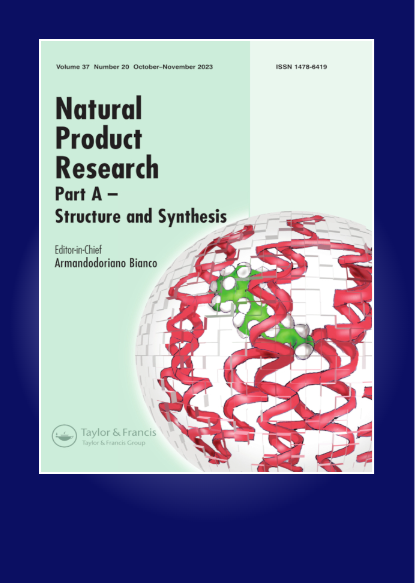
The aim of Natural Product Research is to publish important contributions in the field of natural product chemistry. The journal covers all aspects of research in the chemistry and biochemistry of naturally occurring compounds.
The communications include coverage of work on natural substances of land and sea and of plants, microbes and animals. Discussions of structure elucidation, synthesis and experimental biosynthesis of natural products as well as developments of methods in these areas are welcomed in the journal. Finally, research papers in fields on the chemistry-biology boundary, eg. fermentation chemistry, plant tissue culture investigations etc., are accepted into the journal.
Natural Product Research issues will be subtitled either ""Part A - Synthesis and Structure"" or ""Part B - Bioactive Natural Products"". for details on this , see the forthcoming articles section.
All manuscript submissions are subject to initial appraisal by the Editor, and, if found suitable for further consideration, to peer review by independent, anonymous expert referees. All peer review is single blind and submission is online via ScholarOne Manuscripts.



 京公网安备 11010802042870号
京ICP备2023020795号-1
京公网安备 11010802042870号
京ICP备2023020795号-1

 分享
分享
 求助内容:
求助内容: 应助结果提醒方式:
 扫码关注我们
