Vanessa L. Kronzer, Yangyuna Yang, Punyasha Roul, James L. Crooks, Cynthia S. Crowson, John M. Davis III, Jeffrey A. Sparks, Jeffrey R. Pierce, Katelyn O'Dell, Brian C. Sauer, Grant W. Cannon, Joshua F. Baker, Ted R. Mikuls, Bryant R. England
{"title":"Associations of Fire Smoke and Other Pollutants With Incident Rheumatoid Arthritis and Rheumatoid Arthritis–Associated Interstitial Lung Disease","authors":"Vanessa L. Kronzer, Yangyuna Yang, Punyasha Roul, James L. Crooks, Cynthia S. Crowson, John M. Davis III, Jeffrey A. Sparks, Jeffrey R. Pierce, Katelyn O'Dell, Brian C. Sauer, Grant W. Cannon, Joshua F. Baker, Ted R. Mikuls, Bryant R. England","doi":"10.1002/art.43113","DOIUrl":null,"url":null,"abstract":"<div>\n \n <section>\n \n <h3> Objective</h3>\n \n <p>The aim of this study was to determine whether pollutants such as fire smoke–related particulate matter <2.5 μm (PM<sub>2.5</sub>) are associated with incident rheumatoid arthritis (RA) and RA-associated interstitial lung disease (RA-ILD).</p>\n </section>\n \n <section>\n \n <h3> Methods</h3>\n \n <p>This patient–control study used Veterans Affairs (VA) data from October 1, 2009, to December 31, 2018. We identified patients with incident RA and RA-ILD using validated algorithms, matching each patient to ≤10 controls on age, sex, and VA enrollment year. We obtained pollutants including fire smoke PM<sub>2.5</sub>, carbon monoxide, nitrogen oxides (NOx), ozone, overall PM<sub>2.5</sub>, PM<sub>10</sub>, and sulfur dioxide (SO<sub>2</sub>) at least one year before the index date. We fit conditional logistic regression models to estimate adjusted odds ratios (aORs) with 95% confidence intervals (CIs) for incident RA and RA-ILD, adjusted for confounders.</p>\n </section>\n \n <section>\n \n <h3> Results</h3>\n \n <p>We identified 9,701 patients with incident RA (mean age 65 years, 86% male), including 531 patients with RA-ILD (mean age 69 years, 91% male), and 68,852 matched controls. Fire smoke PM<sub>2.5</sub> was not associated with RA (aOR 1.07, 95% CI 0.92–1.23) but was associated with RA-ILD (aOR 1.98, 95% CI 1.08–3.62, per 1 μg/m<sup>3</sup>). Increased levels of NOx were associated with RA (aOR 1.16, 95% CI 1.06–1.27, highest vs lowest quartile). The highest quartiles of ozone (aOR 1.19, 95% CI 1.06–1.34) and PM<sub>10</sub> (aOR 1.25, 95% CI 1.10–1.43) were associated with seronegative RA. Carbon monoxide, overall PM<sub>2.5</sub>, and SO<sub>2</sub> were not, or negatively, associated with RA and RA-ILD.</p>\n </section>\n \n <section>\n \n <h3> Conclusion</h3>\n \n <p>Increased fire smoke PM<sub>2.5</sub> was associated with RA-ILD, whereas NOx, ozone, and PM<sub>10</sub> were associated with RA risk. Thus, air pollution may increase the risk of RA and RA-ILD.</p>\n \n <div>\n <figure>\n <div><picture>\n <source></source></picture><p></p>\n </div>\n </figure>\n </div>\n </section>\n </div>","PeriodicalId":129,"journal":{"name":"Arthritis & Rheumatology","volume":"77 7","pages":"808-816"},"PeriodicalIF":10.9000,"publicationDate":"2025-01-12","publicationTypes":"Journal Article","fieldsOfStudy":null,"isOpenAccess":false,"openAccessPdf":"https://onlinelibrary.wiley.com/doi/epdf/10.1002/art.43113","citationCount":"0","resultStr":null,"platform":"Semanticscholar","paperid":null,"PeriodicalName":"Arthritis & Rheumatology","FirstCategoryId":"3","ListUrlMain":"https://acrjournals.onlinelibrary.wiley.com/doi/10.1002/art.43113","RegionNum":1,"RegionCategory":"医学","ArticlePicture":[],"TitleCN":null,"AbstractTextCN":null,"PMCID":null,"EPubDate":"","PubModel":"","JCR":"Q1","JCRName":"RHEUMATOLOGY","Score":null,"Total":0}
引用次数: 0
Abstract
Objective
The aim of this study was to determine whether pollutants such as fire smoke–related particulate matter <2.5 μm (PM2.5) are associated with incident rheumatoid arthritis (RA) and RA-associated interstitial lung disease (RA-ILD).
Methods
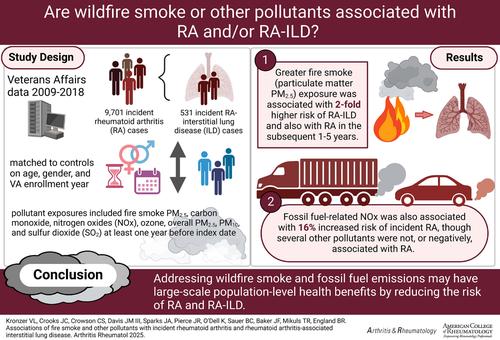
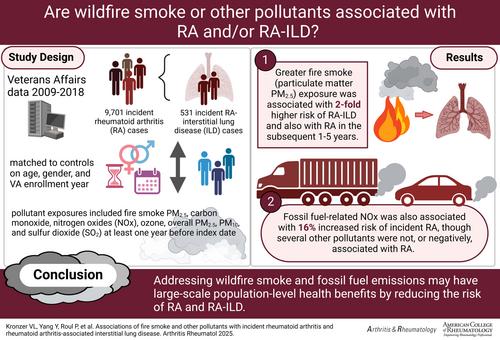
This patient–control study used Veterans Affairs (VA) data from October 1, 2009, to December 31, 2018. We identified patients with incident RA and RA-ILD using validated algorithms, matching each patient to ≤10 controls on age, sex, and VA enrollment year. We obtained pollutants including fire smoke PM2.5, carbon monoxide, nitrogen oxides (NOx), ozone, overall PM2.5, PM10, and sulfur dioxide (SO2) at least one year before the index date. We fit conditional logistic regression models to estimate adjusted odds ratios (aORs) with 95% confidence intervals (CIs) for incident RA and RA-ILD, adjusted for confounders.
Results
We identified 9,701 patients with incident RA (mean age 65 years, 86% male), including 531 patients with RA-ILD (mean age 69 years, 91% male), and 68,852 matched controls. Fire smoke PM2.5 was not associated with RA (aOR 1.07, 95% CI 0.92–1.23) but was associated with RA-ILD (aOR 1.98, 95% CI 1.08–3.62, per 1 μg/m3). Increased levels of NOx were associated with RA (aOR 1.16, 95% CI 1.06–1.27, highest vs lowest quartile). The highest quartiles of ozone (aOR 1.19, 95% CI 1.06–1.34) and PM10 (aOR 1.25, 95% CI 1.10–1.43) were associated with seronegative RA. Carbon monoxide, overall PM2.5, and SO2 were not, or negatively, associated with RA and RA-ILD.
Conclusion
Increased fire smoke PM2.5 was associated with RA-ILD, whereas NOx, ozone, and PM10 were associated with RA risk. Thus, air pollution may increase the risk of RA and RA-ILD.
期刊介绍:
Arthritis & Rheumatology is the official journal of the American College of Rheumatology and focuses on the natural history, pathophysiology, treatment, and outcome of rheumatic diseases. It is a peer-reviewed publication that aims to provide the highest quality basic and clinical research in this field. The journal covers a wide range of investigative areas and also includes review articles, editorials, and educational material for researchers and clinicians. Being recognized as a leading research journal in rheumatology, Arthritis & Rheumatology serves the global community of rheumatology investigators and clinicians.