Angela Y. Y. Tam, Korsa Khan, Shiwen Xu, Marianne Bergin, Linghong Huang, Erik Arroyo Colon, Danyi Cheng, Elisabetta A. M. Verderio, Voon Ong, Christopher P. Denton, John Atkinson, Tim S. Johnson, David J. Abraham
{"title":"Critical Role for Transglutaminase 2 in Scleroderma Skin Fibrosis and in the Development of Dermal Sclerosis in a Mouse Model of Scleroderma","authors":"Angela Y. Y. Tam, Korsa Khan, Shiwen Xu, Marianne Bergin, Linghong Huang, Erik Arroyo Colon, Danyi Cheng, Elisabetta A. M. Verderio, Voon Ong, Christopher P. Denton, John Atkinson, Tim S. Johnson, David J. Abraham","doi":"10.1002/art.43104","DOIUrl":null,"url":null,"abstract":"<div>\n \n <section>\n \n <h3> Objective</h3>\n \n <p>Scleroderma is a life-threatening autoimmune disease characterized by inflammation, tissue remodeling, and fibrosis. This study aimed to investigate the expression and function of transglutaminase 2 (TGM2) in scleroderma skin and experimentally induced dermal fibrosis to determine its potential role and therapeutic implications.</p>\n </section>\n \n <section>\n \n <h3> Methods</h3>\n \n <p>We performed immunohistochemistry on skin sections to assess TGM2 expression and localization, and protein biochemistry of both systemic sclerosis–derived and healthy control dermal fibroblasts to assess TGM2 expression, function, and extracellular matrix deposition in the presence of TGM2 inhibiting and transforming growth factor (TGF)-β neutralizing antibodies and a small-molecule inhibitor of the TGF-βRI kinase. Mice with a complete deficiency of TGM2 (<i>Tgm2-/-)</i> were investigated in the bleomycin-induced model of skin fibrosis.</p>\n </section>\n \n <section>\n \n <h3> Results</h3>\n \n <p>TGM2 was found to be widely expressed in both control and scleroderma skin samples, as well as in cultured fibroblasts. Scleroderma fibroblasts exhibited elevated TGM2 expression, which correlated with increased expression of fibrosis markers (Col-1, αSMA, and CCN2). Inhibition of TGM2 using an inhibiting antibody reduced the expression of key markers of fibrosis. The effects of TGM2 inhibition were similar to those observed with TGF-β neutralization, suggesting a potential crosstalk between TGM2 and TGF-β signaling. Moreover, <i>TGM2</i> knockout mice showed significantly reduced dermal fibrosis compared with wild type mice. In vitro experiments with <i>TGM2</i>-deleted fibroblasts demonstrated impaired cell migration and collagen matrix contraction, which could be partially restored by exogenous TGF-β.</p>\n </section>\n \n <section>\n \n <h3> Conclusion</h3>\n \n <p>TGM2 can regulate several key profibrotic activities of TGF-β suggesting that attenuating TGM2 function may be of benefit in severe forms of connective tissue disease with skin fibrosis.</p>\n \n <div>\n <figure>\n <div><picture>\n <source></source></picture><p></p>\n </div>\n </figure>\n </div>\n </section>\n </div>","PeriodicalId":129,"journal":{"name":"Arthritis & Rheumatology","volume":"77 7","pages":"914-928"},"PeriodicalIF":10.9000,"publicationDate":"2025-01-12","publicationTypes":"Journal Article","fieldsOfStudy":null,"isOpenAccess":false,"openAccessPdf":"https://onlinelibrary.wiley.com/doi/epdf/10.1002/art.43104","citationCount":"0","resultStr":null,"platform":"Semanticscholar","paperid":null,"PeriodicalName":"Arthritis & Rheumatology","FirstCategoryId":"3","ListUrlMain":"https://acrjournals.onlinelibrary.wiley.com/doi/10.1002/art.43104","RegionNum":1,"RegionCategory":"医学","ArticlePicture":[],"TitleCN":null,"AbstractTextCN":null,"PMCID":null,"EPubDate":"","PubModel":"","JCR":"Q1","JCRName":"RHEUMATOLOGY","Score":null,"Total":0}
引用次数: 0
Abstract
Objective
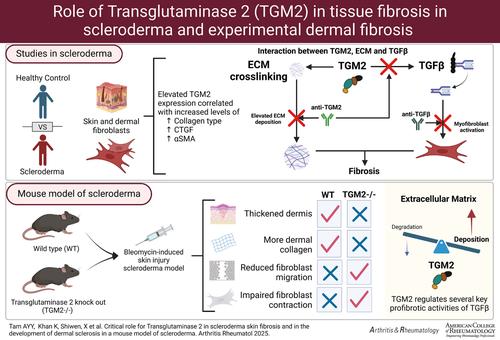
Scleroderma is a life-threatening autoimmune disease characterized by inflammation, tissue remodeling, and fibrosis. This study aimed to investigate the expression and function of transglutaminase 2 (TGM2) in scleroderma skin and experimentally induced dermal fibrosis to determine its potential role and therapeutic implications.
Methods
We performed immunohistochemistry on skin sections to assess TGM2 expression and localization, and protein biochemistry of both systemic sclerosis–derived and healthy control dermal fibroblasts to assess TGM2 expression, function, and extracellular matrix deposition in the presence of TGM2 inhibiting and transforming growth factor (TGF)-β neutralizing antibodies and a small-molecule inhibitor of the TGF-βRI kinase. Mice with a complete deficiency of TGM2 (Tgm2-/-) were investigated in the bleomycin-induced model of skin fibrosis.
Results
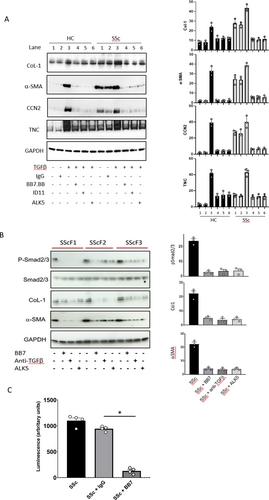
TGM2 was found to be widely expressed in both control and scleroderma skin samples, as well as in cultured fibroblasts. Scleroderma fibroblasts exhibited elevated TGM2 expression, which correlated with increased expression of fibrosis markers (Col-1, αSMA, and CCN2). Inhibition of TGM2 using an inhibiting antibody reduced the expression of key markers of fibrosis. The effects of TGM2 inhibition were similar to those observed with TGF-β neutralization, suggesting a potential crosstalk between TGM2 and TGF-β signaling. Moreover, TGM2 knockout mice showed significantly reduced dermal fibrosis compared with wild type mice. In vitro experiments with TGM2-deleted fibroblasts demonstrated impaired cell migration and collagen matrix contraction, which could be partially restored by exogenous TGF-β.
Conclusion
TGM2 can regulate several key profibrotic activities of TGF-β suggesting that attenuating TGM2 function may be of benefit in severe forms of connective tissue disease with skin fibrosis.
期刊介绍:
Arthritis & Rheumatology is the official journal of the American College of Rheumatology and focuses on the natural history, pathophysiology, treatment, and outcome of rheumatic diseases. It is a peer-reviewed publication that aims to provide the highest quality basic and clinical research in this field. The journal covers a wide range of investigative areas and also includes review articles, editorials, and educational material for researchers and clinicians. Being recognized as a leading research journal in rheumatology, Arthritis & Rheumatology serves the global community of rheumatology investigators and clinicians.