Chiara Trovatello, Carino Ferrante, Birui Yang, Josip Bajo, Benjamin Braun, Zhi Hao Peng, Xinyi Xu, Philipp K. Jenke, Andrew Ye, Milan Delor, D. N. Basov, Jiwoong Park, Philip Walther, Cory R. Dean, Lee A. Rozema, Andrea Marini, Giulio Cerullo, P. James Schuck
{"title":"Quasi-phase-matched up- and down-conversion in periodically poled layered semiconductors","authors":"Chiara Trovatello, Carino Ferrante, Birui Yang, Josip Bajo, Benjamin Braun, Zhi Hao Peng, Xinyi Xu, Philipp K. Jenke, Andrew Ye, Milan Delor, D. N. Basov, Jiwoong Park, Philip Walther, Cory R. Dean, Lee A. Rozema, Andrea Marini, Giulio Cerullo, P. James Schuck","doi":"10.1038/s41566-024-01602-z","DOIUrl":null,"url":null,"abstract":"Nonlinear optics lies at the heart of classical and quantum light generation. The invention of periodic poling revolutionized nonlinear optics and its commercial applications by enabling robust quasi-phase-matching in crystals such as lithium niobate. However, reaching useful frequency conversion efficiencies requires macroscopic dimensions, limiting further technology development and integration. Here we realize a periodically poled van der Waals semiconductor (3R-MoS2). Owing to its large nonlinearity, we achieve a macroscopic frequency conversion efficiency of 0.03% at the relevant telecom wavelength over a microscopic thickness of 3.4 μm (that is, 3 poling periods), 10–100× thinner than current systems with similar performances. Due to intrinsic cavity effects, the thickness-dependent quasi-phase-matched second harmonic signal surpasses the usual quadratic enhancement by 50%. Further, we report the broadband generation of photon pairs at telecom wavelength via quasi-phase-matched spontaneous parametric down-conversion, showing a maximum coincidence-to-accidental ratio of 638 ± 75. This work opens the new and unexplored field of phase-matched nonlinear optics with microscopic van der Waals crystals, unlocking applications that require simple, ultra-compact technologies such as on-chip entangled photon-pair sources for integrated quantum circuitry and sensing. Researchers created a periodically poled van der Waals semiconductor (3R-MoS2) and achieved a macroscopic frequency conversion efficiency of 0.03% over a thickness of 3.4 μm. The quasi-phase-matched second harmonic signal surpasses the usual quadratic enhancement by 50% and broadband generation of photon pairs at telecom wavelength is demonstrated with a coincidence-to-accidental ratio of 638 ± 75.","PeriodicalId":18926,"journal":{"name":"Nature Photonics","volume":"19 3","pages":"291-299"},"PeriodicalIF":32.9000,"publicationDate":"2025-01-13","publicationTypes":"Journal Article","fieldsOfStudy":null,"isOpenAccess":false,"openAccessPdf":"","citationCount":"0","resultStr":null,"platform":"Semanticscholar","paperid":null,"PeriodicalName":"Nature Photonics","FirstCategoryId":"101","ListUrlMain":"https://www.nature.com/articles/s41566-024-01602-z","RegionNum":1,"RegionCategory":"物理与天体物理","ArticlePicture":[],"TitleCN":null,"AbstractTextCN":null,"PMCID":null,"EPubDate":"","PubModel":"","JCR":"Q1","JCRName":"OPTICS","Score":null,"Total":0}
引用次数: 0
Abstract
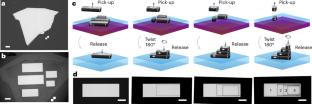
Nonlinear optics lies at the heart of classical and quantum light generation. The invention of periodic poling revolutionized nonlinear optics and its commercial applications by enabling robust quasi-phase-matching in crystals such as lithium niobate. However, reaching useful frequency conversion efficiencies requires macroscopic dimensions, limiting further technology development and integration. Here we realize a periodically poled van der Waals semiconductor (3R-MoS2). Owing to its large nonlinearity, we achieve a macroscopic frequency conversion efficiency of 0.03% at the relevant telecom wavelength over a microscopic thickness of 3.4 μm (that is, 3 poling periods), 10–100× thinner than current systems with similar performances. Due to intrinsic cavity effects, the thickness-dependent quasi-phase-matched second harmonic signal surpasses the usual quadratic enhancement by 50%. Further, we report the broadband generation of photon pairs at telecom wavelength via quasi-phase-matched spontaneous parametric down-conversion, showing a maximum coincidence-to-accidental ratio of 638 ± 75. This work opens the new and unexplored field of phase-matched nonlinear optics with microscopic van der Waals crystals, unlocking applications that require simple, ultra-compact technologies such as on-chip entangled photon-pair sources for integrated quantum circuitry and sensing. Researchers created a periodically poled van der Waals semiconductor (3R-MoS2) and achieved a macroscopic frequency conversion efficiency of 0.03% over a thickness of 3.4 μm. The quasi-phase-matched second harmonic signal surpasses the usual quadratic enhancement by 50% and broadband generation of photon pairs at telecom wavelength is demonstrated with a coincidence-to-accidental ratio of 638 ± 75.
期刊介绍:
Nature Photonics is a monthly journal dedicated to the scientific study and application of light, known as Photonics. It publishes top-quality, peer-reviewed research across all areas of light generation, manipulation, and detection.
The journal encompasses research into the fundamental properties of light and its interactions with matter, as well as the latest developments in optoelectronic devices and emerging photonics applications. Topics covered include lasers, LEDs, imaging, detectors, optoelectronic devices, quantum optics, biophotonics, optical data storage, spectroscopy, fiber optics, solar energy, displays, terahertz technology, nonlinear optics, plasmonics, nanophotonics, and X-rays.
In addition to research papers and review articles summarizing scientific findings in optoelectronics, Nature Photonics also features News and Views pieces and research highlights. It uniquely includes articles on the business aspects of the industry, such as technology commercialization and market analysis, offering a comprehensive perspective on the field.




 京公网安备 11010802042870号
京ICP备2023020795号-1
京公网安备 11010802042870号
京ICP备2023020795号-1

 分享
分享
 求助内容:
求助内容: 应助结果提醒方式:
 扫码关注我们
