Yucheng Liu, Hongtao Liu, Chen Wang, Haoran Sun, Lizhang Wang
{"title":"An observed \"sandwich\" framework mediated via sulfate ions as electron shuttle for efficient electro-oxidation of organic pollutants","authors":"Yucheng Liu, Hongtao Liu, Chen Wang, Haoran Sun, Lizhang Wang","doi":"10.1016/j.watres.2025.123139","DOIUrl":null,"url":null,"abstract":"<div><div>“Electro-oxidation processes are effective in treating sulfate-rich organic wastewater. However, this technology development has been hindered by the poor understanding of the role of sulfate ions. This paper reports that high concentration of sulfate ions significantly enhanced the electro-oxidation of organic pollutants. High sulfate concentration did not affect radical activity or organic pollutant coverage on the electrode surface. We propose that the electrode interface forms a “sandwich” framework mediated by sulfate ions, consisting of the electrode surface, the sulfate ion layer, and the organic pollutant layer. High concentrations of sulfate ions selectively promote the protonated organic pollutant into the framework via electrostatic attraction when the solution pH is lower than the pKa of the organic pollutants. In this framework, the sulfate ion layer acts as an electron shuttle, creating a smooth electron transfer pathway between the electrode surface and the organic maters. In this way, the “sandwich” framework can efficiently electro-oxidize organic pollutants. This study offers new insights into the role of sulfate ions in electro-oxidation processes, redefining their role in pollutant degradation, and guiding the design of sulfate-rich wastewater treatment.”</div></div>","PeriodicalId":443,"journal":{"name":"Water Research","volume":"274 ","pages":"Article 123139"},"PeriodicalIF":12.4000,"publicationDate":"2025-04-15","publicationTypes":"Journal Article","fieldsOfStudy":null,"isOpenAccess":false,"openAccessPdf":"","citationCount":"0","resultStr":null,"platform":"Semanticscholar","paperid":null,"PeriodicalName":"Water Research","FirstCategoryId":"93","ListUrlMain":"https://www.sciencedirect.com/science/article/pii/S0043135425000533","RegionNum":1,"RegionCategory":"环境科学与生态学","ArticlePicture":[],"TitleCN":null,"AbstractTextCN":null,"PMCID":null,"EPubDate":"2025/1/13 0:00:00","PubModel":"Epub","JCR":"Q1","JCRName":"ENGINEERING, ENVIRONMENTAL","Score":null,"Total":0}
引用次数: 0
Abstract
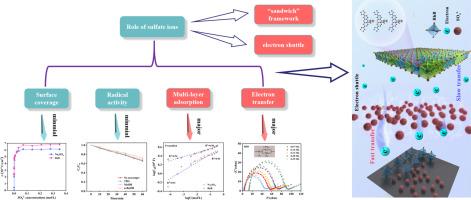
“Electro-oxidation processes are effective in treating sulfate-rich organic wastewater. However, this technology development has been hindered by the poor understanding of the role of sulfate ions. This paper reports that high concentration of sulfate ions significantly enhanced the electro-oxidation of organic pollutants. High sulfate concentration did not affect radical activity or organic pollutant coverage on the electrode surface. We propose that the electrode interface forms a “sandwich” framework mediated by sulfate ions, consisting of the electrode surface, the sulfate ion layer, and the organic pollutant layer. High concentrations of sulfate ions selectively promote the protonated organic pollutant into the framework via electrostatic attraction when the solution pH is lower than the pKa of the organic pollutants. In this framework, the sulfate ion layer acts as an electron shuttle, creating a smooth electron transfer pathway between the electrode surface and the organic maters. In this way, the “sandwich” framework can efficiently electro-oxidize organic pollutants. This study offers new insights into the role of sulfate ions in electro-oxidation processes, redefining their role in pollutant degradation, and guiding the design of sulfate-rich wastewater treatment.”
期刊介绍:
Water Research, along with its open access companion journal Water Research X, serves as a platform for publishing original research papers covering various aspects of the science and technology related to the anthropogenic water cycle, water quality, and its management worldwide. The audience targeted by the journal comprises biologists, chemical engineers, chemists, civil engineers, environmental engineers, limnologists, and microbiologists. The scope of the journal include:
•Treatment processes for water and wastewaters (municipal, agricultural, industrial, and on-site treatment), including resource recovery and residuals management;
•Urban hydrology including sewer systems, stormwater management, and green infrastructure;
•Drinking water treatment and distribution;
•Potable and non-potable water reuse;
•Sanitation, public health, and risk assessment;
•Anaerobic digestion, solid and hazardous waste management, including source characterization and the effects and control of leachates and gaseous emissions;
•Contaminants (chemical, microbial, anthropogenic particles such as nanoparticles or microplastics) and related water quality sensing, monitoring, fate, and assessment;
•Anthropogenic impacts on inland, tidal, coastal and urban waters, focusing on surface and ground waters, and point and non-point sources of pollution;
•Environmental restoration, linked to surface water, groundwater and groundwater remediation;
•Analysis of the interfaces between sediments and water, and between water and atmosphere, focusing specifically on anthropogenic impacts;
•Mathematical modelling, systems analysis, machine learning, and beneficial use of big data related to the anthropogenic water cycle;
•Socio-economic, policy, and regulations studies.





 京公网安备 11010802042870号
京ICP备2023020795号-1
京公网安备 11010802042870号
京ICP备2023020795号-1

 分享
分享
 求助内容:
求助内容: 应助结果提醒方式:
 扫码关注我们
