Jacob W. Ford , Jennifer M. VanNatta , Deboprosad Mondal , Chen-Ming Lin , Yuling Deng , Ruoli Bai , Ernest Hamel , Mary Lynn Trawick , Kevin G. Pinney
{"title":"Drug-linker constructs bearing unique dual-mechanism tubulin binding payloads tethered through cleavable and non-cleavable linkers","authors":"Jacob W. Ford , Jennifer M. VanNatta , Deboprosad Mondal , Chen-Ming Lin , Yuling Deng , Ruoli Bai , Ernest Hamel , Mary Lynn Trawick , Kevin G. Pinney","doi":"10.1016/j.tet.2024.134350","DOIUrl":null,"url":null,"abstract":"<div><div>Antibody-drug conjugates (ADCs) have advanced as a mainstay among the most promising cancer therapeutics, offering enhanced antigen targeting and encompassing wide diversity in their linker and payload components. Small-molecule inhibitors of tubulin polymerization have found success as payloads in FDA approved ADCs and represent further promise in next-generation, pre-clinical and developmental ADCs. Unique dual-mechanism payloads (previously designed and synthesized in our laboratories) function as both potent antiproliferative agents and promising vascular disrupting agents capable of imparting selective and effective damage to tumor-associated microvessels. These payloads have been incorporated into a variety of drug-linker constructs utilizing the clinically relevant cathepsin B cleavable Val-Cit dipeptide linker, employed within several FDA approved ADCs, along with other non-cleavable constructs. Various synthetic strategies were evaluated to prepare these drug-linker constructs. Aniline-based payloads were incorporated utilizing the Val-Cit dipeptide linker similar to FDA approved ADCs such as Adcetris® (brentuximab vedotin). An additional self-immolative group, previously described in the literature for related model systems, was employed to tether the phenolic payloads. A variety of drug-linker constructs (each bearing a unique dual mechanism payload) were synthesized and evaluated biologically for their enzyme-mediated release of payload and inhibition of tubulin polymerization. Following deactivation of the highly electrophilic maleimido terminus as its corresponding <em>N</em>-acetyl cysteine (NAC) derivative, the most promising construct (NAC-<strong>4</strong>) demonstrated approximately 90% release of an aniline-functionalized payload (<strong>1</strong>) upon treatment with cathepsins B or L over 90 min. Building on these promising results, future studies will examine the conjugation of drug-linker construct <strong>4</strong> to selected antibodies and engineered proteins and evaluate the biological activity of the resultant antibody-drug conjugates (ADCs).</div></div>","PeriodicalId":437,"journal":{"name":"Tetrahedron","volume":"171 ","pages":"Article 134350"},"PeriodicalIF":2.2000,"publicationDate":"2025-02-01","publicationTypes":"Journal Article","fieldsOfStudy":null,"isOpenAccess":false,"openAccessPdf":"","citationCount":"0","resultStr":null,"platform":"Semanticscholar","paperid":null,"PeriodicalName":"Tetrahedron","FirstCategoryId":"92","ListUrlMain":"https://www.sciencedirect.com/science/article/pii/S0040402024005313","RegionNum":3,"RegionCategory":"化学","ArticlePicture":[],"TitleCN":null,"AbstractTextCN":null,"PMCID":null,"EPubDate":"2024/11/6 0:00:00","PubModel":"Epub","JCR":"Q2","JCRName":"CHEMISTRY, ORGANIC","Score":null,"Total":0}
引用次数: 0
Abstract
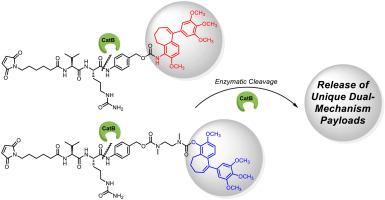
Antibody-drug conjugates (ADCs) have advanced as a mainstay among the most promising cancer therapeutics, offering enhanced antigen targeting and encompassing wide diversity in their linker and payload components. Small-molecule inhibitors of tubulin polymerization have found success as payloads in FDA approved ADCs and represent further promise in next-generation, pre-clinical and developmental ADCs. Unique dual-mechanism payloads (previously designed and synthesized in our laboratories) function as both potent antiproliferative agents and promising vascular disrupting agents capable of imparting selective and effective damage to tumor-associated microvessels. These payloads have been incorporated into a variety of drug-linker constructs utilizing the clinically relevant cathepsin B cleavable Val-Cit dipeptide linker, employed within several FDA approved ADCs, along with other non-cleavable constructs. Various synthetic strategies were evaluated to prepare these drug-linker constructs. Aniline-based payloads were incorporated utilizing the Val-Cit dipeptide linker similar to FDA approved ADCs such as Adcetris® (brentuximab vedotin). An additional self-immolative group, previously described in the literature for related model systems, was employed to tether the phenolic payloads. A variety of drug-linker constructs (each bearing a unique dual mechanism payload) were synthesized and evaluated biologically for their enzyme-mediated release of payload and inhibition of tubulin polymerization. Following deactivation of the highly electrophilic maleimido terminus as its corresponding N-acetyl cysteine (NAC) derivative, the most promising construct (NAC-4) demonstrated approximately 90% release of an aniline-functionalized payload (1) upon treatment with cathepsins B or L over 90 min. Building on these promising results, future studies will examine the conjugation of drug-linker construct 4 to selected antibodies and engineered proteins and evaluate the biological activity of the resultant antibody-drug conjugates (ADCs).
期刊介绍:
Tetrahedron publishes full accounts of research having outstanding significance in the broad field of organic chemistry and its related disciplines, such as organic materials and bio-organic chemistry.
Regular papers in Tetrahedron are expected to represent detailed accounts of an original study having substantially greater scope and details than that found in a communication, as published in Tetrahedron Letters.
Tetrahedron also publishes thematic collections of papers as special issues and ''Reports'', commissioned in-depth reviews providing a comprehensive overview of a research area.



 京公网安备 11010802042870号
京ICP备2023020795号-1
京公网安备 11010802042870号
京ICP备2023020795号-1

 分享
分享
 求助内容:
求助内容: 应助结果提醒方式:
 扫码关注我们
