Jesse Richards , Madisen Fae Dorand , Maria Paszkowiak , Sana Ahmed , Courtney McCorkle , Pranay Kathuria
{"title":"Significantly higher rates of KIDINS220 polymorphisms in patients with obesity and end-stage renal disease","authors":"Jesse Richards , Madisen Fae Dorand , Maria Paszkowiak , Sana Ahmed , Courtney McCorkle , Pranay Kathuria","doi":"10.1016/j.obpill.2024.100155","DOIUrl":null,"url":null,"abstract":"<div><h3>Background</h3><div>Kinase D-interacting substrate of 220 kDa (“KIDINS220”) is an integral plasma membrane protein essential to signaling throughout the body; abnormalities are linked to a variety of disorders, including obesity, but have never been directly linked to chronic- or end-stage renal disease.</div></div><div><h3>Methods</h3><div>Retrospective chart review identified patients with severe obesity who presented for pre-kidney transplant weight management. 20 individuals met criteria for testing for genetic causes of obesity. A χ<sup>2</sup> test of independence was utilized to compare genetic mutation rates in this cohort to all individuals tested nationally.</div></div><div><h3>Results</h3><div>This case series presents a cohort of patients with severe obesity and end-stage renal disease who were subsequently found to have a significantly higher rate of KIDINS220 mutations (20 %, χ<sup>2</sup> = 27.8, <em>p</em> < 0.0001) compared to the national positivity rate of all individuals tested for genetic causes of obesity.</div></div><div><h3>Conclusions</h3><div>Mutations within KIDINS220 may play a modulatory role in the progression of chronic kidney disease in patients with obesity, as evidenced by this small retrospective study. The relationship between KIDINS200, kidney disease, and obesity is complex and requires further study, but may represent a potential therapeutic target in the future.</div></div>","PeriodicalId":100977,"journal":{"name":"Obesity Pillars","volume":"13 ","pages":"Article 100155"},"PeriodicalIF":0.0000,"publicationDate":"2025-03-01","publicationTypes":"Journal Article","fieldsOfStudy":null,"isOpenAccess":false,"openAccessPdf":"https://www.ncbi.nlm.nih.gov/pmc/articles/PMC11719405/pdf/","citationCount":"0","resultStr":null,"platform":"Semanticscholar","paperid":null,"PeriodicalName":"Obesity Pillars","FirstCategoryId":"1085","ListUrlMain":"https://www.sciencedirect.com/science/article/pii/S2667368124000573","RegionNum":0,"RegionCategory":null,"ArticlePicture":[],"TitleCN":null,"AbstractTextCN":null,"PMCID":null,"EPubDate":"2024/12/5 0:00:00","PubModel":"Epub","JCR":"","JCRName":"","Score":null,"Total":0}
引用次数: 0
Abstract
Background
Kinase D-interacting substrate of 220 kDa (“KIDINS220”) is an integral plasma membrane protein essential to signaling throughout the body; abnormalities are linked to a variety of disorders, including obesity, but have never been directly linked to chronic- or end-stage renal disease.
Methods
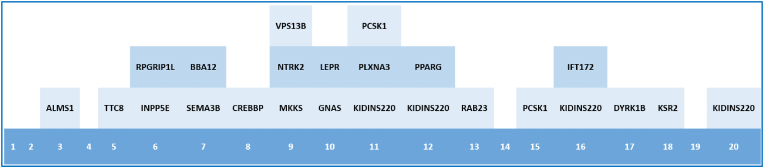
Retrospective chart review identified patients with severe obesity who presented for pre-kidney transplant weight management. 20 individuals met criteria for testing for genetic causes of obesity. A χ2 test of independence was utilized to compare genetic mutation rates in this cohort to all individuals tested nationally.
Results
This case series presents a cohort of patients with severe obesity and end-stage renal disease who were subsequently found to have a significantly higher rate of KIDINS220 mutations (20 %, χ2 = 27.8, p < 0.0001) compared to the national positivity rate of all individuals tested for genetic causes of obesity.
Conclusions
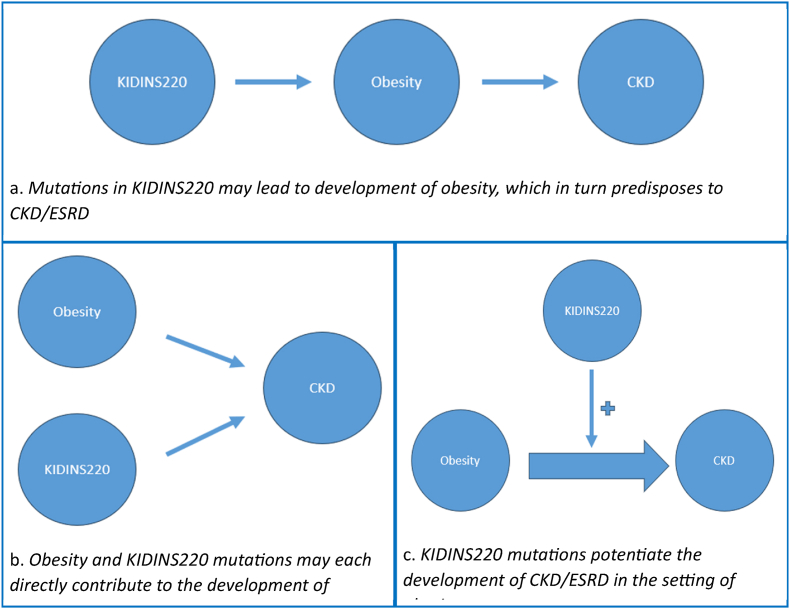
Mutations within KIDINS220 may play a modulatory role in the progression of chronic kidney disease in patients with obesity, as evidenced by this small retrospective study. The relationship between KIDINS200, kidney disease, and obesity is complex and requires further study, but may represent a potential therapeutic target in the future.



 京公网安备 11010802042870号
京ICP备2023020795号-1
京公网安备 11010802042870号
京ICP备2023020795号-1

 分享
分享

 求助内容:
求助内容: 应助结果提醒方式:
 扫码关注我们
