{"title":"Pt1In single atom alloy for visible-light-driven CO2 formylation of benzylamine","authors":"Peng Bai , Jiafa Chen , Yicheng Zhao , Yongdan Li","doi":"10.1016/j.nanoen.2025.110673","DOIUrl":null,"url":null,"abstract":"<div><div>CO<sub>2</sub> formylation of amines provides a promising route to convert CO<sub>2</sub> into value-added chemicals. That process is usually performed through a thermo-catalytic approach with additional reducing agents, which increases the energy consumption and the complexity of the system. Herein, we report photocatalytic CO<sub>2</sub> formylation of benzylamine over Pt<sub>1</sub>In-ZnO<sub>x</sub> single-atom-alloy catalyst at room temperature in <em>N</em>,<em>N</em>-dimethylformamide (DMF) solvent. The anchoring of Pt single atoms onto In nanoparticles through Pt-In bonds accompanied with electron transfer from In to Pt improves the absorption capacity for visible light and the separation efficiency of photogenerated charge carriers. Furthermore, the adsorption and activation of CO<sub>2</sub> and benzylamine are promoted on the surface of Pt<sub>1</sub>In single-atom-alloy. After 6 h reaction under visible-light, the yield of <em>N</em>-benzylformamide reaches 48.6 mmol g<sup>−1</sup> with a 95.3 % selectivity. A possible reaction mechanism is proposed based on a series of in situ characterizations and theoretical calculations. A decomposition-regeneration cycle of DMF is involved in the photocatalytic process, which extends the reaction region and thus facilitates the formylation of benzylamine. The photocatalytic system exhibits good cycling stability and universality. This work provides new insights for the rational design of single-atom-alloy catalyst and an efficient approach for the sustainable utilization of CO<sub>2</sub>.</div></div>","PeriodicalId":394,"journal":{"name":"Nano Energy","volume":"135 ","pages":"Article 110673"},"PeriodicalIF":17.1000,"publicationDate":"2025-03-01","publicationTypes":"Journal Article","fieldsOfStudy":null,"isOpenAccess":false,"openAccessPdf":"","citationCount":"0","resultStr":null,"platform":"Semanticscholar","paperid":null,"PeriodicalName":"Nano Energy","FirstCategoryId":"88","ListUrlMain":"https://www.sciencedirect.com/science/article/pii/S2211285525000321","RegionNum":1,"RegionCategory":"材料科学","ArticlePicture":[],"TitleCN":null,"AbstractTextCN":null,"PMCID":null,"EPubDate":"2025/1/14 0:00:00","PubModel":"Epub","JCR":"Q1","JCRName":"CHEMISTRY, PHYSICAL","Score":null,"Total":0}
引用次数: 0
Abstract
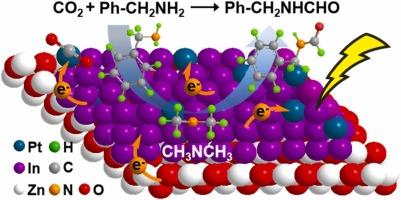
CO2 formylation of amines provides a promising route to convert CO2 into value-added chemicals. That process is usually performed through a thermo-catalytic approach with additional reducing agents, which increases the energy consumption and the complexity of the system. Herein, we report photocatalytic CO2 formylation of benzylamine over Pt1In-ZnOx single-atom-alloy catalyst at room temperature in N,N-dimethylformamide (DMF) solvent. The anchoring of Pt single atoms onto In nanoparticles through Pt-In bonds accompanied with electron transfer from In to Pt improves the absorption capacity for visible light and the separation efficiency of photogenerated charge carriers. Furthermore, the adsorption and activation of CO2 and benzylamine are promoted on the surface of Pt1In single-atom-alloy. After 6 h reaction under visible-light, the yield of N-benzylformamide reaches 48.6 mmol g−1 with a 95.3 % selectivity. A possible reaction mechanism is proposed based on a series of in situ characterizations and theoretical calculations. A decomposition-regeneration cycle of DMF is involved in the photocatalytic process, which extends the reaction region and thus facilitates the formylation of benzylamine. The photocatalytic system exhibits good cycling stability and universality. This work provides new insights for the rational design of single-atom-alloy catalyst and an efficient approach for the sustainable utilization of CO2.
期刊介绍:
Nano Energy is a multidisciplinary, rapid-publication forum of original peer-reviewed contributions on the science and engineering of nanomaterials and nanodevices used in all forms of energy harvesting, conversion, storage, utilization and policy. Through its mixture of articles, reviews, communications, research news, and information on key developments, Nano Energy provides a comprehensive coverage of this exciting and dynamic field which joins nanoscience and nanotechnology with energy science. The journal is relevant to all those who are interested in nanomaterials solutions to the energy problem.
Nano Energy publishes original experimental and theoretical research on all aspects of energy-related research which utilizes nanomaterials and nanotechnology. Manuscripts of four types are considered: review articles which inform readers of the latest research and advances in energy science; rapid communications which feature exciting research breakthroughs in the field; full-length articles which report comprehensive research developments; and news and opinions which comment on topical issues or express views on the developments in related fields.



 京公网安备 11010802042870号
京ICP备2023020795号-1
京公网安备 11010802042870号
京ICP备2023020795号-1

 分享
分享
 求助内容:
求助内容: 应助结果提醒方式:
 扫码关注我们
