Ying Zheng, Zhiyou Wang, Qianju Song, Zao Yi, Shubo Cheng and Yougen Yi
{"title":"Thermal management broadband-emitting device based on VO2 applied in the mid-infrared band","authors":"Ying Zheng, Zhiyou Wang, Qianju Song, Zao Yi, Shubo Cheng and Yougen Yi","doi":"10.1039/D4DT03422H","DOIUrl":null,"url":null,"abstract":"<p >Mid-infrared thermal radiation has attracted attention due to its wide range of applications. Compared to the static process of thermal emission, if thermal radiation can be dynamically controlled, it would be more suitable for practical applications. Herein, we designed a controllable thermal emitter based on phase change materials. When the temperature changes from low to high, VO<small><sub>2</sub></small> transitions from a dielectric state to a metallic state, and its imaginary part of the dielectric constant significantly increases, leading to differences in emission characteristics. At low temperatures, the device is in a low dielectric state and resonates weakly with incident light. The main emission comes from the bottom of the grating structure, with an emissivity of 0.21. At high temperatures, the structure is in a high dielectric state, and multiple resonance modes are excited within the structure, such as cavity resonance and surface plasmon resonance, which increases the emissivity to 0.95 and achieves effective heat dissipation. Given its superior thermal management capabilities and stability, this design holds promise for applications in thermal imaging, infrared communication, and energy-efficient devices.</p>","PeriodicalId":71,"journal":{"name":"Dalton Transactions","volume":" 8","pages":" 3157-3164"},"PeriodicalIF":3.3000,"publicationDate":"2025-01-14","publicationTypes":"Journal Article","fieldsOfStudy":null,"isOpenAccess":false,"openAccessPdf":"","citationCount":"0","resultStr":null,"platform":"Semanticscholar","paperid":null,"PeriodicalName":"Dalton Transactions","FirstCategoryId":"92","ListUrlMain":"https://pubs.rsc.org/en/content/articlelanding/2025/dt/d4dt03422h","RegionNum":3,"RegionCategory":"化学","ArticlePicture":[],"TitleCN":null,"AbstractTextCN":null,"PMCID":null,"EPubDate":"","PubModel":"","JCR":"Q2","JCRName":"CHEMISTRY, INORGANIC & NUCLEAR","Score":null,"Total":0}
引用次数: 0
Abstract
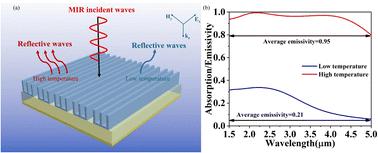
Mid-infrared thermal radiation has attracted attention due to its wide range of applications. Compared to the static process of thermal emission, if thermal radiation can be dynamically controlled, it would be more suitable for practical applications. Herein, we designed a controllable thermal emitter based on phase change materials. When the temperature changes from low to high, VO2 transitions from a dielectric state to a metallic state, and its imaginary part of the dielectric constant significantly increases, leading to differences in emission characteristics. At low temperatures, the device is in a low dielectric state and resonates weakly with incident light. The main emission comes from the bottom of the grating structure, with an emissivity of 0.21. At high temperatures, the structure is in a high dielectric state, and multiple resonance modes are excited within the structure, such as cavity resonance and surface plasmon resonance, which increases the emissivity to 0.95 and achieves effective heat dissipation. Given its superior thermal management capabilities and stability, this design holds promise for applications in thermal imaging, infrared communication, and energy-efficient devices.
期刊介绍:
Dalton Transactions is a journal for all areas of inorganic chemistry, which encompasses the organometallic, bioinorganic and materials chemistry of the elements, with applications including synthesis, catalysis, energy conversion/storage, electrical devices and medicine. Dalton Transactions welcomes high-quality, original submissions in all of these areas and more, where the advancement of knowledge in inorganic chemistry is significant.



 京公网安备 11010802042870号
京ICP备2023020795号-1
京公网安备 11010802042870号
京ICP备2023020795号-1

 分享
分享
 求助内容:
求助内容: 应助结果提醒方式:
 扫码关注我们
