Zhirou Zhang, Enyun Xing, Wenzhuo Zhao, Minghui Song, Cuiping Zhang, Hong Liu, Xiaomin Li and Hongxiu Yu
{"title":"Rapid identification of pathogenic bacteria from clinical positive blood cultures via virus-like magnetic bead enrichment and MALDI-TOF MS profiling","authors":"Zhirou Zhang, Enyun Xing, Wenzhuo Zhao, Minghui Song, Cuiping Zhang, Hong Liu, Xiaomin Li and Hongxiu Yu","doi":"10.1039/D4AN01424C","DOIUrl":null,"url":null,"abstract":"<p >Reducing the time required for the detection of bacteria in blood samples is a critical area of investigation in the field of clinical diagnosis. Positive blood culture samples often require a plate culture stage due to the interference of blood cells and proteins, which can result in significant delays before the isolation of single colonies suitable for matrix-assisted laser desorption/ionization time-of-flight mass spectrometry (MALDI-TOF MS) analysis. In this study, we developed a non-specific enrichment strategy based on SiO<small><sub>2</sub></small>-encapsulated Fe<small><sub>3</sub></small>O<small><sub>4</sub></small> nanoparticles combined with MALDI-TOF MS for direct identification of bacteria from aqueous environments or positive blood culture samples. Three distinct types of Fe<small><sub>3</sub></small>O<small><sub>4</sub></small>@SiO<small><sub>2</sub></small> magnetic nanoparticles (MNPs) with unique surface morphologies were developed: spherical MNPs with smooth surfaces (Fe<small><sub>3</sub></small>O<small><sub>4</sub></small>@SN), mesoporous silica coated MNPs (Fe<small><sub>3</sub></small>O<small><sub>4</sub></small>@MSN), and MNPs exhibiting a viral spiked structure (Fe<small><sub>3</sub></small>O<small><sub>4</sub></small>@VSN). These MNPs exhibited excellent binding affinity towards both <em>Staphylococcus aureus</em> and <em>Klebsiella pneumoniae</em> in PBS and artificial saliva solutions. Furthermore, the strategy of using Fe<small><sub>3</sub></small>O<small><sub>4</sub></small>@VSN, which involves non-specific interactions between bacterial cells and the virus-like surface, resulted in a dramatic reduction in the minimum detectable concentrations of target pathogens by up to 1000-fold compared to conventional methods. Our results demonstrate that the use of Fe<small><sub>3</sub></small>O<small><sub>4</sub></small>@VSN has the potential to significantly reduce the processing time required after blood culture and may be useful for enrichment and identification of microorganisms in complex clinical samples.</p>","PeriodicalId":63,"journal":{"name":"Analyst","volume":" 5","pages":" 827-840"},"PeriodicalIF":3.3000,"publicationDate":"2025-01-14","publicationTypes":"Journal Article","fieldsOfStudy":null,"isOpenAccess":false,"openAccessPdf":"","citationCount":"0","resultStr":null,"platform":"Semanticscholar","paperid":null,"PeriodicalName":"Analyst","FirstCategoryId":"92","ListUrlMain":"https://pubs.rsc.org/en/content/articlelanding/2025/an/d4an01424c","RegionNum":3,"RegionCategory":"化学","ArticlePicture":[],"TitleCN":null,"AbstractTextCN":null,"PMCID":null,"EPubDate":"","PubModel":"","JCR":"Q2","JCRName":"CHEMISTRY, ANALYTICAL","Score":null,"Total":0}
引用次数: 0
Abstract
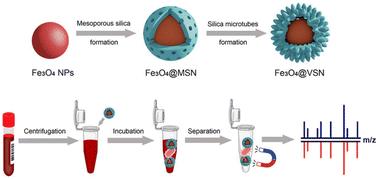
Reducing the time required for the detection of bacteria in blood samples is a critical area of investigation in the field of clinical diagnosis. Positive blood culture samples often require a plate culture stage due to the interference of blood cells and proteins, which can result in significant delays before the isolation of single colonies suitable for matrix-assisted laser desorption/ionization time-of-flight mass spectrometry (MALDI-TOF MS) analysis. In this study, we developed a non-specific enrichment strategy based on SiO2-encapsulated Fe3O4 nanoparticles combined with MALDI-TOF MS for direct identification of bacteria from aqueous environments or positive blood culture samples. Three distinct types of Fe3O4@SiO2 magnetic nanoparticles (MNPs) with unique surface morphologies were developed: spherical MNPs with smooth surfaces (Fe3O4@SN), mesoporous silica coated MNPs (Fe3O4@MSN), and MNPs exhibiting a viral spiked structure (Fe3O4@VSN). These MNPs exhibited excellent binding affinity towards both Staphylococcus aureus and Klebsiella pneumoniae in PBS and artificial saliva solutions. Furthermore, the strategy of using Fe3O4@VSN, which involves non-specific interactions between bacterial cells and the virus-like surface, resulted in a dramatic reduction in the minimum detectable concentrations of target pathogens by up to 1000-fold compared to conventional methods. Our results demonstrate that the use of Fe3O4@VSN has the potential to significantly reduce the processing time required after blood culture and may be useful for enrichment and identification of microorganisms in complex clinical samples.




 京公网安备 11010802042870号
京ICP备2023020795号-1
京公网安备 11010802042870号
京ICP备2023020795号-1

 分享
分享
 求助内容:
求助内容: 应助结果提醒方式:
 扫码关注我们
