Lijun Hu, Lei Jiao, Chengjie Chen, Xiangkun Jia, Xiaotong Li, Dongbo Yan, Yanling Zhai, Xiaoquan Lu
{"title":"Nanozymes with Modulable Inhibition Transfer Pathways for Thiol and Cell Identification","authors":"Lijun Hu, Lei Jiao, Chengjie Chen, Xiangkun Jia, Xiaotong Li, Dongbo Yan, Yanling Zhai, Xiaoquan Lu","doi":"10.1021/acs.analchem.4c05355","DOIUrl":null,"url":null,"abstract":"The elementary mechanism and site studies of nanozyme-based inhibition reactions are ambiguous and urgently require advanced nanozymes as mediators to elucidate the inhibition effect. To this end, we develop a class of nanozymes featuring single Cu–N catalytic configurations and B–O sites as binding configurations on a porous nitrogen-doped carbon substrate (B<sub>6</sub>/Cu<sub>SA</sub>) for inducing modulable inhibition transfer at the atomic level. The full redistribution of electrons across the Cu–N sites, induced by B–O sites incorporation, yields B<sub>6</sub>/Cu<sub>SA</sub> with enhanced peroxidase-like activity versus Cu<sub>SA</sub>. More importantly, Cu<sub>SA</sub> with single Cu–N sites features in cysteine binding and expresses a competitive inhibition through coordination bonds, with an inhibition constant of 0.048 mM. Benefiting from the modulable binding way in nanozymes, B<sub>6</sub>/Cu<sub>SA</sub> possesses mixed binding approaches for cysteine through noncovalent bonds and delivers a record-mixed inhibition interaction with a competitive inhibition constant of 0.054 mM and a noncompetitive inhibition constant of 0.71 mM. Based on the modulable inhibition of B<sub>6</sub>/Cu<sub>SA</sub> and Cu<sub>SA</sub>, a multichannel sensor array accomplishes the detection of various cancer cells, normal cells, and thiols. The design principle of this work is endowed with guidelines for the preliminary inhibition mechanism evaluation of massive potential thiols, cell discrimination, and disease prediction.","PeriodicalId":27,"journal":{"name":"Analytical Chemistry","volume":"36 1","pages":""},"PeriodicalIF":6.7000,"publicationDate":"2025-01-13","publicationTypes":"Journal Article","fieldsOfStudy":null,"isOpenAccess":false,"openAccessPdf":"","citationCount":"0","resultStr":null,"platform":"Semanticscholar","paperid":null,"PeriodicalName":"Analytical Chemistry","FirstCategoryId":"92","ListUrlMain":"https://doi.org/10.1021/acs.analchem.4c05355","RegionNum":1,"RegionCategory":"化学","ArticlePicture":[],"TitleCN":null,"AbstractTextCN":null,"PMCID":null,"EPubDate":"","PubModel":"","JCR":"Q1","JCRName":"CHEMISTRY, ANALYTICAL","Score":null,"Total":0}
引用次数: 0
Abstract
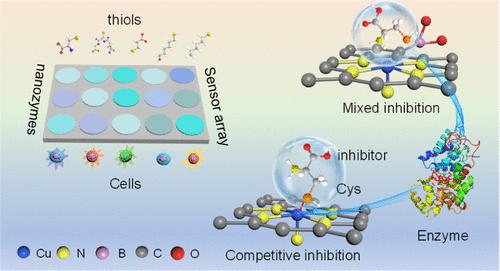
The elementary mechanism and site studies of nanozyme-based inhibition reactions are ambiguous and urgently require advanced nanozymes as mediators to elucidate the inhibition effect. To this end, we develop a class of nanozymes featuring single Cu–N catalytic configurations and B–O sites as binding configurations on a porous nitrogen-doped carbon substrate (B6/CuSA) for inducing modulable inhibition transfer at the atomic level. The full redistribution of electrons across the Cu–N sites, induced by B–O sites incorporation, yields B6/CuSA with enhanced peroxidase-like activity versus CuSA. More importantly, CuSA with single Cu–N sites features in cysteine binding and expresses a competitive inhibition through coordination bonds, with an inhibition constant of 0.048 mM. Benefiting from the modulable binding way in nanozymes, B6/CuSA possesses mixed binding approaches for cysteine through noncovalent bonds and delivers a record-mixed inhibition interaction with a competitive inhibition constant of 0.054 mM and a noncompetitive inhibition constant of 0.71 mM. Based on the modulable inhibition of B6/CuSA and CuSA, a multichannel sensor array accomplishes the detection of various cancer cells, normal cells, and thiols. The design principle of this work is endowed with guidelines for the preliminary inhibition mechanism evaluation of massive potential thiols, cell discrimination, and disease prediction.
期刊介绍:
Analytical Chemistry, a peer-reviewed research journal, focuses on disseminating new and original knowledge across all branches of analytical chemistry. Fundamental articles may explore general principles of chemical measurement science and need not directly address existing or potential analytical methodology. They can be entirely theoretical or report experimental results. Contributions may cover various phases of analytical operations, including sampling, bioanalysis, electrochemistry, mass spectrometry, microscale and nanoscale systems, environmental analysis, separations, spectroscopy, chemical reactions and selectivity, instrumentation, imaging, surface analysis, and data processing. Papers discussing known analytical methods should present a significant, original application of the method, a notable improvement, or results on an important analyte.




 京公网安备 11010802042870号
京ICP备2023020795号-1
京公网安备 11010802042870号
京ICP备2023020795号-1

 分享
分享
 求助内容:
求助内容: 应助结果提醒方式:
 扫码关注我们
