Rafael Salido-Vallejo, Inés Oteiza-Rius, Ana Morelló-Vicente, Javier Antoñanzas, Agustín España
{"title":"Combined flap for the reconstruction of Upper-third auricular complex defects involving the helix root","authors":"Rafael Salido-Vallejo, Inés Oteiza-Rius, Ana Morelló-Vicente, Javier Antoñanzas, Agustín España","doi":"10.1111/ddg.15631","DOIUrl":null,"url":null,"abstract":"<p>The reconstruction of oncological defects located in the upper third of the helical rim presents a significant surgical task due to the anatomical complexity of the ear with its concave and convex features, along with the presence of cartilaginous structures.<span><sup>1</sup></span> Moreover, the necessity to preserve its functionality, particularly in the helix root, and maintain facial symmetry, adds further complexity to the process. Consequently, choosing the optimal reconstruction option for the helix depends on various factors, such as the size and extent of the defect, as well as the characteristics of the patient. There are multiple reconstructive options described to date such as temporoparietal fascia flaps,<span><sup>2</sup></span> retroauricular flaps,<span><sup>1</sup></span> or chondrocutaneous composite transposition flaps.<span><sup>3</sup></span> From our experience, combining flaps may be suitable for defects affecting the upper third of the helix, including the helix root, as they can help to align with the demands of this particular location.</p><p>We report the case of a 90-year-old man who presented at our dermatology department with an infiltrative basal cell carcinoma on the upper third of the helix that had been resected 2 months previously, with involvement of the lateral and deep margins. Tumor clearance was achieved through two stages of Mohs micrographic surgery, resulting in a complete resection of the upper third of the helix, involving the helix root, and a supra and preauricular defect (Figure 1).</p><p>We designed a combined flap, which included an advancement flap of the preauricular region and a rotation of the helix using two discharge triangles in the antihelix. (Figure 2a). The preauricular flap is dissected and shaped in the subcutaneous plane and two wedge excisions are performed in the anterior region of the preauricular defect and in the infra-auricular area. In some cases, the use of guitar-string subcutaneous suture may be helpful to reduce the size of the retroauricular defect and decrease the area to be covered by the flap.<span><sup>4</sup></span> Once the size of the defect is reduced, a discharge triangle is removed and then sutured (non-absorbable 6/0 suture) in the anterior part of the helix (Figure 2b), which helps to recreate its curved shape. In cases where the helix root is affected, it may be necessary to add a second discharge triangle of a smaller size immediately inferior to the helix and antihelix union (Figure 2c) to help recreate the root of the helix by approximating the edge of the helix to the cymba. Subsequently, the preauricular flap is advanced and sutured using a non-absorbable 6/0 suture. It must be taken into account that in older patients with sun-damaged skin, complete closure of the defect should not be forced in order to avoid flap suffering. As in our case, secondary intention healing may be acceptable in the upper part of the defect (Figure 2d). Three months after surgery, healing was completed (Figure 3).</p><p>Generally, the reconstructive options for the ear can be categorized into those that result in an auricular reduction or not.<span><sup>5</sup></span> Techniques preserving the auricular size include temporoparietal fascia flaps,<span><sup>2</sup></span> retroauricular flaps,<span><sup>1</sup></span> or chondrocutaneous composite transposition flaps,<span><sup>3</sup></span> and are usually excellent options for young patients with congenital malformations or traumatic injuries affecting the auricular pavilion, as they uphold facial symmetry. However, it should be noted that these methods entail complex techniques, general anesthesia, cartilaginous grafts and often require multiple interventions, making them less suitable for elderly patients with multiple comorbidities. Conversely, options which reduce the ear size imply a simpler technique, which can be performed under local anesthesia in a single intervention.<span><sup>5</sup></span> These approaches may include excising a discharge triangle in the helix or using a half-moon shaped excision in the antihelix in order to rotate the helix and restore its curved shape. Nonetheless, for larger defects these options may be insufficient and, therefore, combination of flaps should be considered. The use of a Dufourmentel flap,<span><sup>5</sup></span> combined with discharge triangles has been described for reconstructing defects involving the upper third of the helix, including the helix root and the preauricular region. Our approach, with two wedge excisions, reduces the skin mobilization in the preauricular region, leading to satisfactory functional and aesthetic outcomes.</p><p>Combined flaps can be an appropriate option for the reconstruction of complex defects in the upper third of the auricle. The use of two wedge excisions of the antihelix allows for a straightforward reconstruction of the helical root.</p><p>None.</p>","PeriodicalId":14758,"journal":{"name":"Journal Der Deutschen Dermatologischen Gesellschaft","volume":"23 4","pages":"540-542"},"PeriodicalIF":3.8000,"publicationDate":"2025-01-15","publicationTypes":"Journal Article","fieldsOfStudy":null,"isOpenAccess":false,"openAccessPdf":"https://onlinelibrary.wiley.com/doi/epdf/10.1111/ddg.15631","citationCount":"0","resultStr":null,"platform":"Semanticscholar","paperid":null,"PeriodicalName":"Journal Der Deutschen Dermatologischen Gesellschaft","FirstCategoryId":"3","ListUrlMain":"https://onlinelibrary.wiley.com/doi/10.1111/ddg.15631","RegionNum":4,"RegionCategory":"医学","ArticlePicture":[],"TitleCN":null,"AbstractTextCN":null,"PMCID":null,"EPubDate":"","PubModel":"","JCR":"Q1","JCRName":"DERMATOLOGY","Score":null,"Total":0}
引用次数: 0
Abstract
The reconstruction of oncological defects located in the upper third of the helical rim presents a significant surgical task due to the anatomical complexity of the ear with its concave and convex features, along with the presence of cartilaginous structures.1 Moreover, the necessity to preserve its functionality, particularly in the helix root, and maintain facial symmetry, adds further complexity to the process. Consequently, choosing the optimal reconstruction option for the helix depends on various factors, such as the size and extent of the defect, as well as the characteristics of the patient. There are multiple reconstructive options described to date such as temporoparietal fascia flaps,2 retroauricular flaps,1 or chondrocutaneous composite transposition flaps.3 From our experience, combining flaps may be suitable for defects affecting the upper third of the helix, including the helix root, as they can help to align with the demands of this particular location.
We report the case of a 90-year-old man who presented at our dermatology department with an infiltrative basal cell carcinoma on the upper third of the helix that had been resected 2 months previously, with involvement of the lateral and deep margins. Tumor clearance was achieved through two stages of Mohs micrographic surgery, resulting in a complete resection of the upper third of the helix, involving the helix root, and a supra and preauricular defect (Figure 1).
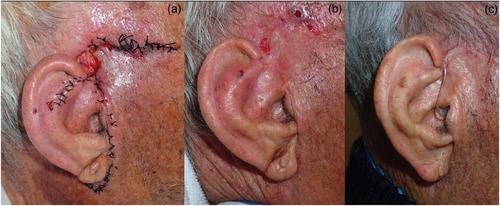
We designed a combined flap, which included an advancement flap of the preauricular region and a rotation of the helix using two discharge triangles in the antihelix. (Figure 2a). The preauricular flap is dissected and shaped in the subcutaneous plane and two wedge excisions are performed in the anterior region of the preauricular defect and in the infra-auricular area. In some cases, the use of guitar-string subcutaneous suture may be helpful to reduce the size of the retroauricular defect and decrease the area to be covered by the flap.4 Once the size of the defect is reduced, a discharge triangle is removed and then sutured (non-absorbable 6/0 suture) in the anterior part of the helix (Figure 2b), which helps to recreate its curved shape. In cases where the helix root is affected, it may be necessary to add a second discharge triangle of a smaller size immediately inferior to the helix and antihelix union (Figure 2c) to help recreate the root of the helix by approximating the edge of the helix to the cymba. Subsequently, the preauricular flap is advanced and sutured using a non-absorbable 6/0 suture. It must be taken into account that in older patients with sun-damaged skin, complete closure of the defect should not be forced in order to avoid flap suffering. As in our case, secondary intention healing may be acceptable in the upper part of the defect (Figure 2d). Three months after surgery, healing was completed (Figure 3).
Generally, the reconstructive options for the ear can be categorized into those that result in an auricular reduction or not.5 Techniques preserving the auricular size include temporoparietal fascia flaps,2 retroauricular flaps,1 or chondrocutaneous composite transposition flaps,3 and are usually excellent options for young patients with congenital malformations or traumatic injuries affecting the auricular pavilion, as they uphold facial symmetry. However, it should be noted that these methods entail complex techniques, general anesthesia, cartilaginous grafts and often require multiple interventions, making them less suitable for elderly patients with multiple comorbidities. Conversely, options which reduce the ear size imply a simpler technique, which can be performed under local anesthesia in a single intervention.5 These approaches may include excising a discharge triangle in the helix or using a half-moon shaped excision in the antihelix in order to rotate the helix and restore its curved shape. Nonetheless, for larger defects these options may be insufficient and, therefore, combination of flaps should be considered. The use of a Dufourmentel flap,5 combined with discharge triangles has been described for reconstructing defects involving the upper third of the helix, including the helix root and the preauricular region. Our approach, with two wedge excisions, reduces the skin mobilization in the preauricular region, leading to satisfactory functional and aesthetic outcomes.
Combined flaps can be an appropriate option for the reconstruction of complex defects in the upper third of the auricle. The use of two wedge excisions of the antihelix allows for a straightforward reconstruction of the helical root.
期刊介绍:
The JDDG publishes scientific papers from a wide range of disciplines, such as dermatovenereology, allergology, phlebology, dermatosurgery, dermatooncology, and dermatohistopathology. Also in JDDG: information on medical training, continuing education, a calendar of events, book reviews and society announcements.
Papers can be submitted in German or English language. In the print version, all articles are published in German. In the online version, all key articles are published in English.



 京公网安备 11010802042870号
京ICP备2023020795号-1
京公网安备 11010802042870号
京ICP备2023020795号-1

 分享
分享
 求助内容:
求助内容: 应助结果提醒方式:
 扫码关注我们
