{"title":"Predictive Inspection and Maintenance Optimization for Partially Observable Semi-Markov Deteriorating Systems","authors":"Chunhui Guo;Zhenglin Liang","doi":"10.1109/TASE.2025.3530014","DOIUrl":null,"url":null,"abstract":"Inspection and maintenance strategies are crucial for ensuring system serviceability. Due to stochastic deterioration and limited observability, sequential decision-making often relies on established approaches such as Partially Observable Markov Decision Processes (POMDPs). However, such approaches impose constraints on periodic decision epochs and exponentially distributed sojourn times, leading to redundant early-stage inspections and increased overall costs. To address these limitations, we propose a novel Predictive Semi-Markov Decision Process (PSMDP) that leverages Remaining Useful Life (RUL) predictions to reduce unnecessary inspections. Our approach incorporates an online scheme that utilizes inspection data for RUL prediction and proactively schedules subsequent maintenance decisions. When applied to infrastructure management, such as bridge maintenance, our PSMDP demonstrates an average cost reduction of 8.9% across various deterioration scenarios compared to other sequential decision-making models. Note to Practitioners—Effective infrastructure maintenance is essential for ensuring public safety and economic growth. However, limited budgets necessitate more efficient strategies. Current periodic inspection strategies often lead to wasteful expenditures due to unnecessary inspections during the early stages of deterioration. To address this challenge, we propose a predictive and proactive approach that leverages Remaining Useful Life (RUL) estimation to schedule inspections and optimize sequential maintenance decisions. By intelligently planning inspections, practitioners can reduce redundant inspections by 89.5% and save overall costs by 8.9% while retaining the required reliability. This approach facilitates a paradigm shift from condition-based maintenance to predictive maintenance.","PeriodicalId":51060,"journal":{"name":"IEEE Transactions on Automation Science and Engineering","volume":"22 ","pages":"10893-10904"},"PeriodicalIF":6.4000,"publicationDate":"2025-01-15","publicationTypes":"Journal Article","fieldsOfStudy":null,"isOpenAccess":false,"openAccessPdf":"","citationCount":"0","resultStr":null,"platform":"Semanticscholar","paperid":null,"PeriodicalName":"IEEE Transactions on Automation Science and Engineering","FirstCategoryId":"94","ListUrlMain":"https://ieeexplore.ieee.org/document/10843261/","RegionNum":2,"RegionCategory":"计算机科学","ArticlePicture":[],"TitleCN":null,"AbstractTextCN":null,"PMCID":null,"EPubDate":"","PubModel":"","JCR":"Q1","JCRName":"AUTOMATION & CONTROL SYSTEMS","Score":null,"Total":0}
引用次数: 0
Abstract
Inspection and maintenance strategies are crucial for ensuring system serviceability. Due to stochastic deterioration and limited observability, sequential decision-making often relies on established approaches such as Partially Observable Markov Decision Processes (POMDPs). However, such approaches impose constraints on periodic decision epochs and exponentially distributed sojourn times, leading to redundant early-stage inspections and increased overall costs. To address these limitations, we propose a novel Predictive Semi-Markov Decision Process (PSMDP) that leverages Remaining Useful Life (RUL) predictions to reduce unnecessary inspections. Our approach incorporates an online scheme that utilizes inspection data for RUL prediction and proactively schedules subsequent maintenance decisions. When applied to infrastructure management, such as bridge maintenance, our PSMDP demonstrates an average cost reduction of 8.9% across various deterioration scenarios compared to other sequential decision-making models. Note to Practitioners—Effective infrastructure maintenance is essential for ensuring public safety and economic growth. However, limited budgets necessitate more efficient strategies. Current periodic inspection strategies often lead to wasteful expenditures due to unnecessary inspections during the early stages of deterioration. To address this challenge, we propose a predictive and proactive approach that leverages Remaining Useful Life (RUL) estimation to schedule inspections and optimize sequential maintenance decisions. By intelligently planning inspections, practitioners can reduce redundant inspections by 89.5% and save overall costs by 8.9% while retaining the required reliability. This approach facilitates a paradigm shift from condition-based maintenance to predictive maintenance.
期刊介绍:
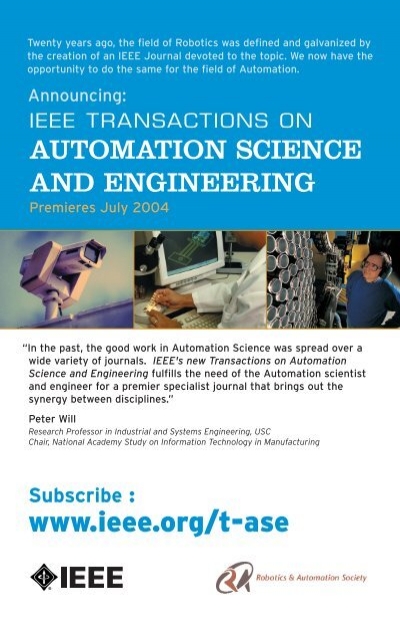
The IEEE Transactions on Automation Science and Engineering (T-ASE) publishes fundamental papers on Automation, emphasizing scientific results that advance efficiency, quality, productivity, and reliability. T-ASE encourages interdisciplinary approaches from computer science, control systems, electrical engineering, mathematics, mechanical engineering, operations research, and other fields. T-ASE welcomes results relevant to industries such as agriculture, biotechnology, healthcare, home automation, maintenance, manufacturing, pharmaceuticals, retail, security, service, supply chains, and transportation. T-ASE addresses a research community willing to integrate knowledge across disciplines and industries. For this purpose, each paper includes a Note to Practitioners that summarizes how its results can be applied or how they might be extended to apply in practice.



 京公网安备 11010802042870号
京ICP备2023020795号-1
京公网安备 11010802042870号
京ICP备2023020795号-1

 分享
分享
 求助内容:
求助内容: 应助结果提醒方式:
 扫码关注我们
