Tanmay Goswami, Himanshu Bhatt, Dharmendra Kumar Yadav and Hirendra N. Ghosh
{"title":"Ultrafast broadband spectroscopy of widely spread excitonic features in WSe2 nanosheets†","authors":"Tanmay Goswami, Himanshu Bhatt, Dharmendra Kumar Yadav and Hirendra N. Ghosh","doi":"10.1039/D4NR03874F","DOIUrl":null,"url":null,"abstract":"<p >The performance of an optoelectronic device is largely dependent on the light harvesting properties of the active material as well as the dynamic behaviour of the photoexcited charge carriers upon absorption of light. Recently, atomically thin two-dimensional transition metal dichalcogenides (2D TMDCs) have garnered attention as highly prospective materials for advanced ultrathin solar cells and other optoelectronic applications, owing to their strong interaction with electromagnetic radiation, substantial optical conductivity, and impressive charge carrier mobility. WSe<small><sub>2</sub></small> is one such extremely promising solar energy material. It has absorption throughout the UV-Vis-NIR region with the existence of four excitonic features, just like MoS<small><sub>2</sub></small> and WS<small><sub>2</sub></small>. However, stability issues and the absence of any robust synthetic route limit their practical applications. Herein, we have successfully synthesized atomically thin stable WSe<small><sub>2</sub></small> nanosheets using a very effective colloidal hot injection method and further studied the optical properties of this material using femtosecond transient absorption spectroscopy. We probed all four excitonic features of WSe<small><sub>2</sub></small> spread throughout the visible region. The dynamics of the high-energy excitons were found to be distinctively slower when compared to their band edge counterparts, adding an additional advantage in optoelectronic applications. We delved further into the factors governing exciton dynamics within WSe<small><sub>2</sub></small>, uncovering the strong influence of the electronic band structure. Importantly, our study highlights the importance of all four excitonic features in a 2D TMDC material, which emerge in the system irrespective of the excitation wavelength and influence each other.</p>","PeriodicalId":92,"journal":{"name":"Nanoscale","volume":" 9","pages":" 5213-5221"},"PeriodicalIF":5.1000,"publicationDate":"2025-01-16","publicationTypes":"Journal Article","fieldsOfStudy":null,"isOpenAccess":false,"openAccessPdf":"","citationCount":"0","resultStr":null,"platform":"Semanticscholar","paperid":null,"PeriodicalName":"Nanoscale","FirstCategoryId":"88","ListUrlMain":"https://pubs.rsc.org/en/content/articlelanding/2025/nr/d4nr03874f","RegionNum":3,"RegionCategory":"材料科学","ArticlePicture":[],"TitleCN":null,"AbstractTextCN":null,"PMCID":null,"EPubDate":"","PubModel":"","JCR":"Q1","JCRName":"CHEMISTRY, MULTIDISCIPLINARY","Score":null,"Total":0}
引用次数: 0
Abstract
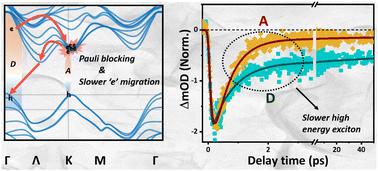
The performance of an optoelectronic device is largely dependent on the light harvesting properties of the active material as well as the dynamic behaviour of the photoexcited charge carriers upon absorption of light. Recently, atomically thin two-dimensional transition metal dichalcogenides (2D TMDCs) have garnered attention as highly prospective materials for advanced ultrathin solar cells and other optoelectronic applications, owing to their strong interaction with electromagnetic radiation, substantial optical conductivity, and impressive charge carrier mobility. WSe2 is one such extremely promising solar energy material. It has absorption throughout the UV-Vis-NIR region with the existence of four excitonic features, just like MoS2 and WS2. However, stability issues and the absence of any robust synthetic route limit their practical applications. Herein, we have successfully synthesized atomically thin stable WSe2 nanosheets using a very effective colloidal hot injection method and further studied the optical properties of this material using femtosecond transient absorption spectroscopy. We probed all four excitonic features of WSe2 spread throughout the visible region. The dynamics of the high-energy excitons were found to be distinctively slower when compared to their band edge counterparts, adding an additional advantage in optoelectronic applications. We delved further into the factors governing exciton dynamics within WSe2, uncovering the strong influence of the electronic band structure. Importantly, our study highlights the importance of all four excitonic features in a 2D TMDC material, which emerge in the system irrespective of the excitation wavelength and influence each other.
期刊介绍:
Nanoscale is a high-impact international journal, publishing high-quality research across nanoscience and nanotechnology. Nanoscale publishes a full mix of research articles on experimental and theoretical work, including reviews, communications, and full papers.Highly interdisciplinary, this journal appeals to scientists, researchers and professionals interested in nanoscience and nanotechnology, quantum materials and quantum technology, including the areas of physics, chemistry, biology, medicine, materials, energy/environment, information technology, detection science, healthcare and drug discovery, and electronics.



 京公网安备 11010802042870号
京ICP备2023020795号-1
京公网安备 11010802042870号
京ICP备2023020795号-1

 分享
分享
 求助内容:
求助内容: 应助结果提醒方式:
 扫码关注我们
