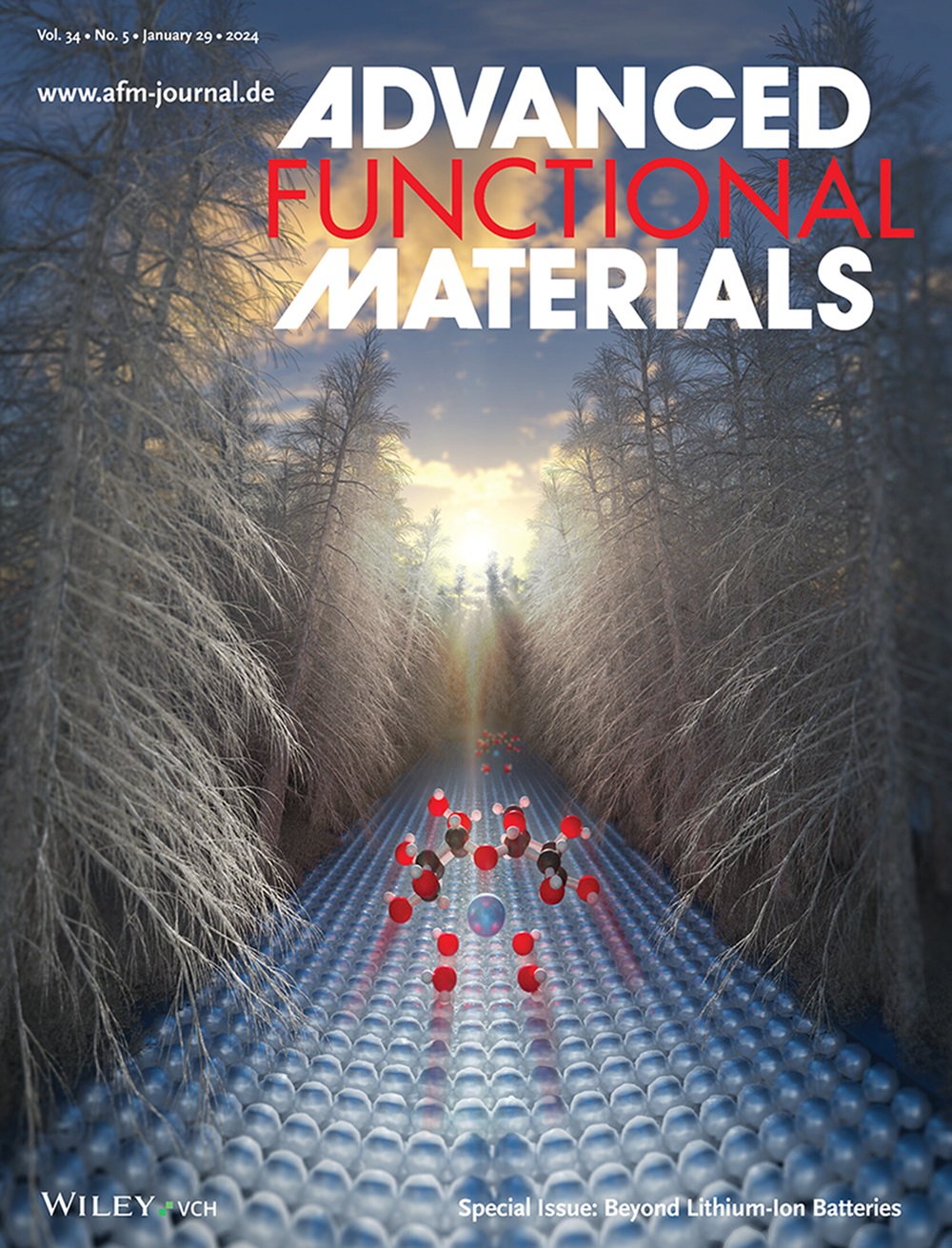
{"title":"Engineering the Metal/Oxide Interfacial O-Filling Effect to Tailor Oxygen Spillover for Efficient Acidic Water Oxidation","authors":"Yu Zhu, Fei Guo, Qiliang Wei, Feiyan Lai, Runzhe Chen, Jianing Guo, Manxi Gong, Shunqiang Zhang, Zichen Wang, Jun Zhong, Guanjie He, Niancai Cheng","doi":"10.1002/adfm.202421354","DOIUrl":null,"url":null,"abstract":"<p>The oxygen spillover on the metal/oxide electrocatalysts interface acts as an essential role in promoting the oxygen evolution reaction (OER) for proton exchange membrane water electrolyzers (PEMWEs). However, oxygen spillover mechanisms and corresponding regulatory strategies are still unclear for addressing slow OH-migration kinetics. Herein, an interface is constructed between Iridium (Ir) and Niobium (Nb)-doped Titanium oxide (TiO<sub>2</sub>) with abundant oxygen vacancies area by plasma processing, enabling oxygen spillover from the metal Ir to supports. The optimized Ir/Nb-doped TiO<sub>2</sub> with a significant OER activity (η = 253 mV) and durability in acids compared to commercial IrO<sub>2</sub>. In situ experiments combined with theoretical computations reveal the presence of interfacial oxygen vacancies not only regulates the Ir structure toward boosted activity but also constructs a directional spillover pathway from Ir to interfacial oxygen vacancies area and then TiO<sub>2</sub> via the OH<sup>*</sup>-filling route, which strikingly mitigates the OH<sup>*</sup> migration barriers. In addition, the optimized Ir/Nb-doped TiO<sub>2</sub> exhibits excellent performance (1.69 V/1.0 A cm<sup>−2</sup>@80 °C) and long-term stability (≈500 [email protected] A cm<sup>−2</sup>) with practical potential in PEMWEs. This work provides a unique insight into the role of oxygen spillover, paving the way for designing Ir-based catalysts for PEMWEs.</p>","PeriodicalId":112,"journal":{"name":"Advanced Functional Materials","volume":"35 22","pages":""},"PeriodicalIF":19.0000,"publicationDate":"2025-01-16","publicationTypes":"Journal Article","fieldsOfStudy":null,"isOpenAccess":false,"openAccessPdf":"https://onlinelibrary.wiley.com/doi/epdf/10.1002/adfm.202421354","citationCount":"0","resultStr":null,"platform":"Semanticscholar","paperid":null,"PeriodicalName":"Advanced Functional Materials","FirstCategoryId":"88","ListUrlMain":"https://advanced.onlinelibrary.wiley.com/doi/10.1002/adfm.202421354","RegionNum":1,"RegionCategory":"材料科学","ArticlePicture":[],"TitleCN":null,"AbstractTextCN":null,"PMCID":null,"EPubDate":"","PubModel":"","JCR":"Q1","JCRName":"CHEMISTRY, MULTIDISCIPLINARY","Score":null,"Total":0}
引用次数: 0
Abstract
The oxygen spillover on the metal/oxide electrocatalysts interface acts as an essential role in promoting the oxygen evolution reaction (OER) for proton exchange membrane water electrolyzers (PEMWEs). However, oxygen spillover mechanisms and corresponding regulatory strategies are still unclear for addressing slow OH-migration kinetics. Herein, an interface is constructed between Iridium (Ir) and Niobium (Nb)-doped Titanium oxide (TiO2) with abundant oxygen vacancies area by plasma processing, enabling oxygen spillover from the metal Ir to supports. The optimized Ir/Nb-doped TiO2 with a significant OER activity (η = 253 mV) and durability in acids compared to commercial IrO2. In situ experiments combined with theoretical computations reveal the presence of interfacial oxygen vacancies not only regulates the Ir structure toward boosted activity but also constructs a directional spillover pathway from Ir to interfacial oxygen vacancies area and then TiO2 via the OH*-filling route, which strikingly mitigates the OH* migration barriers. In addition, the optimized Ir/Nb-doped TiO2 exhibits excellent performance (1.69 V/1.0 A cm−2@80 °C) and long-term stability (≈500 [email protected] A cm−2) with practical potential in PEMWEs. This work provides a unique insight into the role of oxygen spillover, paving the way for designing Ir-based catalysts for PEMWEs.
金属/氧化物电催化剂界面上的氧溢出是促进质子交换膜水电解槽(PEMWEs)析氧反应(OER)的重要因素。然而,氧溢出机制和相应的调控策略仍然不清楚,以解决缓慢的氢氧迁移动力学。通过等离子体处理,在铱(Ir)和铌(Nb)掺杂的氧化钛(TiO2)之间构建了一个具有丰富氧空位区域的界面,使氧气从金属Ir溢出到支撑体。与工业IrO2相比,优化后的Ir/Nb掺杂TiO2具有显著的OER活性(η = 253 mV)和耐酸性能。原位实验结合理论计算表明,界面氧空位的存在不仅调节了Ir结构的活性,而且通过OH*‐填充途径构建了从Ir到界面氧空位区再到TiO2的定向溢出途径,显著减轻了OH*的迁移障碍。此外,优化后的Ir/Nb掺杂TiO2表现出优异的性能(1.69 V/1.0 A cm−2@80°C)和长期稳定性(≈500 h@1.0 A cm−2),在PEMWEs中具有实际应用潜力。这项工作为氧气溢出的作用提供了独特的见解,为设计基于Ir的PEMWEs催化剂铺平了道路。
期刊介绍:
Firmly established as a top-tier materials science journal, Advanced Functional Materials reports breakthrough research in all aspects of materials science, including nanotechnology, chemistry, physics, and biology every week.
Advanced Functional Materials is known for its rapid and fair peer review, quality content, and high impact, making it the first choice of the international materials science community.





 京公网安备 11010802042870号
京ICP备2023020795号-1
京公网安备 11010802042870号
京ICP备2023020795号-1

 分享
分享
 求助内容:
求助内容: 应助结果提醒方式:
 扫码关注我们
