Mingi Choi, Donguk Kim, Tae Kyeong Lee, Jaeyeob Lee, Hyun Sik Yoo, Wonyoung Lee
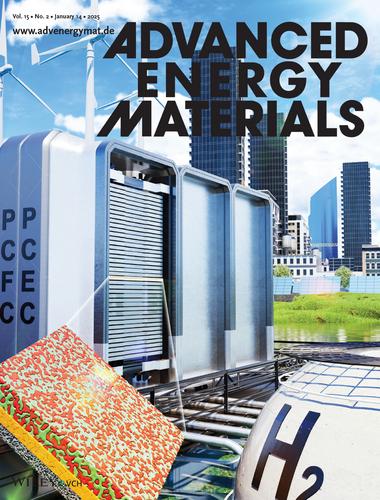
{"title":"Interface Engineering to Operate Reversible Protonic Ceramic Electrochemical Cells Below 500 °C (Adv. Energy Mater. 2/2025)","authors":"Mingi Choi, Donguk Kim, Tae Kyeong Lee, Jaeyeob Lee, Hyun Sik Yoo, Wonyoung Lee","doi":"10.1002/aenm.202570007","DOIUrl":null,"url":null,"abstract":"<p><b>Electrochemical Cells</b></p><p>Quasi-2D electrode/electrolyte composite interlayer exhibits unique mono-grain, phase-separated, alternately arranged features, significantly extending the coherent heterointerface and increasing the concentration of oxygen vacancies. This unique configuration results in a substantial reduction in both ohmic and polarization resistances through vertically aligned oxygen vacancies, exhibiting exceptional electrochemical performances in fuel cell and electrolysis cell mode. More in article number 2400124, Wonyoung Lee and co-workers.\n\n <figure>\n <div><picture>\n <source></source></picture><p></p>\n </div>\n </figure></p>","PeriodicalId":111,"journal":{"name":"Advanced Energy Materials","volume":"15 2","pages":""},"PeriodicalIF":26.0000,"publicationDate":"2025-01-15","publicationTypes":"Journal Article","fieldsOfStudy":null,"isOpenAccess":false,"openAccessPdf":"https://onlinelibrary.wiley.com/doi/epdf/10.1002/aenm.202570007","citationCount":"0","resultStr":null,"platform":"Semanticscholar","paperid":null,"PeriodicalName":"Advanced Energy Materials","FirstCategoryId":"88","ListUrlMain":"https://advanced.onlinelibrary.wiley.com/doi/10.1002/aenm.202570007","RegionNum":1,"RegionCategory":"材料科学","ArticlePicture":[],"TitleCN":null,"AbstractTextCN":null,"PMCID":null,"EPubDate":"","PubModel":"","JCR":"Q1","JCRName":"CHEMISTRY, PHYSICAL","Score":null,"Total":0}
引用次数: 0
Abstract
Electrochemical Cells
Quasi-2D electrode/electrolyte composite interlayer exhibits unique mono-grain, phase-separated, alternately arranged features, significantly extending the coherent heterointerface and increasing the concentration of oxygen vacancies. This unique configuration results in a substantial reduction in both ohmic and polarization resistances through vertically aligned oxygen vacancies, exhibiting exceptional electrochemical performances in fuel cell and electrolysis cell mode. More in article number 2400124, Wonyoung Lee and co-workers.
期刊介绍:
Established in 2011, Advanced Energy Materials is an international, interdisciplinary, English-language journal that focuses on materials used in energy harvesting, conversion, and storage. It is regarded as a top-quality journal alongside Advanced Materials, Advanced Functional Materials, and Small.
With a 2022 Impact Factor of 27.8, Advanced Energy Materials is considered a prime source for the best energy-related research. The journal covers a wide range of topics in energy-related research, including organic and inorganic photovoltaics, batteries and supercapacitors, fuel cells, hydrogen generation and storage, thermoelectrics, water splitting and photocatalysis, solar fuels and thermosolar power, magnetocalorics, and piezoelectronics.
The readership of Advanced Energy Materials includes materials scientists, chemists, physicists, and engineers in both academia and industry. The journal is indexed in various databases and collections, such as Advanced Technologies & Aerospace Database, FIZ Karlsruhe, INSPEC (IET), Science Citation Index Expanded, Technology Collection, and Web of Science, among others.






 京公网安备 11010802042870号
京ICP备2023020795号-1
京公网安备 11010802042870号
京ICP备2023020795号-1

 分享
分享
 求助内容:
求助内容: 应助结果提醒方式:
 扫码关注我们
