Angela Dettling, Caroline Kellner, Jonas Sundermeyer, Benedikt N. Beer, Lisa Besch, Letizia Fausta Bertoldi, Stefan Blankenberg, Jeroen Dauw, Dennis Eckner, Ingo Eitel, Tobias Graf, Patrick Horn, Joanna Jozwiak-Nozdrzykowska, Paulus Kirchhof, Stefan Kluge, Jannis Krais, Dirk von Lewinski, Axel Linke, Peter Luedike, Enzo Lüsebrink, Peter Nordbeck, Federico Pappalardo, Matthias Pauschinger, Alastair Proudfoot, Tienush Rassaf, Hermann Reichenspurner, Can Martin Sag, Clemens Scherer, P. Christian Schulze, Robert H.G. Schwinger, Carsten Skurk, Marek Sramko, Guido Tavazzi, Holger Thiele, Nuccia Morici, Ephraim B. Winzer, Dirk Westermann, Benedikt Schrage, Norman Mangner
{"title":"Incidence and predictors of weaning failure from veno-arterial extracorporeal membrane oxygenation therapy in patients with cardiogenic shock","authors":"Angela Dettling, Caroline Kellner, Jonas Sundermeyer, Benedikt N. Beer, Lisa Besch, Letizia Fausta Bertoldi, Stefan Blankenberg, Jeroen Dauw, Dennis Eckner, Ingo Eitel, Tobias Graf, Patrick Horn, Joanna Jozwiak-Nozdrzykowska, Paulus Kirchhof, Stefan Kluge, Jannis Krais, Dirk von Lewinski, Axel Linke, Peter Luedike, Enzo Lüsebrink, Peter Nordbeck, Federico Pappalardo, Matthias Pauschinger, Alastair Proudfoot, Tienush Rassaf, Hermann Reichenspurner, Can Martin Sag, Clemens Scherer, P. Christian Schulze, Robert H.G. Schwinger, Carsten Skurk, Marek Sramko, Guido Tavazzi, Holger Thiele, Nuccia Morici, Ephraim B. Winzer, Dirk Westermann, Benedikt Schrage, Norman Mangner","doi":"10.1002/ejhf.3583","DOIUrl":null,"url":null,"abstract":"<div>\n \n \n <section>\n \n <h3> Aims</h3>\n \n <p>This study aimed to investigate incidence and predictors of weaning failure and in-hospital death after successful weaning from veno-arterial extracorporeal membrane oxygenation (VA-ECMO) in patients with cardiogenic shock (CS).</p>\n </section>\n \n <section>\n \n <h3> Methods and results</h3>\n \n <p>Overall, 685 patients with CS treated with VA-ECMO from 23 tertiary care centres in 7 countries were analysed (median age 57 [interquartile range 49–66] years, 542 [79.1%] male, median lactate 7.6 [interquartile range 4.1–12.7] mmol/L). The cause of CS was acute myocardial infarction in 438 (63.9%) patients, and 431 (62.9%) patients presented with cardiac arrest. A total of 410 patients (59.9%) were successfully weaned from VA-ECMO, whereas in 275 patients (40.1%) weaning failed (i.e. patients died on or within 48 h after VA-ECMO support). Of the successfully weaned patients, 150 (36.6%) died before hospital discharge. On multivariable logistic regression, predictors for both patient groups varied: age (per 10 years, odds ratio [OR] 1.49, 95% confidence interval [CI] 1.25–1.76; <i>p</i> < 0.001) and cardiac arrest before VA-ECMO implantation (OR 1.64, 95% CI 1.01–2.64; <i>p</i> = 0.04) were associated with weaning failure, whereas lactate clearance within 24 h after VA-ECMO initiation was associated with successful weaning (OR 0.21, 95% CI 0.1–0.44; <i>p</i> < 0.001). In-hospital death after successful weaning was more likely with higher age (per 10 years, OR 1.56, 95% CI 1.24–1.97; <i>p</i> < 0.001), renal replacement therapy (OR 2.56, 95% CI 1.4–4.68; <i>p</i> = 0.002) and bleeding events (OR 2.93, 95% CI 1.4–6.14; <i>p</i> = 0.004).</p>\n </section>\n \n <section>\n \n <h3> Conclusion</h3>\n \n <p>Weaning from VA-ECMO fails in 40% of patients treated with VA-ECMO for CS. When successful, survival after VA-ECMO weaning mostly depends on age and the incidence of device- and shock-related complications.</p>\n </section>\n </div>","PeriodicalId":164,"journal":{"name":"European Journal of Heart Failure","volume":"27 5","pages":"832-841"},"PeriodicalIF":10.8000,"publicationDate":"2025-01-17","publicationTypes":"Journal Article","fieldsOfStudy":null,"isOpenAccess":false,"openAccessPdf":"https://onlinelibrary.wiley.com/doi/epdf/10.1002/ejhf.3583","citationCount":"0","resultStr":null,"platform":"Semanticscholar","paperid":null,"PeriodicalName":"European Journal of Heart Failure","FirstCategoryId":"3","ListUrlMain":"https://onlinelibrary.wiley.com/doi/10.1002/ejhf.3583","RegionNum":1,"RegionCategory":"医学","ArticlePicture":[],"TitleCN":null,"AbstractTextCN":null,"PMCID":null,"EPubDate":"","PubModel":"","JCR":"Q1","JCRName":"CARDIAC & CARDIOVASCULAR SYSTEMS","Score":null,"Total":0}
引用次数: 0
Abstract
Aims
This study aimed to investigate incidence and predictors of weaning failure and in-hospital death after successful weaning from veno-arterial extracorporeal membrane oxygenation (VA-ECMO) in patients with cardiogenic shock (CS).
Methods and results
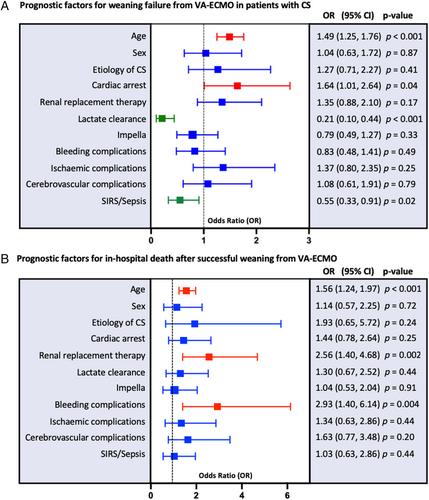
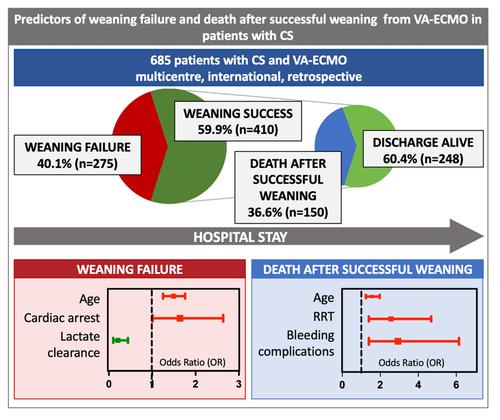
Overall, 685 patients with CS treated with VA-ECMO from 23 tertiary care centres in 7 countries were analysed (median age 57 [interquartile range 49–66] years, 542 [79.1%] male, median lactate 7.6 [interquartile range 4.1–12.7] mmol/L). The cause of CS was acute myocardial infarction in 438 (63.9%) patients, and 431 (62.9%) patients presented with cardiac arrest. A total of 410 patients (59.9%) were successfully weaned from VA-ECMO, whereas in 275 patients (40.1%) weaning failed (i.e. patients died on or within 48 h after VA-ECMO support). Of the successfully weaned patients, 150 (36.6%) died before hospital discharge. On multivariable logistic regression, predictors for both patient groups varied: age (per 10 years, odds ratio [OR] 1.49, 95% confidence interval [CI] 1.25–1.76; p < 0.001) and cardiac arrest before VA-ECMO implantation (OR 1.64, 95% CI 1.01–2.64; p = 0.04) were associated with weaning failure, whereas lactate clearance within 24 h after VA-ECMO initiation was associated with successful weaning (OR 0.21, 95% CI 0.1–0.44; p < 0.001). In-hospital death after successful weaning was more likely with higher age (per 10 years, OR 1.56, 95% CI 1.24–1.97; p < 0.001), renal replacement therapy (OR 2.56, 95% CI 1.4–4.68; p = 0.002) and bleeding events (OR 2.93, 95% CI 1.4–6.14; p = 0.004).
Conclusion
Weaning from VA-ECMO fails in 40% of patients treated with VA-ECMO for CS. When successful, survival after VA-ECMO weaning mostly depends on age and the incidence of device- and shock-related complications.
期刊介绍:
European Journal of Heart Failure is an international journal dedicated to advancing knowledge in the field of heart failure management. The journal publishes reviews and editorials aimed at improving understanding, prevention, investigation, and treatment of heart failure. It covers various disciplines such as molecular and cellular biology, pathology, physiology, electrophysiology, pharmacology, clinical sciences, social sciences, and population sciences. The journal welcomes submissions of manuscripts on basic, clinical, and population sciences, as well as original contributions on nursing, care of the elderly, primary care, health economics, and other related specialist fields. It is published monthly and has a readership that includes cardiologists, emergency room physicians, intensivists, internists, general physicians, cardiac nurses, diabetologists, epidemiologists, basic scientists focusing on cardiovascular research, and those working in rehabilitation. The journal is abstracted and indexed in various databases such as Academic Search, Embase, MEDLINE/PubMed, and Science Citation Index.



 京公网安备 11010802042870号
京ICP备2023020795号-1
京公网安备 11010802042870号
京ICP备2023020795号-1

 分享
分享
 求助内容:
求助内容: 应助结果提醒方式:
 扫码关注我们
