Glen Cletus DSouza , Chonlong Chio , Aditya Venkatesh , Haoyu Wang , Madhumita B. Ray , Anand Prakash , Wensheng Qin , Chunbao Xu
{"title":"Microbially degradable phenolic foams based on depolymerized Kraft lignin for hydrophilic applications","authors":"Glen Cletus DSouza , Chonlong Chio , Aditya Venkatesh , Haoyu Wang , Madhumita B. Ray , Anand Prakash , Wensheng Qin , Chunbao Xu","doi":"10.1016/j.biortech.2025.132082","DOIUrl":null,"url":null,"abstract":"<div><div>Hydrophilic phenol–formaldehyde (PF) foams, widely used in floral and hydroponic applications, are produced using phenol typically derived from non-renewable petroleum-based resources. This study examines the potential of depolymerized Kraft lignin (DKL) as a sustainable substitute for phenol in the synthesis of hydrophilic biobased foams. At 50 % DKL substitution, the foams demonstrated excellent water absorption capacities (up to 2557 %), relatively low densities (∼62 kg/m<sup>3</sup>), and nearly 100 % open-cell content. Its compressive strength (20.64 kPa at 10 % deformation) is comparable to commercially available floral and hydroponic foams. Additionally, foams with 10 % phenol substitution by DKL exhibited better thermal stability compared to neat phenolic foams. After 15 days of incubation with Laccase-producing bacterium <em>Bacillus</em> sp., 30 % and 50 % DKL foams exhibited the highest weight loss of 39.03 % and 38.9 %, respectively. Qualitative degree of biodegradation was further assessed using scanning electron microscopy and FT-IR analysis of the degraded samples.</div></div>","PeriodicalId":258,"journal":{"name":"Bioresource Technology","volume":"419 ","pages":"Article 132082"},"PeriodicalIF":9.0000,"publicationDate":"2025-01-15","publicationTypes":"Journal Article","fieldsOfStudy":null,"isOpenAccess":false,"openAccessPdf":"","citationCount":"0","resultStr":null,"platform":"Semanticscholar","paperid":null,"PeriodicalName":"Bioresource Technology","FirstCategoryId":"5","ListUrlMain":"https://www.sciencedirect.com/science/article/pii/S0960852425000483","RegionNum":1,"RegionCategory":"环境科学与生态学","ArticlePicture":[],"TitleCN":null,"AbstractTextCN":null,"PMCID":null,"EPubDate":"","PubModel":"","JCR":"Q1","JCRName":"AGRICULTURAL ENGINEERING","Score":null,"Total":0}
引用次数: 0
Abstract
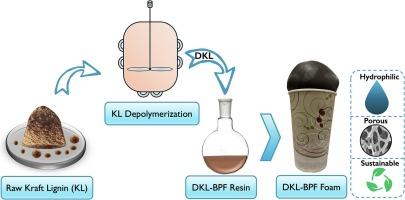
Hydrophilic phenol–formaldehyde (PF) foams, widely used in floral and hydroponic applications, are produced using phenol typically derived from non-renewable petroleum-based resources. This study examines the potential of depolymerized Kraft lignin (DKL) as a sustainable substitute for phenol in the synthesis of hydrophilic biobased foams. At 50 % DKL substitution, the foams demonstrated excellent water absorption capacities (up to 2557 %), relatively low densities (∼62 kg/m3), and nearly 100 % open-cell content. Its compressive strength (20.64 kPa at 10 % deformation) is comparable to commercially available floral and hydroponic foams. Additionally, foams with 10 % phenol substitution by DKL exhibited better thermal stability compared to neat phenolic foams. After 15 days of incubation with Laccase-producing bacterium Bacillus sp., 30 % and 50 % DKL foams exhibited the highest weight loss of 39.03 % and 38.9 %, respectively. Qualitative degree of biodegradation was further assessed using scanning electron microscopy and FT-IR analysis of the degraded samples.
期刊介绍:
Bioresource Technology publishes original articles, review articles, case studies, and short communications covering the fundamentals, applications, and management of bioresource technology. The journal seeks to advance and disseminate knowledge across various areas related to biomass, biological waste treatment, bioenergy, biotransformations, bioresource systems analysis, and associated conversion or production technologies.
Topics include:
• Biofuels: liquid and gaseous biofuels production, modeling and economics
• Bioprocesses and bioproducts: biocatalysis and fermentations
• Biomass and feedstocks utilization: bioconversion of agro-industrial residues
• Environmental protection: biological waste treatment
• Thermochemical conversion of biomass: combustion, pyrolysis, gasification, catalysis.



 京公网安备 11010802042870号
京ICP备2023020795号-1
京公网安备 11010802042870号
京ICP备2023020795号-1

 分享
分享
 求助内容:
求助内容: 应助结果提醒方式:
 扫码关注我们
