Yuan Liu, Xingyuan Zhou, Yupei Wu, Hongwei Zhang and Kun Cao
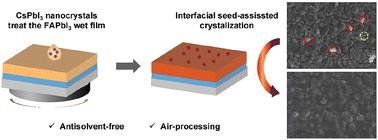
{"title":"Interfacial seed-assisted FAPbI3 crystallization and phase stabilization enhance the performance of all-air-processed perovskite solar cells†","authors":"Yuan Liu, Xingyuan Zhou, Yupei Wu, Hongwei Zhang and Kun Cao","doi":"10.1039/D4DT03120B","DOIUrl":null,"url":null,"abstract":"<p >Formamidinium lead triiodide (FAPbI<small><sub>3</sub></small>) has received significant attention in the field of perovskite solar cells (PSCs) owing to its excellent optoelectronic properties and high thermal stability. However, the photoactive α-FAPbI<small><sub>3</sub></small> perovskites are highly susceptible to degradation into non-perovskite δ-FAPbI<small><sub>3</sub></small> phases, especially under humid conditions, which severely diminishes the device performance of FAPbI<small><sub>3</sub></small> PSCs. Here, we propose an interfacial seeding strategy for regulating crystallization and stabilizing α-FAPbI<small><sub>3</sub></small> perovskites in humid air. By post-treating an antisolvent-free, air-processed perovskite wet film with inorganic cesium lead triiodide (CsPbI<small><sub>3</sub></small>) nanocrystals, a functional seed layer is formed that effectively mitigates the erosion by humid air while facilitating the conversion of intermediates to the α-FAPbI<small><sub>3</sub></small> phase. The interfacial seed-modified FAPbI<small><sub>3</sub></small> perovskite films exhibit improved crystal quality and denser morphology. As a result, the efficiency of all-air-processed carbon-based PSCs is improved from 15.90% for the control to 18.04%. In addition, the unencapsulated PSCs based on interfacial seed-modified FAPbI<small><sub>3</sub></small> films show improved environmental stability compared to their control counterparts, maintaining 80% of their initial efficiency after 60 days.</p>","PeriodicalId":71,"journal":{"name":"Dalton Transactions","volume":" 9","pages":" 3695-3703"},"PeriodicalIF":3.3000,"publicationDate":"2025-01-17","publicationTypes":"Journal Article","fieldsOfStudy":null,"isOpenAccess":false,"openAccessPdf":"","citationCount":"0","resultStr":null,"platform":"Semanticscholar","paperid":null,"PeriodicalName":"Dalton Transactions","FirstCategoryId":"92","ListUrlMain":"https://pubs.rsc.org/en/content/articlelanding/2025/dt/d4dt03120b","RegionNum":3,"RegionCategory":"化学","ArticlePicture":[],"TitleCN":null,"AbstractTextCN":null,"PMCID":null,"EPubDate":"","PubModel":"","JCR":"Q2","JCRName":"CHEMISTRY, INORGANIC & NUCLEAR","Score":null,"Total":0}
引用次数: 0
Abstract
Formamidinium lead triiodide (FAPbI3) has received significant attention in the field of perovskite solar cells (PSCs) owing to its excellent optoelectronic properties and high thermal stability. However, the photoactive α-FAPbI3 perovskites are highly susceptible to degradation into non-perovskite δ-FAPbI3 phases, especially under humid conditions, which severely diminishes the device performance of FAPbI3 PSCs. Here, we propose an interfacial seeding strategy for regulating crystallization and stabilizing α-FAPbI3 perovskites in humid air. By post-treating an antisolvent-free, air-processed perovskite wet film with inorganic cesium lead triiodide (CsPbI3) nanocrystals, a functional seed layer is formed that effectively mitigates the erosion by humid air while facilitating the conversion of intermediates to the α-FAPbI3 phase. The interfacial seed-modified FAPbI3 perovskite films exhibit improved crystal quality and denser morphology. As a result, the efficiency of all-air-processed carbon-based PSCs is improved from 15.90% for the control to 18.04%. In addition, the unencapsulated PSCs based on interfacial seed-modified FAPbI3 films show improved environmental stability compared to their control counterparts, maintaining 80% of their initial efficiency after 60 days.
期刊介绍:
Dalton Transactions is a journal for all areas of inorganic chemistry, which encompasses the organometallic, bioinorganic and materials chemistry of the elements, with applications including synthesis, catalysis, energy conversion/storage, electrical devices and medicine. Dalton Transactions welcomes high-quality, original submissions in all of these areas and more, where the advancement of knowledge in inorganic chemistry is significant.



 京公网安备 11010802042870号
京ICP备2023020795号-1
京公网安备 11010802042870号
京ICP备2023020795号-1

 分享
分享
 求助内容:
求助内容: 应助结果提醒方式:
 扫码关注我们
