Komal Soni, Attila Horvath, Olexandr Dybkov, Merlin Schwan, Sasanan Trakansuebkul, Dirk Flemming, Klemens Wild, Henning Urlaub, Tamás Fischer, Irmgard Sinning
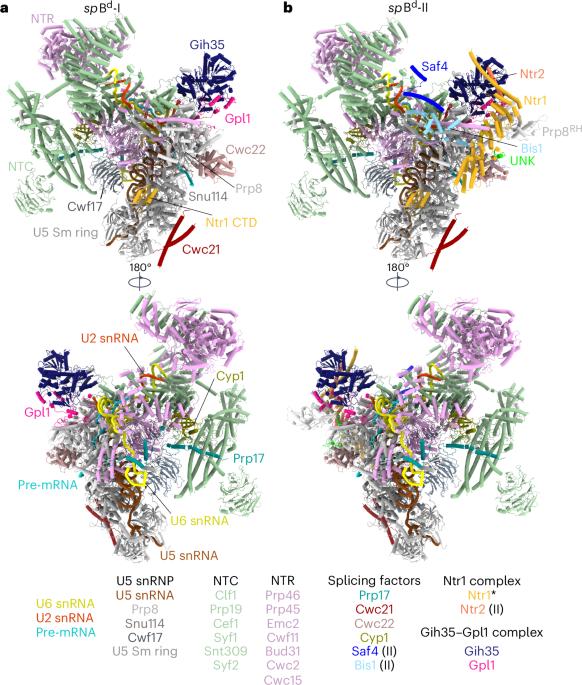
{"title":"Structures of aberrant spliceosome intermediates on their way to disassembly","authors":"Komal Soni, Attila Horvath, Olexandr Dybkov, Merlin Schwan, Sasanan Trakansuebkul, Dirk Flemming, Klemens Wild, Henning Urlaub, Tamás Fischer, Irmgard Sinning","doi":"10.1038/s41594-024-01480-7","DOIUrl":null,"url":null,"abstract":"Intron removal during pre-mRNA splicing is of extraordinary complexity and its disruption causes a vast number of genetic diseases in humans. While key steps of the canonical spliceosome cycle have been revealed by combined structure–function analyses, structural information on an aberrant spliceosome committed to premature disassembly is not available. Here, we report two cryo-electron microscopy structures of post-Bact spliceosome intermediates from Schizosaccharomyces pombe primed for disassembly. We identify the DEAH-box helicase–G-patch protein pair (Gih35–Gpl1, homologous to human DHX35–GPATCH1) and show how it maintains catalytic dormancy. In both structures, Gpl1 recognizes a remodeled active site introduced by an overstabilization of the U5 loop I interaction with the 5′ exon leading to a single-nucleotide insertion at the 5′ splice site. Remodeling is communicated to the spliceosome surface and the Ntr1 complex that mediates disassembly is recruited. Our data pave the way for a targeted analysis of splicing quality control. Here, the authors provide insights into a splicing quality control mechanism. The Gpl1–Gih35 complex binds to the active site of aberrant spliceosomes, blocks splicing progression and triggers the spliceosome discard pathway.","PeriodicalId":49141,"journal":{"name":"Nature Structural & Molecular Biology","volume":"32 5","pages":"914-925"},"PeriodicalIF":10.1000,"publicationDate":"2025-01-20","publicationTypes":"Journal Article","fieldsOfStudy":null,"isOpenAccess":false,"openAccessPdf":"https://www.nature.comhttps://www.nature.com/articles/s41594-024-01480-7.pdf","citationCount":"0","resultStr":null,"platform":"Semanticscholar","paperid":null,"PeriodicalName":"Nature Structural & Molecular Biology","FirstCategoryId":"99","ListUrlMain":"https://www.nature.com/articles/s41594-024-01480-7","RegionNum":1,"RegionCategory":"生物学","ArticlePicture":[],"TitleCN":null,"AbstractTextCN":null,"PMCID":null,"EPubDate":"","PubModel":"","JCR":"Q1","JCRName":"BIOCHEMISTRY & MOLECULAR BIOLOGY","Score":null,"Total":0}
引用次数: 0
Abstract
Intron removal during pre-mRNA splicing is of extraordinary complexity and its disruption causes a vast number of genetic diseases in humans. While key steps of the canonical spliceosome cycle have been revealed by combined structure–function analyses, structural information on an aberrant spliceosome committed to premature disassembly is not available. Here, we report two cryo-electron microscopy structures of post-Bact spliceosome intermediates from Schizosaccharomyces pombe primed for disassembly. We identify the DEAH-box helicase–G-patch protein pair (Gih35–Gpl1, homologous to human DHX35–GPATCH1) and show how it maintains catalytic dormancy. In both structures, Gpl1 recognizes a remodeled active site introduced by an overstabilization of the U5 loop I interaction with the 5′ exon leading to a single-nucleotide insertion at the 5′ splice site. Remodeling is communicated to the spliceosome surface and the Ntr1 complex that mediates disassembly is recruited. Our data pave the way for a targeted analysis of splicing quality control. Here, the authors provide insights into a splicing quality control mechanism. The Gpl1–Gih35 complex binds to the active site of aberrant spliceosomes, blocks splicing progression and triggers the spliceosome discard pathway.
在前mrna剪接过程中内含子的去除是非常复杂的,它的破坏导致了人类大量的遗传疾病。虽然典型剪接体周期的关键步骤已经通过组合结构-功能分析揭示,但对过早拆卸的异常剪接体的结构信息尚不清楚。在这里,我们报告了两个冷冻电镜结构的后bact剪接体中间物从裂糖菌pombe引物拆卸。我们鉴定了DEAH-box解旋酶- g -patch蛋白对(Gih35-Gpl1,与人类DHX35-GPATCH1同源),并展示了它如何维持催化休眠。在这两种结构中,Gpl1识别了一个重构的活性位点,该活性位点是由U5环I与5 ‘外显子相互作用的过度稳定引入的,导致在5 ’剪接位点插入单核苷酸。重塑传递到剪接体表面,介导拆卸的Ntr1复合体被招募。我们的数据为有针对性地分析拼接质量控制铺平了道路。
期刊介绍:
Nature Structural & Molecular Biology is a comprehensive platform that combines structural and molecular research. Our journal focuses on exploring the functional and mechanistic aspects of biological processes, emphasizing how molecular components collaborate to achieve a particular function. While structural data can shed light on these insights, our publication does not require them as a prerequisite.




 京公网安备 11010802042870号
京ICP备2023020795号-1
京公网安备 11010802042870号
京ICP备2023020795号-1

 分享
分享
 求助内容:
求助内容: 应助结果提醒方式:
 扫码关注我们
